In the heart of Wajir County, where the sun beats down relentlessly, a revolutionary solution is taking root.
A solar-powered greenhouse designed to nurture crops year-round is transforming the lives of a community plagued by malnutrition. With the help of Solargen Technologies, a leading provider of energy, water and irrigation solutions, local farmers are using solar power to irrigate and ventilate the greenhouses, creating an ideal environment for fresh produce to flourish. As the crops thrive, so do the children, their eyes brightening with newfound energy and hope. According to Ms Nuria Ibrahim Abdi, the Wajir County Nutritionist, producing food in greenhouses positively impacts household food security and improves the nutritional status of vulnerable groups.
Findings from the Standardised Monitoring and Assessment of Relief and Transitions (SMART) survey report from last year indicated significant improvements in nutritional outcomes compared to previous years across Wajir. The prevalence of global acute malnutrition (GAM) in children under five decreased from 19 per cent in 2023 to 11.2 per cent in 2024. Severe acute malnutrition (SAM) also declined, from 2.2 per cent in 2023 to 1.8 per cent in 2024, reflecting positive trends in addressing malnutrition.
Mid-upper arm circumference (MUAC) data further supported these findings, with global malnutrition rates reported at 1.4 percent. The survey covered 628 households and successfully collected anthropometric data from 554 children.
Ms Abdi attributed this improvement to food security, with 89 per cent of households reporting an acceptable level of food consumption compared to 76 per cent in 2023. "The proportion of households with poor food consumption decreased from 7.1 percent to 1.8 percent with the production of food under solar-powered greenhouses," she said. Ms Abdi says that greenhouses have improved dietary diversity in Wajir by enabling the cultivation of a wider variety of crops. This is crucial for obtaining essential vitamins and minerals, as well as for combating micronutrient deficiencies. Mr Ahmed Hassan, the regional manager at Solargen Technologies, says that most locals who use solar-powered irrigation systems are feeding the local population. He adds that solar-powered greenhouses support sustainable agriculture by reducing the carbon footprint of agricultural methods and conserving resources such as water.
Mr Ahmed Hassan outside SolarGen offices in Wajir town on December 9, 2025.
“We encourage farmers to use drip irrigation systems, which use far less water than furrow irrigation,” he said. He adds: “Solar-powered greenhouses help to lower carbon emissions and prevent climate change by relying on sustainable energy sources.” However, challenges to irrigation in Wajir include severe water scarcity exacerbated by climate change, poor infrastructure that is often broken, unsuitable soil types (shallow, gravelly and alkaline) and flat topography that makes gravity-fed systems difficult to implement. Socio-economic factors such as the high cost of modern systems, limited access to credit and low technical knowledge among farmers also hinder development and effective implementation. Greenhouse farmers now focus on growing high-value crops such as spinach, tomatoes, capsicum, kale and other vegetables consumed in households across Wajir. Ms Asha Guleid, a farmer, says that the greenhouses have greatly contributed to improved livelihoods, adding that community members now have food and a consistent income. She says: “We don't go to sleep hungry or depend on wild fruits as we used to.” The farmers are optimistic that additional training in greenhouse farming will enable them to increase their crop yield further.
“If we can access better markets and increase sales, we will be able to educate our children and transform Wajir County. We are encouraging more farmers to form groups so they can benefit from similar initiatives and break free from the culture of dependency.” She said. Ms Halima Kahiye, a mother of nine, says her children’s health has improved since she started solar-powered greenhouse farming. “All my children are healthy because we get fresh vegetables from our greenhouse, which supports year-round farming,” she said. She says that solar-powered farming is extremely energy efficient and that solar-powered greenhouses are less expensive to operate than conventional greenhouses because they are fuelled by renewable energy. She says the system has increased her crop production as it maintains constant temperatures and lighting. “I am growing crops all year round, which gives me high-quality produce with fewer pests and diseases,” she said. Greenhouse farming in Wajir combats malnutrition by providing families with year-round access to diverse, nutrient-rich vegetables, such as kale and spinach, which diversifies their diets beyond traditional livestock-based meals and improves their income for purchasing other foods.
Richard Omondi, a technician at Fine Touch Africa, a company specialising in greenhouse construction, says a solar-powered greenhouse should be built in an area free from obstruction by trees or shade. “A solar-powered greenhouse should be built in an open area that allows maximum sunlight exposure, with access to water,” he said. He adds that the soil should be well drained to avoid dampness caused by excess water affecting the crops.
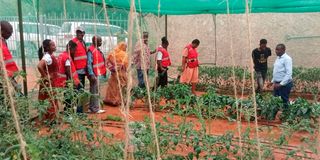
A solar-powered farm in Wajir on December 9, 2025.
Photo credit: Manase Otsialo | Nation Media Group
Mr Omondi says that solar-powered greenhouses must be designed with efficient solar energy capture in mind, which may result in design restrictions to optimise crop development. According to him, they simply need to be properly oriented in relation to wind direction, have a high roof to allow for air circulation, and have more side netting to improve ventilation. Building a greenhouse in an arid area requires careful planning to mitigate the effects of extreme heat, water scarcity and potential wind damage. “The goal is to create a controlled microclimate that protects crops while conserving resources. Key requirements include specialised, efficient irrigation systems; enhanced cooling or ventilation mechanisms; durable materials; and strategic site selection,” he said. Mr Mohamed Weli, a farmer in Wajir with a solar-powered greenhouse, says that the only challenge he faced was the initial cost of setting up the system. “I had to spend between 200,000 and 400,000 shillings setting up this system. Initial costs are normally high, but once set up, things run smoothly,” he said. He says that greenhouse farming is more profitable than pastoralism. “The nomadic lifestyle was never profitable. Settling down and practising crop production has proved to be a lucrative enterprise,” he said. He says he now makes a profit of up to Sh250,000 per month, unlike when he was a pastoralist. Solar-powered greenhouses need routine maintenance and monitoring to ensure that the solar panels and other technologies are working properly, but Mr Weli says the service provider has always been on hand to help. He says his greenhouse provides a consistent supply of fresh, nutritious fruit and vegetables, improving the overall health and well-being of the local population in Wajir. “When floods hit this region in 2023, I was the only supplier of food from this solar-powered greenhouse to our local market. This system has reduced the use of pesticides, creating a healthier environment for consumers,” he revealed. Despite the region's potential, farmers in Wajir face challenges including the high cost of farm inputs and exploitation by middlemen who offer low prices for their produce. They lack the knowledge and support to use modern farming techniques, resulting in crop failures and poor yields. However, Solargen is offering farmers in Wajir integrated solutions comprising irrigation technologies, production planning, training, financing, and market linkages. Through the Pay-As-You-Go (PAYGO) financing model, at least 40 farmers have benefited from installing solar-powered greenhouses across Wajir.