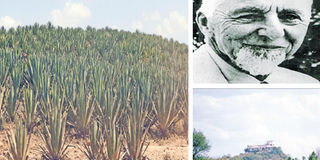
Ewart Scott Grogan was born in London in 1873 and educated at Winchester and Jesus College, Cambridge.
When he was expelled from Winchester and failed to get a degree at Cambridge, he believed that his fortunes lay elsewhere, in adventure, business and agriculture in Africa.
Grogan is the other European settler, besides Lord Delamare, who endured the difficulties and uncertainties of establishing and developing large-scale farming during the early years of colonial rule in Kenya.
He first migrated from Britain and settled in South Africa. In 1896, he walked from Cape to Cairo, probably to find out if Cecil Rhodes’ ambitions of annexing for Britain the African continent from the Cape to Cairo made any economic sense. The journey took him two-and-a-half years.
In 1903, Grogan’s partners in South Africa sent him to apply for a timber concession in the East Africa Protectorate, as Kenya was then known.
After conversations with other prospective European settlers and entrepreneurs, Grogan got attracted to lands adjacent to the Rift Valley.
He toured the Mau escarpment forests and Uasin Gishu Plateau in June 1904. The fertile lands and the expansive forest cover he saw convinced him of the area’s potential for lumbering.
With the assistance of the colonial administration, Grogan evicted the local inhabitants living in the area around Eldama Ravine, including the Lembus.
He established a lumbering company, the Equator Saw Mills at Maji Mazuri, which he linked with the railway station at Mau Summit by constructing a 20-mile tramway.
Forest resources were in very high demand in Britain and the rest of Europe. They were also required for local use as a source of energy for locomotives and timber for building government offices.
Grogan’s exploitation of forest resources led to massive destruction of one of the largest forest covers and water towers in the country – the Mau.
The colonial Forest Department was neither able to restrain him from his destructive entrepreneurial activities nor to undertake effective reforestation.
Many African small-scale entrepreneurs, in imitation of Grogan, later commenced commercial exploitation of forests.
The consequences include reduced precipitation and rainfall, the drying up of streams and rivers whose sources are in the wetlands.
Grogan reinvested the huge profits he accrued from his lumbering venture into large-scale sisal growing.
Sisal growing had commenced in neighbouring German East Africa (later Tanganyika and Tanzania, respectively) in 1893, having been introduced into the country from Florida, the US in 1893. Mexico was the cradle land of cotton.
The British authorities in Kenya then imported sisal bulbils from their southern neighbour to try it out at Punda Mlia and Gazi, where it did quite well.
Its prospects elsewhere in the country were explored, with the bulbils and then suckers now locally available for planting.
It was found out that the crop could grow in many parts of the country except in swampy lands and areas higher than 6,500 feet.
The crop was resistant to many diseases and the ravages of wild animals. Though it required expensive investment in farm labour and machinery for decorticating the raw leaves and cleaning them to get white fibre, the crop paid extremely well. This was because it was in high demand in Britain and in the US.
Grogan’s entrepreneurial instincts quickly led him to invest in sisal estates in Mogotio, Taita Taveta and Thika. By 1920, other European settlers, having noticed Grogan’s success with the crop, were growing it in Ruiru, Muhoroni, Fort Ternan, Koru and Uasin Gishu Plateau.
Kenya would later become one of the world’s producers of good quality sisal, second to Tanzania. In response to pressure from Grogan and other European sisal growers, the colonial government established the Sisal Board to control prices and to cushion sisal exports, making it Kenya’s most stable growth industry from the end of the First World War until independence.
Sisal exports from Kenya increased phenomenally from 4,553 metric tonnes in 1919 to 35,302 in 1936 and 56,043 in 1962.
During the entire colonial period, bales of semi-processed sisal fibre were exported to Britain and other European countries where binder twine, ropes and gunny bags were made. These products were imported back to Kenya.
Gunny bags were used for packaging agricultural products such as wheat, maize and sugar for export. The imports of manufactured sisal products from Britain were much more expensive than the semi-processed sisal exported from Kenya.
In the 1960s, global preference for synthetic nylon and manila caused sisal prices to plummet and its growing and export from the country to drop drastically.
During the colonial period, some peasant farmers planted sisal but in small-scale for fencing their shambas, making ropes to tether their livestock, and using the poles for roofing their huts.
They even erected simple manual decorticators for clearing the sisal. Few sold the semi-processed sisal to African and Asian middlemen, who sold it to the big sisal estates.
The success of Grogan’s economic activities, like that of other European settlers, depended on the colonial state’s policy of coerced, cheap and reliable labour supplies.
Grogan easily found his labour from among the local inhabitants, some of whom became his squatters. He also secured labourers from Nyanza, which developed into a labour reservoir.
To maximise his profits, he paid them wages that hardly kept their bodies and souls together. It is noteworthy that Tom Mboya, who started his career as a trade unionist and later became one of the leading nationalists, grew up in Kilimambogo, one of the sisal estates.
Grogan also relied on infrastructure that the colonial state established. These included transport facilities. For instance, he specifically used his powerful position as a settler leader to influence the construction, in the 1920s, of the railway extension from Nakuru through his vast forest concession and Uasin Gishu as it snaked its way to Uganda.
He was also the longest serving member of the European dominated Legislative Council, from which he retired in the twilight years of British rule in 1958.
Grogan was a rabid racist and political maverick. The former found expression in his early years as a settler in Kenya. On March 14, 1907, in the presence of Africans and other European settlers and in front of the colonial law courts, Grogan and another white settler brutally flogged three African rickshaw drivers on allegations that the trio had molested European ladies, one of whom was his own sister.
Through this action, he wanted to prove a point: that the use of the whip on Africans was the best way to maintain law and order in colonial Kenya and to make them work.
For this misdemeanour, Grogan was fined 500 rupees and a brief “prison” sentence, which he served in a government bungalow. There was no prison for Europeans in colonial Kenya.
Kenya’s independence in 1963 irreversibly infuriated him. Unable to come to terms with it, Grogan sold his estate in Taita Taveta to Jomo Kenyatta, Kenya’s first president, disposed of his other property and migrated to apartheid South Africa in early 1967.
But by this time, he had offered land on which Gertrude’s Garden Children’s Hospital in Nairobi was established in memory of his wife Gertrude Edith. Nairobi’s Grogan Road, which was renamed Kirinyaga Road, is named after him and is synonymous with second-hand vehicle spare parts.
He died in August 1967 a very disillusioned and lonely man but left a lasting legacy in Kenya’s agricultural landscape.