Vet on call: Relax, for now, Covid-19 doesn’t affect livestock
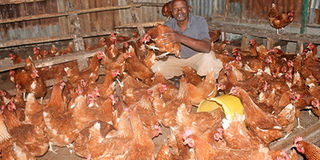
Peter Mburu feeds some of the 400 chicken that he keeps in Elburgon. Most farmers live close to their livestock and birds due to space and security constraints. While currently the covid-19 virus is not known to affect livestock, it is advisable for infected people to distance themselves from animals until the extent of the virus host range and activity is understood. PHOTO | JOHN NJOROGE | NATION MEDIA GROUP
The current coronavirus outbreak is suspected to have emanated from bats and snakes sold as food in a wet meat market in Wuhan, China.
The corona family causes many diseases in children and young animals, adult humans and animals. These include diarrhoea in children and young animals, common cold in humans and gut infection and pneumonia in adult pigs
The major challenges with Covid-19 are its ease of person-to-person transmission and its long incubation period of up to two weeks. During this period, the infected person does not show signs of the disease.
The corona family causes many diseases in children and young animals, adult humans and animals. These include diarrhoea in children and young animals, common cold in humans and gut infection and pneumonia in adult pigs.
Years back while in veterinary school, our public health professor of zoonosis warned us that failure to recognise diseases in wild and domestic animals that can be transmitted to humans is the greatest sin a vet can commit.
The diseases are called zoonoses. He further told us that such diseases do not necessarily have to be initially infective to humans but human exposure can make disease-causing organisms, called pathogens, change their genetic code or adapt to infect the human host.