Coconut trees were originally domesticated along the Indian and Pacific oceans’ tropical coastlands. This was very many thousands of years ago.
The seeds were brought to the Kenyan coast around 1000 AD by Arab and Persian traders who eventually colonised the area, which was already inhabited by Swahili and Mijikenda communities.
Here coconuts found suitable conditions for growth: ample sunshine, warm temperatures and average rainfall.
The trees attained heights of up to 30 metres, developed fine feathery pinnate leaves 7.5 metres long and yielded between 30 and 70 fruits per tree annually.
The trees possessed many other attractions: food in the form of edible seeds, coconut milk; copra whose dried flesh is material from which oil for cooking and cosmetics is extracted and also used as livestock fodder; fuel from the hard shell and tree trunk; the tree itself, which also makes fine roofing poles; and, the leaves from which a variety of aesthetic materials for furnishing and decoration are made.
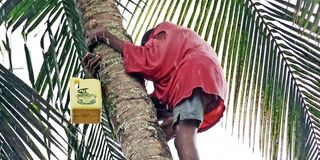
Coconut fruit also provided material for the manufacture of wine. The coconut therefore became central to coastal people’s cuisine, alcoholic beverage and technology, including the skill required to climb its extraordinarily long trunk to tap fruits. For its multi-purpose uses, the coconut has been referred to as “the tree of life”.
Durability and many other coconut’s characteristics led to its role in staking each family’s claims to land at least for use during the life of the trees.
Its export value led to the development of early trade between Kenya’s coast and Arabia and India before the nineteenth century.
The Portuguese reign between the sixteenth and eighteenth centuries was more characterised by plunder than by production and led to a decline in coconut trade.
After the combined Swahili and Omani forces defeated and evicted the Portuguese from the coast, coconut production and trade flourished once again.
This happened particularly after Seyyid Said moved the Omani capital from Muscat to Zanzibar in 1840. His purpose was to enhance trade in slave trade and clove growing.
He ordered all his subjects in the island to plant cloves in proportion to coconut trees. He threatened with loss of land those who failed to do so.
Said’s directive also popularised coconuts in all his other coastal domains north of Zanzibar as part of his general agricultural development policy.
During his reign and that of his successors after his death in 1856, Zanzibar signed anti-slave trade and commercial treaties with European countries like Germany, Britain and France and also the United States of America.
Apart from cloves from Zanzibar and Pemba, coconuts products also increasingly became the major exports from the East African coast to Germany and France.
When the hurricane destroyed most of the clove and coconut trees in Zanzibar in 1872, the Sultanate largely relied on the Kenya coast for coconut supplies.
During the Omani rule, the land tenure system at the Kenyan coast was irreversibly transformed. The Arabs became a plantocracy, a class of large-scale land owners and coconut growers.
Others operated a variety of businesses. African slaves worked on Arab farms. After the abolition of slave trade, the indigenous Swahili, Mijikenda and freed slave communities formed the peasant, squatter and labouring classes.
In 1886, an agreement between Britain and Germany ceded to the Sultan of Zanzibar a ten-mile coastal strip, which included part of what was Kenya’s Coast province.
This meant that the Swahili and the Mijikenda, who inhabited this stretch of land, were henceforth the subjects of the Sultan of Zanzibar and by implication his tenants, though ostensibly under the British protection. Worse was yet to come with the British colonisation of Kenya in 1895.
During the colonial period, coconut was the major indigenous fruit that was incorporated into Kenya’s colonial and international economy.
But coconut growing and trade concentrated on wine more than copra for most of the period. Colonial agricultural officials’ reports were full of complaints that
Ironically, the ban on the sale of alcohol by Europeans and Asians to Africans contributed immensely to their relative neglect of copra.
As increasing numbers of African labourers from other parts of the country migrated to the Coast Province for work, for instance at the Mombasa Port and in the sugar cane plantation at Ramisi and sisal plantations in Taveta, their demand for their own traditional brew in African-owned clubs also developed.
Enterprising women were quick to provide premises where coconut wine and sex were sold, though illegally.
It was not until 1934 that colonial authorities legalised the opening by Mombasa Municipal Council of African clubs (singular in Kiswahili, klabu), or beer halls, to benefit from taxes that accrued from alcohol sales.
This was soon emulated by the Local Native Councils in the other districts in Coast Province and the rest of the country.
Notably it was not until 1952 that the East African Breweries Limited established a brewery in Mombasa.
Although British colonial authorities termed Africans on the Coast lazy and preferring the production of coconut wine to the production of copra, they ignored the fact that Africans were simply responding to batter economic opportunities.
Coconut wine was easier to prepare and fetched quicker and higher returns than the production of copra which, by traditional methods of heating, took about four hours and paid comparatively less.
It was not until the 1950s that coconut growing and exports increased though briefly. This was primarily because of the economic boom which followed the rise of Korea.
This led to a dramatic increase in demand for both coconut oil and copra. In response to the boom the State enacted the Coconut
Preservation Ordinance in 1950 to compel coconut growers cut down and burn old and unproductive trees and to destroy pests such as the rhinoceros leaf beetles, mites and the phyto-plasma disease and their breeding grounds.
Seeds from newly established nurseries were distributed to the Digo, the Giriama, the Taveta and other communities to plant new trees.
The Mafugo Experimental Station was commissioned to find out ways of improving the quality of coconut fruits.
Finally, an improved type of coconut fruit drier was also established in Mombasa. These measures took time to have effect.
For example, it would take at least eight years before the new trees matured for tapping. Finance shortage meant the absence of extension services to producers.
These schemes, therefore, led to little improvement of the coconut industry during the 1950s.
Copra’s low export prices, the increase in the use of synthetic oils and the problems which characterised land ownership at the Coast and which were exacerbated during and after the transition to Kenya’s independence were also hugely responsible for this.
Peasants who are usually known to be quite sensitive to the unreliability and instability of factors of production, including labour, capital and land, and indeed an unpredictable market situation, quickly stopped tending their coconut plants and growing new ones.
In particular, the land problem on the coast was brought about by a confluence of many factors dating to the pre-colonial period.
To revive coconut production today, the government and business people should create a Kenya-wide and East African regional coconut market.
The potential is quite great. The government should also resolve the perennial land question in the Coast region.