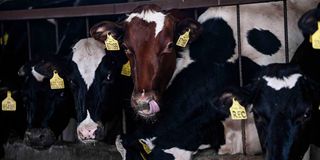
The best way of evaluating the quality of cattle feed is to present it to the animal as advised by the manufacturer, supplier or your animal health and production service provider; then observe the animals’ response.
Of course all feeds must be properly labelled showing the manufacturer, the ingredients, quantity of ingredients and the mark of certification by the Kenya Bureau of Standards.
If feeds are being recommended by professionals such as animal health and production service providers, the professional must explain to the farmer the reasons for the claim of superior performance based on credible and verifiable scientific or experiential knowledge.
The professional must also be available and willing to address any shortcomings the farmer may experience after using the feeds on her animals.
Farmers should desist from feeding their animals on products that are claimed to have good or superior performance from people who only identify themselves as experts without verification or marketers of manufacturers.
The farmer had a rude shock weeks ago when some marketers visited his land and said their mineral salts had very high milk yield.
He planned to buy more after his cows improved on milk yield. Unfortunately, the animals drastically reduced production by the third day of feeding.
When the farmer called the salt marketers, they kept promising to visit the farm but never showed up.
Like a computer, the healthy animal body never lies. It is simply garbage in-garbage out.
If the wrong materials are fed to a cow, the production will also be inadequate.
For a lactating cow, milk is the main production that a farmer observes. A reduction in milk yield is a good indicator of a problem.
If the animal appears healthy and has good appetite, then inadequate feed quantity and quality are the key suspects of a fall in milk production.
In general, the best indicator of the adequacy of the quantity and quality of feed is the body condition of the animal, the colour of the hair and physical condition of the hair such as length and form.
The body condition is usually based on a score of one to five where one is the lowest and five the highest.
Well-nourished, high-yielding lactating dairy cows should have a score of 2.25 to 2.75.
To the layman, this means the cows should show their short ribs just slightly.
Pregnant cows should have a score of 3.0 to 3.25, meaning their short ribs are barely visible.
For heifers and young stock, the short ribs should not be seen at all but there should be no visible fat deposits.
For dairy cattle in any stage of production, the hair colour should be consistent with the breed.
Friesians are standard black and white. Ayrshires are red and white while Guernseys are brown and white. Jerseys are mauve with a tinge of black.
Malnourished animals have long, thin dishevelled hair that tends to be curly.
Their faces look sad, especially for calves. The animals tend to move with a lot of caution, possibly because they feel weak.
Interestingly, my experience is that more than 80 per cent of dairy cattle in zero grazing in Kenya are malnourished.
Earlier this week I visited a dairy farm in Murang’a County and was impressed by the level of uniformity in the good body condition of the Friesians.
Most people can take good care of the adult milking cattle but calves and other young stock are usually a serious challenge.
I have mostly found them in very poor body condition. The hair is often discoloured, long, thin and curly.
The farm I visited had only one poorly kept young stock. The manager explained to me that the calf was neglected after weaning because it was a bull.
Most farmers, unfortunately, fail to understand that bulls and heifers have the same nutritional requirements in readiness for their different future roles in reproduction.
The bull lays down muscle and develops its sperm-producing organs in readiness for mating in future.
The heifer, on the other hand, lays down fat and develops its uterus and ovaries in readiness for pregnancies.