Two months ago I narrated how I visited a dairy farm for performance assessment only to be notified of a foot and mouth disease (FMD) outbreak five days before my scheduled visit.
The owner wondered why the animals had come down with the infection while they had been vaccinated earlier in March.
I confirmed with the owner they had vaccinated against the four known types of the disease in Kenya.
They are type A,O,SAT1 and SAT2. Farmers should always ensure their animals are vaccinated against these virus types even if one is told a virus type does not exist in their area.
The reason for the caution is that animals carrying any type of the virus may be introduced in a farm where the virus type is not known to be present.
The vaccine used in Kenya is called the Quadrivalent type because it contains the four types of the virus known to be circulating in the country.
Two questions arose from the notification of the FMD outbreak. First is whether I should still proceed with the visit to the farm.
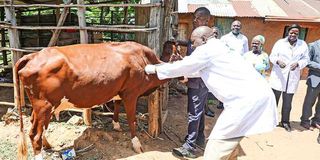
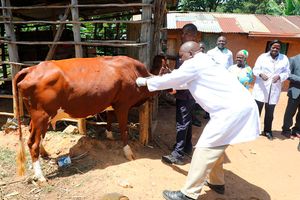
Livestock veterinary officer Bernard Odera vaccinates a cow against foot-and-mouth disease on January 15, 2025 at Handidi village in Shinyalu, Kakamega County.
Photo credit: Isaac Wale | Nation
The second is what had caused the vaccination to fail and what should the farmer do to contain the situation and get the animals to recover and be protected from future infections?
To visit or not to visit the farm is a question of whether I could spread the virus from the farm to other areas if I visited. Canceling the visit until the disease subsided is the recommended practice.
I decided not to follow this option because I needed to see how severe the infection was and also study the disease pattern in the herd to try and find out what could have caused the infection despite the vaccination having been done.
It is still allowed for a veterinary doctor to visit a farm with infection but I had to take very strict measures to minimize the chances of spreading the virus from the farm to other areas and farms.
Once on the farm, I parked the car about 50 meters from the cow yard to minimize virus contamination. I disinfected the car tyres on arrival and departure, did the same for my gumboots, overalls and gloved hands.
I also restricted my contact with the animals to my gloved hands only. Over time, I have found these biosecurity measures effective.
When I finished my task on the farm, I packed my gumboots and overalls in air tight plastic bags to prevent dispersal of the virus inside the car. Fighting with germs looks like witchcraft because the enemy is invisible to the naked eye.
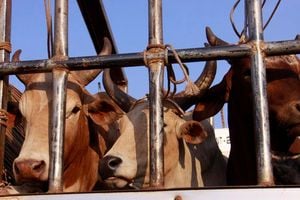
Meat prices soar as foot-and-mouth disease hits North Rift livestock markets.
Photo credit: File | Nation Media Group
One only knows they lost the battle if a visit to a farm results in an infection outbreak that can be associated with the visit.
When I was out of the farm, the car was thoroughly washed with plenty of soap and water and the tyres were disinfected again. Beyond those actions, I could only hope that I and the car were clean of viral contamination.
I confirmed from the records the animals had been vaccinated. However, the vaccine had been obtained locally.
Considering the farm had 206 high quality Friesian cattle, I advised the farm should be obtaining their vaccine directly from the manufacturer to ensure that the vaccine had been properly stored and transported.
The FMD vaccine and most other vaccines have to be kept refrigerated at 2 to 8 degrees Centigrade to remain viable for one year as recommended by the Kenya Veterinary Vaccines Production Institute (KEVEVAPI).
I recall one time I bought vaccines and got an emergency call before reaching my clinic. I went to attend to the call and forgot all the vaccines in the car when I returned to the office.
The following morning I found the ice cooling the vaccines had all melted and the vaccine was at close to room temperature. I counted my losses and destroyed the vaccine. Such vaccines should never be used to vaccinate. They are likely to result in failure.
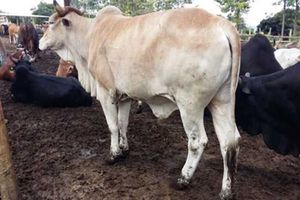
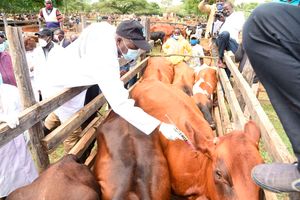
Cows being vaccinated against foot and mouth disease in Emining in Baringo County on June 26, 2020.
Photo credit: File | Nation Media Group
Another source of vaccine failure is improper vaccination where the animals gets too little of the vaccine deposited into the body.
There is a minimum number of viral particles that should be deposited into the body to elicit sufficient immunity. Each cow regardless of size, age and sex should be vaccinated with the recommended dose of 3ml for the KEVEVAPI FMD vaccine.
The infected herd appeared to have got insufficient anti FMD immunity because the disease was not severe like it is in unvaccinated animals.
Further, the animals were taking a short time to recover because even some which had shown infection three days earlier were starting to show signs of recovery.
Vaccination may also fail because of poor quality of the product or change in the genetic type of the virus. Consequently, I advised the farm to report the outbreak to the vaccine manufacturer KEVEVAPI giving the batch number of the vaccine and also report to the government FMD laboratory.
The lab staff would collect samples from fresh cases of the infection and analyse the virus type in the laboratory and also the level of immunity development in the cows.
All the current cases could not provide samples because they had already been treated with Magadi soda which kills the FMD virus.
About 60 animals had been infected but the number of new cases was dwindling. I advised the cattle would be vaccinated against FMD about 30 days from the time the last case recovered.
The farm never submitted samples to the laboratory for investigation because no other case of the disease developed after my visit. It meant the virus had died out after infecting about 30 per cent of the herd.
This means the incident was a partial vaccine failure because most of the animals infected only had mild disease.
The virus type was also weak because most of the animals infected were unvaccinated calves and cows that were not vaccinated due to pregnancy at the time of vaccination.