Simon Ng’ang’a Wamsey worked as a matatu driver for 25 years. He left his job in 2016 following the death of his daughter, who had given birth to twins in 2013.
His wife was unable to care for the grandchildren alone. One year after leaving his job, Mr Wamsey visited a friend in Nyeri County who kept goats for their milk, and was impressed by his farming.
“I was attracted to my friend’s farming project, and I decided to start it after realising that I would save money on buying milk every day to feed my grandchildren. By then, I was buying two litres of cow’s milk daily for domestic use at Sh120. My friend also told me that goat’s milk is more nutritious and that I could sell the surplus to local buyers,” Mr Simon recalls.
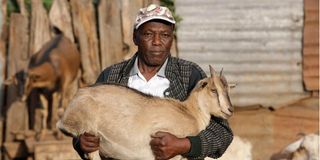
Simon Ng'ang'a Wamsey, holds some of his young breeds he rears in Elburgon, Nakuru County on October 21, 2026.
Photo credit: John Njoroge | Nation Media Group
With an initial investment of Sh40,000, he bought two pregnant Toggenburg goats, aged two months, from Kenana Farm in Njoro for Sh15,000 each, and used the remaining funds to purchase building materials such as timber, iron sheets, and nails to construct a shelter. Three months later, the goats gave birth to twins and Mr Simon said that from that day, milk was no longer a problem for his family.
During a recent visit to his home in Elburgon, Nakuru County, we found Mr Simon feeding his now larger herd of goats. He said that, within one year, the goats had given birth twice, each time delivering twins.
“There was plenty of milk to feed my family, and I sold the surplus to local buyers at Sh150 per litre. From the sales, I was able to buy more food from local livestock shops to supplement the feed,” he said, adding that feeding his flock is not challenging since he conserves dry maize stalks during harvest, buys protein-rich hay and lucerne, and ensures mineral lick blocks are plentiful, as these help with bodily functions, nutrient absorption, appetite and digestion.
He lets his flock roam around his plot, where they feed and drink from troughs. They also graze on nearby uncultivated land under the supervision of a farmhand. To ensure the dry maize stalks are fit for consumption, he uses a manual chopping machine, assisted by his son.
He stores surplus feed to combat shortages, especially during the dry season.
He revealed that milk goats are easier to manage so long as they have enough food and water, which is paramount.
Exuding confidence, he said that ten milk goats are equivalent to a single cow. He added that rearing cows is his last option since they consume a lot and farmers spend more to sustain them. He added that goats require a smaller area for rearing and management than cattle.
Simon Ng’ang’a Wamsey, feeds some of his German Alpine and Toggenburg goat breeds in Elburgon, Nakuru County on October 21, 2026.
Photo credit: John Njoroge | Nation Media Group
To manage his flock, Mr Simon deworms the young goats one month after birth, and the mature goats every two months. He also marks their ears while they are still young for identification purposes and keeps records to help him track their growth, milk production and sales.
Three months after weaning, he sells the male offspring, especially those under six months old, for Sh15,000 each.
“I sell the females to buyers who want to rear them for between Sh18,000 and Sh 20,000, while mature goats retail at between Sh 25,000 and Sh 30,000, depending on the breed.” My flock has now grown to over 100 goats of the German Alpine and Toggenburg breeds,” said Mr Ng’ang’a. He currently milks around 40 goats, collecting at least 80 litres of milk every morning, which he sells at the local market for Sh250 per litre.
He says these sales have helped him pay his grandchildren’s school fees, purchase an additional plot of land on which to rear his goats, and cover other personal expenses.
In the wake of the recent milk shortage, the farmer says the market is good. He adds that he has not even been able to meet the current demand from his customers.
He says that goats multiply quickly, and his plan is to have over 200 goats by next year, which will enable him to save up for his grandchildren’s transition to Grade 10 in 2028.
Nutritionists say that goat’s milk provides high-quality protein, essential minerals and fat, unlike cow’s milk. It also aids digestion and strengthens bones and the heart, and offers high levels of potassium and magnesium, among other elements.
To improve his skills, Mr Simon visits agricultural shows and the Kenya Agricultural and Livestock Research Organisation (KALRO) in Njoro. He also liaises with local and extension livestock officers, and visits other experienced farmers in the surrounding areas, learning about feed, diseases and treatment methods.
To prevent inbreeding, he exchanges male goats with other farmers who also rear better breeds. He says that other farmers visit his farm to benchmark, and that others have started producing goat’s milk on their own farms. He says that this project is labour-intensive but easy to manage, and that anyone can do it in a small area, unlike cattle rearing, which is expensive.
“I have no regrets about investing in this project because it has helped me to easily meet my financial needs. I urge other farmers to embrace rearing better goat breeds that produce enough milk for commercial and domestic use, giving them access to better markets at home and abroad, particularly when reared on a large scale,” says Mr Simon.
Simon Ng'ang'a Wamsey, with some of his German Alpine and Toggenburg goat breeds in Elburgon, Nakuru County on October 21, 2026.
Photo credit: John Njoroge | Nation Media Group
He adds that the gestation period is five months, which has enabled his flock to grow quickly, especially when they give birth to twins or triplets. Before investing in this project, Mr Simon urges farmers to source feed and water and to construct a suitable pen for their flock.
According to Mr Antony Kariuki, a former Livestock Officer in Kuresoi North, the shelter should be raised 2 ft off the ground, have a good roof and ventilation, and comprise an open feeding section and a spacious sleeping area, in order to allow the goats to move freely.
“Breeding requires record-keeping to prevent inbreeding. Farmers should keep a buck for one year and then sell it to other farmers to prevent inbreeding with its offspring,” said Mr Kariuki, adding that the type of breed varies according to climate conditions.
He notes that German Alpine, British Alpine and Swiss Alpine breeds prefer highland areas, while Galla and Boer breeds do well in lowlands. The Kenya Alpine and Toggenburg breeds fare better in the medium highlands.
He adds that a successful dairy farmer should have enough feed for the goats to last at least one year.