Traditionally, Kenya’s tea industry has been associated with the black tea commonly found in households, hotels, and supermarkets. However, a growing range of premium and speciality teas is opening up new opportunities for producers and consumers alike.
From purple and oolong (a traditional Chinese tea that is partially oxidised and sits between green and black tea in flavour, colour and processing) to yellow, green and whole-leaf black tea, these varieties give consumers more choice while creating opportunities for the industry to diversify beyond conventional crush, tear and curl (CTC) tea.
These teas were among the products showcased by Chebango EPZ Tea Company Ltd from Sotik in Bomet County during the 125th edition of the Nairobi International Trade Fair organised by the Agricultural Society of Kenya (ASK).
The seven-day exhibition, held at Jamhuri Showground in Nairobi from 28 September to 4 October, was conducted under the theme 'Promoting Climate-Smart Agriculture and Trade Initiatives for Sustainable Economic Growth' and brought together farmers, agribusinesses, government agencies, and technology providers to showcase products and innovations across the agricultural value chain.
Joyster Temko, a marketing consultant at Chebango EPZ Tea Company Ltd, said the company had used the fair to introduce consumers to a wider range of teas, while also highlighting the potential of premium and speciality products in the domestic market.
"At this exhibition, we are showcasing some of the teas that we have on the market. We have CTC tea. It has undergone processing and is the type of tea commonly consumed in households and sold in supermarkets,” Ms Temko told Seeds of Gold at the event.
Alongside CTC tea, Chebango showcased its premium and speciality range of Orthodox teas. This range includes purple, oolong, yellow, green and black teas.
Unlike CTC tea, Orthodox tea is made from whole leaves that undergo gentler processing. The leaves are rolled or roasted to retain their natural characteristics and flavours more effectively. “Speciality tea has not gone through the same processing as CTC tea. It uses whole tea leaves, which may be rolled or roasted, and retains more of the tea's natural characteristics,” Temko said.
The different varieties have distinct flavours and characteristics, and some are becoming increasingly popular with consumers interested in wellness beverages. Ms Temko said that the teas contain antioxidants and that some varieties are preferred by consumers for their perceived benefits to the stomach and gut.
She says that yellow tea is less concentrated and is preferred by some consumers who experience stomach discomfort, while purple tea is sought for its antioxidant properties and regarded as beneficial to gut health.
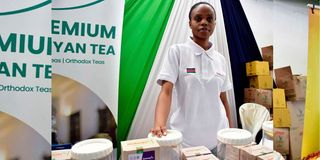
A variety of teas produced by Chebango EPZ Tea Company Limited on display during the Agricultural Trade Fair on October 3, 2026.
Photo credit: Francis Nderitu | Nation Media Group
Although Kenya has a wide variety of teas, the domestic market remains largely familiar with conventional black and green tea, leaving considerable room for growth in the premium sector.
“We produce a lot of tea that many people don’t know about from Bomet, Kericho, and Othaya. I feel like the tea market has not been explored that much,” she noted.
She believes that a greater focus on premium and speciality teas could help to expand the country's tea market, particularly as producers seek to diversify their products and reach consumers with different tastes.
The export market remains the larger outlet for speciality teas, with products finding customers in countries including China, Rwanda, and Burundi. However, the Kenyan market is still relatively small, creating an opportunity for companies to invest in raising awareness and educating consumers.
The strategy at Chebango is to make premium teas more accessible to consumers by selling them in supermarkets, hotels, cafés and retail outlets. Sampling and promotional activities are also being considered to encourage consumers to sample the products and familiarise themselves with their characteristics.
“We are trying to sell our teas in supermarkets, hotels, cafés and retail shops. That is where we will mostly base our market, so that we can create awareness, run promotions and offer samples, and allow people to taste the tea,” she explained. The company is targeting markets in Nairobi, Kitui, Murang'a and Nakuru as it seeks to expand the domestic market for premium tea.
Ms Temko said that speciality tea has traditionally been more popular among people aged about 30 years and above, while younger consumers have tended to prefer CTC tea.
However, more young people are beginning to explore Orthodox tea as they become familiar with the different varieties and their characteristics.
“I am 27 years old, and my favourite tea is oolong,” said Ms Temko, noting that her preference reflects the growing interest in speciality teas among young people.
She believes that providing more education and tasting opportunities could help to introduce premium and speciality teas to a younger market, particularly through supermarkets, cafés, and other retail spaces where consumers can sample different varieties.
“Maybe educating them more about tea. We could have sampling activities in those markets and in café shops so that people can sample the tea and experience its taste and benefits,” she explained.
A variety of teas produced by Chebango EPZ Tea Company Limited on display during the Agricultural Trade Fair on October 3, 2026.
Photo credit: Francis Nderitu | Nation Media Group
According to Ms Temko, Orthodox tea's appeal also lies in its ability to retain the natural flavour of the leaves. “I would like more people to embrace Orthodox tea and learn more about it, rather than just CTC.”
She adds that this less intensive processing allows consumers to experience the tea's natural character and richer flavour. 'It is in its natural state. It hasn't undergone other processes, so it retains its natural flavour. You can experience the rich flavour of the tea through Orthodox tea,” she stated.
Chebango EPZ Tea Company Ltd produces tea for export and is seeking to increase demand for premium products in Kenya.
Participating in the Nairobi International Trade Fair gave the company the opportunity to interact directly with consumers and other players in the agricultural sector, as well as promoting the diversification of Kenya’s tea products.
The fair’s climate-smart agriculture theme also offered producers the opportunity to consider how the tea industry can respond to changing weather patterns. Ms Temko identifies this as one of the challenges facing farmers and processors.
“Climate change can affect how tea is produced and the quantity produced. It also affects farmers. That is one of the challenges that we face,” she noted.
Limited awareness of premium and speciality teas remains another hurdle. While consumers readily recognise CTC tea, many are unfamiliar with oolong, purple, yellow and other whole-leaf varieties.