Before retiring as a primary school teacher in 2025, Mr Patrick Ng’ang’a taught Agriculture and Science at his former school. While taking care of his parents' sheep in the early '90s, he also bought some of his own and reared them alongside them.
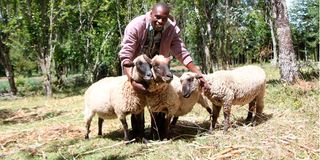
During a recent visit to his Pamalees Farm in the Kiambu area of Molo in Nakuru County, approximately two kilometres off the Molo-Keringet road, Mr Ng’ang’a was feeding his new breed of Hampshire sheep with his son.
'In 2014, I built a temporary shelter for my growing flock, despite the challenges of finding enough time to care for them. From an initial investment of Sh25,000, I bought iron sheets, poles, nails, and other materials required to build the shelter,” he recalls, adding that he loves livestock farming and used to visit agricultural shows, as well as taking his students to Baraka Agricultural College in Molo to learn more about farming.
It was at one of these shows in Nakuru that he was attracted to one of the exhibitors who displayed Hampshire breeds on his stand. After a lengthy conversation, he learnt that the breed grew quickly, was large in size and produced the best meat. It also increased in weight quickly, was resistant to the cold and was popular with buyers. A few days after the agricultural show, he visited the manager at Penzi Farm in Kuresoi North, where these breeds were reared in large numbers.
"In September 2025, just a few months after retiring, I decided to switch to a new breed of sheep. I selected and kept about 28 large female sheep and sold the rest to local butchers for between Sh15,000 and Sh20,000 depending on size, while the nine-month-old lambs sold for Sh6,000 each as they were not good quality. I used the proceeds from these sales to buy more food for the mothers and to purchase a nine-month-old male Hampshire breed from Penzi Farm, one of the most well-established farms in Kuresoi North, for Sh60,000 to breed with my female flock,” said Mr Ng’ang’a.
He rebuilt the structure, which can now hold over 400 sheep. He also installed automatic bowl drinkers, salt lick holders and feeding troughs, and partitioned the shelter to prevent inbreeding. The partition also helps him during feeding at different stages, depending on the age of the sheep, and provides easy access for identification and other management tasks. He added that inbreeding leads to a low growth rate in animals and causes deformities and diseases if the male is infected.
Patrick Nganga, a retired teacher, and his son, Manasses Mbugua, feed some of the Hampshire sheep at Pamalees Farm in Kiambu area in Molo, Nakuru County on September 28, 2026.
Photo credit: John Njoroge | Nation Media Group
A few months later, all 28 sheep had given birth, some of them delivering twins. Two days after birth, the lambs' tails were docked and they were ear-tagged to help with treatment and weight records. According to Manasses Mbugua, the farm manager and the owner's son, the lambs are vaccinated one month after birth to prevent pneumonia and other infections, and dewormed one-and-a-half months later.
“The flock is weighed every month to keep records of weight, as this helps us to identify which sheep breed faster than the others. The ones that weigh less are culled and sold to local butchers, while the rest are kept,” says Mbugua, adding that they only sell male lambs after they have been weaned for three months and are under six months old, at Sh25,000 each.
At that stage, they usually weigh between 35 and 40 kg, unlike normal breeds which weigh between 10 and 12 kg. He uses the proceeds from the sales to manage the farm and cater for other needs.
Mr Ng’ang’a, who sells his breed to willing buyers at the local market, says that the price depends on the weight. He adds that if a lamb is older than six months, it is more expensive. “I have no regrets about starting this project because the market is good. Farmers from other areas also visit my farm to benchmark, paying a fee of 1,000 shillings per person,” he says, adding that he has currently reared over 200 sheep.
His vision for the next five years is to add value by setting up a chain of butcheries on the farm where they will produce and sell higher-quality meat products from sheep. To achieve this, he plans to increase the amount of feed by extending the acreage and planting more maize for silage, nappier grass and lucerne, in order to reduce the cost of buying feed from Agrovet shops. Mr Ng’ang’a urges those willing to start a similar project to first ensure they have enough feed, and to follow the right schedule for feeding, management, deworming, vaccination and other important tasks.
To manage the breed, Mr Ng'ang'a has planted high-protein fodder such as super nappier, pakchong and lucerne. He also grows maize for silage on his farm, harvesting it at the milking stage. The maize is then chopped by an electric machine and conserved for 21 days before being fed to his sheep. Mr Ng'ang'a feeds his flock in the morning and evening, supplementing the feed with lamb pellets, dairy meal, burley chuffs, and chuffs made from beans and peas, among other things.
To ensure the security of his sheep and other essential farm facilities, Mr Ng'ang'a has installed CCTV cameras and employed casual workers to care for the animals, which are housed in a well-enclosed, raised, spacious shed that protects them from the cold and wild animal attacks. During the day, the sheep roam around the compound, feeding on fodder in wooden troughs placed in strategic areas.
Patrick Ng'ang'a holds one of the Hampshire lambs at Pamalees Farm in Kiambu area in Molo, Nakuru County on September 28, 2026.
Photo credit: J
“I market my breed on social media such as TikTok, WhatsApp and Facebook, which has increased my customer base, either through farm visits or people reaching me online. To improve my skills, I visit agricultural shows and experienced farmers. I liaise closely with the Ministry of Agriculture and government organisations. I also learn online and read newspapers that publish farming articles, such as Seeds of Gold, among others,” said Mr Ng’ang’a. He added that he goes to Baraka Agricultural College to learn about feeds.
The former teacher says that rearing livestock is challenging during the dry season, due to insufficient food or water. To combat this issue, he has drilled two wells on the farm and erected a large tank. He also collects manure every morning for use on the farm, selling the surplus to other farmers at 300 Kenyan shillings per 70 kg bag.
He cites the lack of sufficient livestock extension officers as the main challenge in the area. “The county government should dispatch officers to work at a grassroots level to educate farmers, organise seminars for livestock farmers, and inform them about diseases and treatment management,” said Mr Ng’ang’a. His son, Mbugua, called on young people to invest in sheep farming to improve their livelihoods, as it generates income quickly.
According to Nicholas Rono, the Livestock Officer in Kuresoi North, farmers should work closely with the few officers on the ground to learn how to rear livestock successfully. “Farmers should ensure that they provide high-quality feed and deworm their animals at the right time. The housing should also be spacious and well partitioned according to age,” he said.