Kenyans joining Quant Vest Stock Exchange (QVSE) on the promise of turning small investments into huge profits within months were told the online trading platform was run by a person called ‘Carl Grindan’.
Grindan, whom they would later grow fond of calling ‘Prof Carl’ or ‘Professor’, had local agents who recruited teachers, small-scale traders, mid-level professionals and boda boda operators into the scheme.
Investors deposited money into their QVSE accounts and waited for trading signals from ‘Prof Carl’, who messaged them on the messaging app BonChat.
Those with a $500 (Sh65,000) principal earned $6 (Sh777) per trade, while investors who deposited $1,000 (Sh130,000) earned $12 (Sh1,553). This meant one could make at least Sh1,553 a day from the two trading sessions.
The operation relied on copy trading, where an investor automatically mirrors the trades of another, usually more experienced, trader.
Investors needed to be awake at peak trading sessions, often at night, and had five minutes to execute each signal Grindan shared before it expired.
But details about Grindan were scanty. “We could not find any online presence of his name apart from discussions related to QVSE or Global Investment Group,” Justus, a Kitui-based teacher who requested to be identified only by his first name, told Nation.
Global Investment Group (GIG) is the company purported to own the QVSE platform. The teacher joined QVSE in June after a family member convinced him and had $870.39 (Sh112,654) in his account when Grindan froze all investors’ accounts on September 5.
Some investors said Grindan was French; others speculated he was American, but none could substantiate their claims.
“We were told he is from France by some of his local recruiters, but we have never spoken to him to establish who he is,” said Edwin Mutuma, a Laikipia-based hotel manager who joined the app through a friend in August and has $2,100 (Sh271,740) locked in his account.
Grindan used a photograph of a white, middle-aged Caucasian man in a dark grey plaid blazer and white Oxford shirt on his BonChat profile.
Nation conducted a reverse search of the photo, which showed it was first uploaded on the internet in September 2021 to a Norway-based photographer’s portfolio alongside five other shots of the model.
A similar picture, which appears to be from the same shoot, is currently the LinkedIn profile picture of a business executive working for a major Norwegian automotive group headquartered in Oslo.
On search engines like Google, queries of the name ‘Carl Grindan’ only bring up recent QVSE-related discussions online. The other person with the same name is an American professor whose photos on his university’s website are different from those of the man in the QVSE profile.
Details about GIG were also not publicised, and investors said Grindan was defensive and agitated when they asked for more information about the firm.
“Carl said his company had been in existence for 16 years, although many of the people I came across had only joined the platform from 2025,” Justus said.
“He was almost always on the defensive about QVSE’s legitimacy. The issue seemed to come up repeatedly, with explanations being given almost daily.”
In messages to investors, Grindan said QVSE was operated under GIG, which he claimed to have founded.
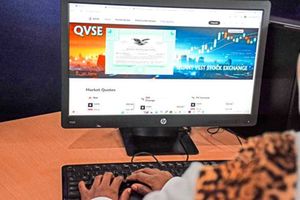
A user tries to log in to the Quant Vest Stock Exchange (QVSE) App. The Capital Markets Authority has listed it among illegal, unlicensed funds.
Photo credit: Billy Ogada|Nation Media Group
“As the founder of GIG, I have led this team for 16 years. I am deeply aware that every member who joins us hopes to achieve long-term, stable income through our collaboration in QVSE stock trading, allowing them to improve their quality of life and realise their personal goals,” read a message to one of the local agents.
However, regulatory filings seen by Nation indicate that GIG was only incorporated in Colorado, United States, in June 2025.
Its registered agent was listed as Marc Hudon, and the company has not made any filings since.
BonChat is more restricted compared to WhatsApp and Telegram, and investors could not take screenshots of group or one-on-one conversations on the platform, for instance.
Grindan does not interact with investors over calls, and they only message him directly in case of issues with their QVSE accounts. Multiple investors Nation spoke to said any comments by investors had to be approved by Grindan before they appeared on the main group.
The Kenyan investors have other smaller BonChat groups where they shared experiences freely without Grindan’s moderation.
One of the allures of the scheme was physical meetings it organised in hotels in Nairobi where investors discussed money-making opportunities, investors said.
Grindan was never seen at the meetings, which his ‘spokespeople’ – agents in Kenya described as some of the scheme’s largest investors – conducted.
On September 5, Grindan froze all accounts, accusing investors of creating multiple accounts to increase their trading limits. He told members they needed to deposit another Sh65,000 or Sh129,000 to verify their accounts.
A local recruiter claimed there were 12,005 Kenyan investors in the group, which would suggest that if every member had contributed the minimum Sh65,000, the scheme collected about Sh780 million. Nation could not independently verify the membership figure.
The Capital Markets Authority (CMA) on September 12 said QVSE was not licensed to operate in Kenya, and that it was under active investigation by Kenyan authorities.
Yet hours later, ‘Prof Carl’ went on BonChat to reject the regulator's statement. He told investors to continue putting in money to unfreeze their accounts.
While he had initially promised investors that they would begin withdrawing their balances from September 12 if they deposited more cash, he pushed the deadline by a week to give investors more time to put in more money.
In 2019, a Brazilian pyramid scheme collapsed similarly, with hundreds of millions of shillings from Kenyans.
Velox 10 Global, run by Brazilian Ricardo Rocha, charged $100 (about Sh12,800 currently) as a membership fee, but members needed to upgrade by paying an additional $200, with the promise of earning up to $4,000 daily through a cryptocurrency investment fund.
The firm was launched at a top Nairobi hotel and operated locally for nearly four years without registration.
But in March 2019, its websites went offline, and its local promoters and company leaders turned off their phones.
A user tries to log in to the Quant Vest Stock Exchange (QVSE) App. The Capital Markets Authority has listed it among illegal, unlicensed funds.
Photo credit: Billy Ogada|Nation Media Group
Mr Rocha was arrested by local police but released hours later and driven to the Jomo Kenyatta International Airport by a former governor’s entourage.
QVSE’s investors have now turned against Grindan and his local recruiters, with BonChat groups riddled with insults to a person they thought would be their bridge to fortunes.
“I believe QVSE is completely over, and now only AI is managing us,” one user wrote, referencing the generic encouraging messages Grindan has been sending in response to their frustrations.
“He is a very wise person, whoever that Carl is,” Mr Mutuma said. “He got us.”