African countries should prepare for increased tariffs on their exports to the US following the expiry of the African Growth and Opportunity Act (Agoa), which may not be renewed with the same advantages or for the same length of time as before.
There was talk this week that President Donald Trump may extend the privileges for another year. However, experts warn that the current stalemate in the US Congress on appropriations, President Trump’s own opposition to long-term free trade deals and the shift towards more bilateral arrangements are hindering the renewal of Agoa.
The renewal of Agoa is being delayed due to potential changes in the agreement's focus, including critical minerals and geopolitical alignment under a Republican administration.
Kenya and Tanzania's market access under Agoa, which expired on September 30, 2025, is now over-shadowed by increased tariffs of 28 percent and 20 percent respectively, making their exports to the US unprofitable.
“It is a really bad timing that Agoa is expiring at a time the US government is in shutdown. Agoa’s extension requires bipartisan congressional approval but the focus is on resolving funding disputes,” said Ngovi Gitau, a former Kenyan ambassador to South Korea.
“That completely diverts and delays attention and resources from other priorities like trade pacts. I think the government of Kenya has to think differently, in mitigation.”
Despite efforts by President William Ruto, South African President Cyril Ramaphosa and other African leaders to lobby the White House on the sidelines of UNGA80, Washington DC has yet to issue a clear statement on renewal.
The uncertainty surrounding Agoa’s renewal has led to reduced orders from US buyers, which under-mines the competitiveness of Kenyan firms and risks job losses for thousands of workers.
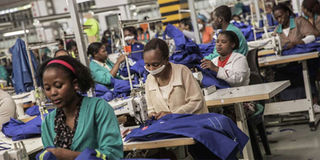
Export Processing Zone (EPZ) factories in Kenya, such as Shona EPZ, have laid off staff and may be forced to close due to the lapse of Agoa, which granted duty-free access to the US market, and the additional 10 percent Trump tariff, which has hurt garment sales.
“I do not see the US renewing Agoa. The US President has no authority to extend Agoa. It is congressional legislation—enacted by Congress, not the President,” said Prof James Gathii, professor of law and Wing-Tat Lee chairperson in International Law at Loyola University Chicago School of Law.
“Agoa may not come back anytime soon. In any case, does Agoa matter now? Because there is a baseline tariff of 10 percent for every country in the world. Any preferences we get could be wiped out by that baseline.
“Depending on which country you are in, anything added on top of that baseline wipes out the benefits that Agoa—or any preference programme—would produce. It is a complicated time for international trade.”
The US Congress, which is responsible for Agoa, is currently in the midst of a crisis.
On Wednesday, the Senate adjourned without reaching a resolution on how to reopen the government. The shutdown began at 12.01am after Democratic senators voted against a Republican Bill to extend funding for seven weeks.
Hours later, a vote to end the shutdown failed, as Senate Democrats held firm on their demand for health care subsidies, which President Donald Trump and Republicans refuse to extend.
Senators will return on Friday, after a break for the Jewish holiday of Yom Kippur, to vote again on the GOP measure.
“Currently, there is a dispute over Trump’s tariffs. Until it is resolved—specifically whether the White House has the authority over tariffs—Agoa is unlikely to be on the table for discussion,” said Prof Gathii, who is also lead editor at Afronomics Law and sits on the editorial boards of the American Journal of International Law , Journal of African Law , and Journal of International Trade Law and Policy .
“Right now, Trump’s tariff case is in the Supreme Court. That will determine whether the President can impose tariffs without Congress. That question will be answered when Congress speaks.”
On November 5, the US Supreme Court will hear arguments in two cases challenging President Trump’s authority to impose tariffs under the International Emergency Economic Powers Act.
The Trump administration argues that a federal appeals court ruling declaring the tariffs unlawful “has disrupted highly impactful, sensitive, ongoing diplomatic trade negotiations,” while challengers cite the “severe economic hardships” caused by the tariffs.
“Really bad timing with Agoa’s expiration. The US federal government is shut down. Agoa’s extension requires bipartisan congressional approval, but the shutdown’s focus on funding disputes completely diverts attention and resources from other priorities like trade pacts,” said Amb Gitau.
Kenya’s textile and apparel industry is one of Agoa’s biggest beneficiaries, earning a record Sh60.57 billion from textile exports to the US in 2024 — a 19.2 percent increase from Sh50.82 billion the previous year.
Data from the Kenya National Bureau of Statistics shows that the sector directly supported 66,804 jobs in 2024, highlighting the potential impact of Agoa’s non-renewal on households dependent on the industry.
Kenya’s Trade Cabinet Secretary, Lee Kinyanjui, who remains optimistic about the renewal of Agoa, at-tended President Ruto’s consultative meeting with the Kenya Private Sector Alliance on Thursday night.
“The President briefed us on his recent discussions in Washington with US Secretary of State Marco Ru-bio, which covered not only Agoa’s extension but also the establishment of a long-term framework to guarantee stable and predictable market access for our products,” said Kinyanjui.
“The government is committed to safeguarding jobs and driving continued growth in the sector. The President assured investors there would be no disruption in operations as talks with the US proceed with urgency.”
As pressure from African countries to renew Agoa gains momentum, starting October 1, Kenya’s aver-age weighted trade tariff with the US tripled to 28 percent, according to the UN Conference on Trade and Development (UNCTAD)—a major blow to jobs and investment in the country’s textile and apparel sector.
“For example, Kenya would see its trade-weighted average US tariff nearly triple, jumping from 10 per-cent to 28 percent. For Madagascar, it would double to 23 percent,” UNCTAD said in a report dated September 29 titled “When Trade Deals Expire: What’s at Stake for Africa and the US?”
“This is because country-specific and sectoral tariffs would apply on top of most-favoured-nation rates (applied equally to all World Trade Organization members), instead of the current preferential treatment.”
Other African countries most affected include Cape Verde at 26 percent, Tanzania at 20 percent, and Mauritius at 19 percent.
Special textiles and apparel preferences are applied to lesser-developed countries with a third-country fabric provision.
South Africa (15 percent), São Tomé and Príncipe (14 percent), and Guinea-Bissau (14 percent) will face slight increases in tariffs.