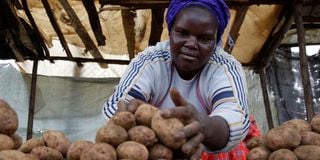
A majority of Kenyans can no longer afford meals made from potatoes—an alternative to ugali—due to a sharp rise in prices.
The cost of a kilogramme of potatoes has surged by 20.9 percent, marking the highest increase among food items in the consumer price basket used to measure inflation.
The Economic Survey 2025 shows a kilo of English potatoes rose to about Sh119 last year from Sh98 in 2023.
For many large households, a single kilo of potatoes is barely enough to feed everyone, making the price spike even more burdensome.
Potato growers and industry experts attribute the price surge to the skyrocketing cost of farm inputs, diseases that eat into production, and climate change.
In the markets, a spot check in Nairobi and its environs shows that a 20-kilo bucket is retailing between Sh900 to Sh1,000, an increase from Sh600. A 70-kilo bag is sold between Sh3,500 to Sh4,000, the farm gate price.
Martha Wambui, a Nairobi resident and a mother of three, says if she were to make a decent meal for her family, she would require about four kilos of potatoes.
Dr George Oluoch, a senior research officer, says the sharp increase in potato prices is mostly caused by climate change shocks.
Farmers, he notes, are incurring high expenses to control destructive pests and diseases affecting potatoes, hence impacting production.
“Farmers are spending a lot of money to control diseases such as bacterial wilt, which is very destructive to potatoes,” says Dr Oluoch.
Bacterial wilt in potatoes, caused by the bacterium scientifically known as Ralstonia solanacearum , is characterised by sudden wilting and death of plants, often without leaf yellowing.
According to Dr Oluoch, the bacteria primarily infect the roots through wounds and can cause significant yield losses.
The crop expert, who holds a PhD in molecular biology and biotechnology, explains that the bacteria multiply very fast within temperatures between 25 to 28°C.
“It gets through the roots and accumulates over time, and covers the xylem of the plant—where water passes. It prevents water and nutrients from moving up the plant, resulting in the crop wilting and ultimately drying,” he explains.
Kamunya Warukwaro, a potato farmer in Kieni West, Nyeri County, is among those grappling with a mix of stubborn crop diseases, rising production costs, and unpredictable weather that have eaten into his profits.
A farmer sprays his Irish potatoes with pesticide in Elburgon, Nakuru County, in November last year.
Photo credit: File | Nation Media Group
From his one-acre plot, Mr Warukwaro would typically harvest over 50 bags of potatoes. However, this season has been far from smooth. Buyers are hard to come by.
“In the local market here, we sell a small sack — about six buckets — at Sh3,000,” he says. “But when I take the same to Murang’a, it goes for around Sh4,500. That difference is what keeps us moving from one market to another to get buyers.”
Mr Warukwaro sells not just in Murang’a town but also travels to smaller trading centres like Kiriani, Gikoe, and Kangema. “Sometimes the market is good, sometimes not. You just have to keep moving around to get a buyer,” he adds.
Still, he says the challenges on the farm are becoming harder to manage.
“This season, the potatoes were hit by diseases that we didn’t even notice early enough,” he says. “By the time I realised, the leaves were already drying up — especially during the cold mornings. Aphids were also a big problem.”
Mr Warukwaro also blames the harsh weather conditions. “We came from a dry, sunny season, and many farmers lost a lot. That’s why potatoes are now expensive,” he says.
But weather is not his only concern. The cost and quality of inputs, particularly fertiliser, have also taken a toll.
“The fertiliser we got from the government was not good. It looked like it was mixed with 'other things'. It didn’t help the crop at all,” he says visibly frustrated. “And yet the price of fertiliser keeps going up.”
To get his produce a market, Mr Warukwaro works with brokers who help distribute his potatoes across Murang’a.
They help us reach more places, especially the small towns. Without them, it would be hard to sell all our harvest,” he says.
Potatoes are primarily grown in Nyandarua. Other counties contributing to the potato basket are Nakuru, Elgeyo Marakwet, Meru, Narok, Nyeri, Kiambu, and West Pokot.
Dangerous pesticides found in Nyandarua potatoes.
Photo credit: Isaiah Esipisu I Nation Media Group
The potato industry is still grappling with access to certified seeds, as most farmers largely depend on uncertified ones, prone to bacterial wilt, which is a soil-borne disease, transferred through potato seeds and related family crops.
Farmers primarily plant harvest remains, which are turned into seeds.
Paul Mwangi, a Nyandarua-based farmer, recalls how he nearly lost his two acres of potatoes.
“Bacterial wilt, alongside potato late blight fungus, is a very destructive disease. When the wilt attacks crops, we are forced to uproot the plants, which is not a guaranteed remedy,” he says.
He adds that he is currently preparing for the next planting season, but is worried that late blight, which thrives in cold weather, may affect his production.
Kenya recorded its first drop in potato production since 2022. Production fell by 100,000 tonnes last year, according to the Kenya National Bureau of Statistics 2024.
Farmers produced 2.2 million tonnes last year, compared to 2.3 million the previous year.
Dr Oluoch notes that bacterial wilt has been aggravated by climate change, hence affecting potato production, which has an impact on what lands on Kenyans' plates.
“Most farmers do not have access to certified seeds, which are expensive. They primarily rely on harvest remains, which, in case they are affected by the wilt, become agents of transfer,” says the expert, urging growers to go for certified seeds produced by certified growers.
The Kenya Agricultural and Livestock Research Organisation (Kalro), a state-owned agency, is one of the producers of certified potato seeds.
Currently, there is no bactericide to control the spread of bacterial wilt, with farmers being urged to go for certified seeds and adopt good agricultural practices such as crop rotation and biological methods.
Clean planting materials—the use of certified seeds and uprooting of affected plants, Dr Oluoch says, will help cushion farmers and increase production, which he noted will lower prices.