COP31 talks collapse without deal as clashes cloud talks
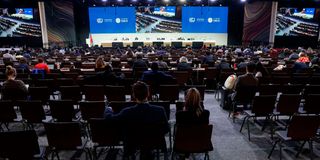
Delegates at the closing plenary at the UN Climate Change Conference (COP31) in Antalya, Turkey, November 22, 2026.


In Antalya, Türkiye
A lack of consensus brought the 31st United Nations climate summit in Antalya to a dramatic halt on Sunday after marathon overtime negotiations pushed the Conference of Parties (COP31) into the longest climate conference in history, leaving nearly 200 nations without an overarching agreement.
Scheduled to end on Friday, November 20, the summit dragged into Sunday afternoon in Antalya amid bitter disputes over fossil fuels, climate finance, and the just transition. Around 2 am local time on Sunday, the joint presidency of Türkiye and Australia circulated a third draft cover decision, the "Antalya Pact", after late-night procedural maneuvering.


The text retained a target to raise electricity’s share of global final energy consumption to 35 per cent by 2035 and introduced a collective ambition for carbon capture and storage (CCS) at gigatonne scale, while omitting explicit mention of transitioning away from fossil fuels and dropping a $120 billion target for adaptation finance.
Just before the text was made public, the COP presidency had attempted to hold a closing plenary, which started shortly after midnight early Sunday and closed a little past 2am, due to lack of consensus. Africa was among the dissenting voices.
"We cannot accept this text in its current form and do not approve it to proceed," Africa said.
"The European Union will not accept any further changes to the document as we have already compromised too much," the EU interjected.
The presidency then tried to get Africa to reconsider its position but the continent stood firm.
As talks spilled into overtime, frustration boiled over inside and outside the plenary halls. Activists staged silent protests outside the plenary and held signs reading "SHAME!" inside the hall, with at least one protester removed during closing proceedings, while ministers clashed over procedure and perceived disrespect. African delegates voiced anger at being sidelined during late-night huddles, and Ghana’s Environment Minister Zanetor Agyeman-Rawlings was interrupted while she was speaking, which upset the African Group further.
"Why are other allowed to speak without interruption? The African Group is disappointed at this disrespect that you have shown the minister of Ghana, and how you have treated us generally," Dr Antwi Amoah, the chairman of the African Group of Negotiators, said.
Call for adoption
When the final closing plenary convened after repeated delays, COP31 President Murat Kurum urged adoption.
“We have done our utmost; ultimately, we have not imposed this text on anyone, nor have we issued an ultimatum such as a ‘take it or leave it’ demand," he said.
Under UN consensus rules, a single objection blocks adoption, and at least six major blocs and countries formally spoke from the floor to reject the text: the European Union (speaking for 27 member states), Norway, the Marshall Islands, Panama, Vanuatu, and Belize. Delivering the EU’s rejection to applause, Ireland’s Environment Minister Darragh O’Brien said: “We will not endorse a decision that does not respond to the science, that disregards the implementation gap. We will not endorse a cover decision or an Antalya pact that does not even mention fossil fuels, which is the key driver of climate change.”
Outside the hall, O’Brien said the summit had been “hijacked by some oil states.” Marshall Islands climate envoy Kathy Jetnil-Kijiner added: “We will not compromise our future to benefit fossil fuel interests. We will not accept an outcome that undermines our security and threatens our future,” warning that accepting the text would betray frontline communities. Panama’s Environment Minister Juan Carlos Navarro accused a “petroleum mafia” of holding the talks hostage.
Conversely, major developing and fossil-fuel-producing blocs declined to block the text despite reservations.
Speaking on behalf of the African Group of Negotiators (AGN), Ghana, chaired by Nana Dr. Antwi Amoah, acknowledged major shortcomings on climate finance, loss and damage, and the just transition, noting the latter had been reduced to “a single generic sentence,” yet eventually said the group would not stand in the way of consensus because the text reflected views from a wide range of parties. Saudi Arabia (for the League of Arab States), China, India (for Like-Minded Developing Countries), Brazil, Pakistan, and the Philippines also declined to object.
Meanwhile, Kenya, which had drawn scrutiny earlier in the talks alongside Saudi Arabia and India over debates on the timeline of upcoming Intergovernmental Panel on Climate Change (IPCC) reports, maintained through its delegation that its position was rooted in ensuring scientific equity and capacity for Global South researchers rather than politics.
"Mr President (of COP31), we will not pretend that Antalya delivered for Africa. It leaves without agreement on what mattered most. Many issues that mattered to us were linked to the cover decision. Now we feel shortchanged. No agreement on the Mitigation Work Programme. No agreement on Green Environment Facility (GEF). No agreement on a just transition for workers and communities," Environment CS Debora Barasa said.
Seeing the floor objections, Kurum indicated the collapse.
“It is clear that there are parties in this hall who oppose this text. We recognise that there is no consensus on this document. Therefore, these decisions have not been adopted," he said.
UN Secretary-General António Guterres called the outcome a setback while insisting the scientific reality remains unchanged.
“There may be no consensus in the negotiating room, but there is no ambiguity in the science,” Guterres said in a statement. “Those who profit from the destruction of our planet must never dictate the terms of the fight to save it.”
African civil society delivered an even harsher verdict. Mohamed Adow, director of Nairobi-based think tank Power Shift Africa, branded COP31 a “ghost COP” and the worst ever.
“Rich nations and polluting governments cannot keep arriving empty-handed and expecting a carefully worded declaration to get them off the hook.” Adow accused the joint presidency of letting “their vanity project” stall mandated negotiations.
Ani Dasgupta, president and CEO of the World Resources Institute, framed the collapse as “a failure of political leadership, not a failure of the Paris Agreement,” adding: “At a time when the science could not be clearer, it is indefensible that countries could not agree on even mentioning fossil fuels, the primary driver of climate change.”
The no-deal outcome leaves unresolved mandates on fossil fuels, adaptation finance, and a just transition mechanism hanging over the UN process as the presidency passes to Ethiopia for COP32 in Addis Ababa in November 2027. As Adow warned, “It’s a crying shame that the mess left over by Türkiye and Australia is left to Africa to sort out. Hopefully, a COP held on the front line of the climate crisis will focus minds.”
Follow our WhatsApp channel for breaking news updates and more stories like this.