Premium
2.7 million displaced in 17 years: How climate change is redefining migration in Kenya
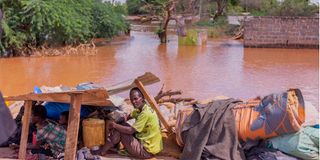
A man and his children, displaced by floods in Garissa County, take cover from the scorching sun in a makeshift shelter amidst the threat of the raging Tana River.
What you need to know:
- When the rain fails three years in a row, or a village is swallowed by rising floodwaters, the decision to stay becomes impossible.
From 2008 to 2024, more than 2.7 million people in Kenya were displaced by disasters, primarily droughts and floods. In 2023 alone, 641,000 were forced to flee, the highest annual figure since 2008. Experts warn these numbers could rise sharply by 2,100, underscoring how climate change is reshaping life for millions.
For northern Kenya’s pastoralists, seasonal movement has always been vital. Herders once relied on predictable rains to sustain livestock and livelihoods, but climate change has broken that contract. The 2020–2022 La Niña drought, Kenya’s worst in 70 years, decimated herds and livelihoods with no buffer. Then came El Niño-fuelled floods, triggering 335,000 displacements in 2020 and 336,000 in 2018. This punishing cycle of severe drought, then floods, then drought again is now the hallmark of Kenya’s climate reality. According to the Internal Displacement Monitoring Centre’s 2025 Kenya Disaster Displacement Risk Profile, of the 2.7 million displacements recorded over 17 years, floods caused 2.4 million and droughts 316,000, with storms, landslides and wildfires, accounting for the rest.
What’s changing isn’t just the frequency of these events but their aftermath. More people are not returning. Droughts destroy livestock, the primary asset and savings of pastoralist families. Floods destroy homes, roads, and rural infrastructure. When nothing remains to return to, displacement becomes relocation. And relocation, whether to a nearby town or a distant city, becomes an act of adaptation.
So, what exactly is climate migration?
It is the movement of people forced to leave because the environment can no longer sustain them. This is not the choice to seek better opportunities. The farmer whose harvests have failed three times in a row, or the family fleeing a coastal home swallowed by floodwaters, is not chasing something better. They are escaping something that has become impossible.
The United Nations recognises climate migration as a defining humanitarian challenge of this century. Most of Kenya’s displacement is internal—people moving between counties—though cross-border movement remains rarer in East Africa, for now. Displacement can be sudden, triggered overnight by a flood or landslide, or slow and nearly invisible, as families quietly decide that staying is no longer worth the risk.
The link between climate and human movement is not new. What is new is the speed, scale, and unpredictability with which climate change is severing people from the land they call home.
The Intergovernmental Panel on Climate Change predicts that East Africa will face more intense and frequent droughts and floods as temperatures rise. Warmer air holds more moisture, making rainfall heavier and more destructive. Prolonged heat accelerates evaporation, drying soils faster and deepening the impact of droughts on crops and pasture.
For subsistence farmers, pastoralists, and coastal fishing communities, these shifts erase the margins that once allowed them to survive a bad season and recover. When resilience runs out, movement begins.
But climate migration is not inevitable. Many people move because the systems around them failed first. Investing in community-level resilience can meaningfully reduce the pressure to leave.
Drought-tolerant, fast-maturing crops, promoted by the Kenya Agricultural and Livestock Research Organisation, give smallholder farmers a fighting chance during erratic seasons. Farmer-managed natural re generation, where communities protect and cultivate native trees, stabilises soil, retains moisture, and provides fodder during dry spells, quietly rebuilding the conditions for staying.
Water harvesting infrastructure such as sand dams, rainwater tanks, and rehabilitated water pans help communities bridge dry periods without immediate crisis. Small-scale, locally managed water storage transforms survival odds during drought.
Diversifying income is equally critical. Pastoralist families with access to small businesses, remittances, or off-farm income are far less vulnerable to total loss when livestock die. Savings groups, mobile money, and community insurance schemes for climate shocks already exist; they simply need to reach more people.
But community resilience alone cannot bear the weight of a structural climate crisis. The government has a central role.
Early warning systems are perhaps the most cost-effective intervention. Kenya's Meteorological Department can produce credible seasonal forecasts, but those forecasts must travel further and faster in languages and formats communities can act on.
Land use planning and enforcement must also be taken seriously. Much flood-related displacement occurs because people have built homes in high-risk zones, often with no alternative. County governments have planning tools to designate safer settlement areas, enforce riverbank setbacks, and invest in drainage infrastructure in flood-prone towns.


