In the floodplains of the Tana Delta in Tana River County, displacement has become a way of life.
Every rainy season in the country, families pack what remains of their belongings and move in search of higher grounds. For many residents of villages along the lower River Tana, this cycle has been repeated for decades, leaving behind a generation that has never known permanent settlement.
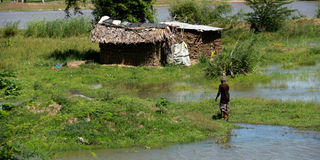
At Bularahma village in Galili, floodwaters have swallowed farms and left homesteads marooned after heavy rains upstream caused rising water levels in the river. The floods are also attributed to overflow from some of the Seven Forks dams upstream, which are along the Tana River cascade.
Nina Ali Kulo, a resident of Bularahma village, stands near what remains of her submerged farm, counting her losses.
A local peddles through a flooded homestead along the Garsen- Witu Road in Tana River County as floods wreak havoc to families in Parts of Tana Delta in this photo taken on May 14, 2026.
Photo credit: Kevin Odit | Nation Media Group
“The water flooded and destroyed our farm. We had planted vegetables, tomatoes and fruits, but everything was destroyed,” she says.
Around her, families are once again preparing to leave. This has become a cumbersome routine that constantly disrupts their lives.
Mr Said Zajardul says the community had settled in this village after they were displaced by floods in Gamba. Tens of homesteads have been affected in this area alone.
“People moved here from other places, and now they will have to move again. They have cut down trees to go build elsewhere. They have suffered for more than 12 years,” Mr Zajardul narrates.
A walk through the villages reveals families preparing to move to temporary shelters. Long branches tied together are strategically placed outside different houses to be used in anticipated construction elsewhere.
In nearby Lango la Simba village, Mr Joseph Masila rows his small boat across the floodwaters in search of construction materials. He says the economic burden of repeated displacement is crushing already struggling families.
“This situation affects us economically because wherever you move to, you have to start over again. And when you return, you find that the belongings you left behind have also been destroyed, so you have to start afresh,” he lamented.
The floods bring more than water. According to residents, crocodiles and snakes pose a danger, as well as water-borne and mosquito-borne diseases.
“A woman was recently nearly mauled by a crocodile. Many of my neighbours have already moved, and I am now preparing to relocate as well,” the father of seven added.
“Whenever the floods come in, schools cannot continue operating,” he says.
Further downstream, Mr Mohamed Golo is among hundreds who relocated from Bandi village in Gamba, only to be displaced yet again after pitching camp in Minjila when the rains flooded their temporary shelters on one side of the road.
About 400 people have relocated to the Minjila area for their safety, and they are now forced to crowd onto the other side of the road, which is not susceptible to flooding. Mr Golo says the county government permitted them to build houses there, but many are poor and rely on tents offered by the Kenya Red Cross Society.
“People here are poor, and rebuilding comes at a heavy cost. Since there is no income, you are forced to sell livestock to buy sand, timber and everything else needed for building,” he explained.
Mr Bobode Ali, one of the displaced persons, revealed the challenges that come with relying on tents for shelter.
“We have been displaced by rains every year for decades. These tents were given to us by the Red Cross, but now they are worn out. It is very hot, and parents and children all stay together in the same small space. There is no privacy,” said Mr Ali.
At the camps, they rely on well-wishers for food, clean water and other essential supplies such as mosquito nets and medication. This, to families that have always been self-reliant, is stripping them of dignity.
Flooded homesteads at Bularahma Village along the Garsen- Witu Road in Tana River County and other Parts of Tana Delta in this photo taken on May 14, 2026.
Photo credit: Kevin Odit | Nation Media Group
As the displacement of families continues, residents say what they need most is not another temporary shelter, but a permanent solution. Tana River, an area that bears the brunt of famine during drought and flooding during heavy rains upstream, has left residents questioning why dams cannot be constructed to trap the water instead of it flowing into the Indian Ocean.
The latest River Tana Flood Watch Update issued by the Kenya Meteorological Services Authority showed a high risk of flooding between May 12 and May 18 due to rising average water levels at Saka, Hola and Garsen.
Earlier, the Kenya Electricity Generating Company PLC (KenGen) confirmed that two of its five dams were above full capacity. Of the five, Masinga, the country’s largest reservoir, reached 1,057.43 metres above sea level (masl), beyond its 1,056.5 masl capacity.
Water levels at Kiambere Dam rose to 700.91 masl, beyond the normal full supply level of 700 masl. Levels at Kamburu, Gitaru and Kindaruma remained within range.
In a statement, KenGen CEO Peter Njenga said water from Masinga was being discharged to the lower dams under tightly managed protocols, while Kiambere was also being actively managed.
“Authorities, however, urged caution for communities living downstream, particularly along the Tana River. Residents in low-lying and flood-prone areas have been advised to avoid riverbanks and remain attentive to guidance from local officials as rainfall persist,” the statement added.
Plans to expand the capacity of Masinga Dam have been underway for years. According to the latest 2025 Environmental and Social Impact Assessment prepared for KenGen, the proposed Sh428.3 million project seeks to raise the dam wall by 1.5 metres.
The plan is intended to increase water storage and improve both electricity generation and flood regulation downstream.
The Tana River County Government confirmed that Bangale and Tana Delta sub-counties are the most affected by the ongoing floods. The county’s Special Programmes department is leading an assessment of the situation in partnership with other agencies, while residents are being advised to move to higher ground for their safety.
“We are advising everyone in the high-risk areas to move to the IDP camps. This is just temporary. We are going to look for partners to assist them,” Governor Dhadho Godhana told journalists.
He reiterated that the county government has an ongoing plan to permanently relocate residents living in high-risk areas to identified village clusters. The cluster project, one of Mr Godhana’s flagship initiatives, seeks to establish modern villages by relocating residents to 15 areas mapped out across the county for development into eco-villages.