Premium
Africa's vast solar potential held by a $23 Billion annual funding gap
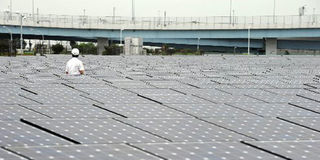
A man walks through a solar power plant. Overall energy investment in Africa today is about one-third lower than it was 10 years ago.

What you need to know:
- A total of 730 million people worldwide live without access to electricity, and 80 per cent of them, over 580 million people, reside in sub-Saharan Africa.
A stark disconnect between Africa's boundless clean energy potential and a crippling financial shortfall is locking the continent out of its sustainable future, according to the International Energy Agency's (IEA) latest World Energy Outlook.
While the global energy system is undergoing an irreversible shift towards renewables, the IEA’s 2025 report paints a worrying picture for Africa, revealing that the continent's progress is stagnating due to a devastating lack of investment, even as it stands to be one of the regions most affected by the slow progress on global climate goals.


The IEA states that the world has entered the ‘Age of Electricity’, where power is the central nervous system of modern economies. A digital and industrial revolution is driving this shift. Bruce Douglas, CEO of the Global Renewables Alliance, agrees, stating: “We will build more renewables between now and 2030 than in the last 40 years combined. Nearly all new electricity demand, driven by manufacturing growth, AI, cooling needs, and the shift to electric cars, will be supplied by renewable energy.”
However, this new age brings new risks. The IEA warns that energy security is no longer just about oil and gas, but also about vulnerable supply chains for critical minerals and the resilience of power grids. For Africa, these global shifts present a profound paradox. The continent possesses a staggering 40 per cent of the world's solar resources but has managed to install only one per cent of global solar PV capacity. This untapped potential exists alongside the world's most severe energy access crisis.
The twin crises: Darkness and smoke
The IEA report delivers a sobering assessment of Africa's energy poverty. A total of 730 million people worldwide live without access to electricity, and 80 per cent of them, over 580 million people, reside in sub-Saharan Africa. Thuli Makama, Africa Director at Oil Change International, emphasised the urgency, stating: "True energy security means bold, aggressive and progressive investment in modern grids and storage to deliver clean, reliable power to the more than 600 million people still without access to electricity."
The situation is even more dire for clean cooking. Nearly two billion people worldwide rely on polluting fuels, a problem concentrated in Africa, where the number of people without access continues to rise. "Progress in sub-Saharan Africa is stagnating and household electricity consumption per person with access is falling," the IEA notes, indicating that even those with a connection often lack sufficient, reliable power.
A clear roadmap, a daunting price tag
The IEA has introduced a new scenario, the Accelerating Clean Cooking and Electricity Services Scenario, which provides a country-by-country roadmap to solve this crisis. The targets are clear: achieve universal access to electricity by 2035 and universal access to clean cooking by 2040.
To bring electricity to all Africans within a decade, the continent would need to connect an average of 80 million people each year. This would require a massive, parallel rollout of grid extensions, mini-grids, and solar-powered stand-alone systems.
The price tag for this monumental effort is USD 23 billion per year until 2035. This represents a sevenfold increase from current financing commitments, underscoring the scale of the investment gap. For clean cooking, the IEA estimates an additional USD 4 billion is needed annually.
Investment is fleeing when it's needed most
The core of the problem, the IEA finds, is a prohibitive cost of capital. The IEA's Cost of Capital Observatory analysis reveals that the cost of financing power generation projects in emerging markets, such as those in Africa, is over twice as high as in advanced economies. This scares away private investment.
Experts warn that the nature of the investment is as essential as the amount. Fadhel Kaboub, president of the Global Institute for Sustainable Prosperity, argued that "Africa cannot transition by importing clean technology while exporting its minerals in an unprocessed state; that would merely repeat colonial dependency under a green label." Echoing this, Dean Bhebhe, a just transition expert, stated that the continent must avoid locking into new dependencies, asserting that: "The real transition is not just technological, it is political. It's time to stop chasing inclusion in broken systems."
Consequently, overall energy investment in Africa today is about one-third lower than it was 10 years ago. This decline comes precisely when the rest of the world is surging ahead. Laurence Tubiana, CEO of the European Climate Foundation, highlighted the global momentum, noting: "More than $10 trillion has been invested in clean energy since 2014, and oil demand is on track to peak before 2030 in the IEA's main scenario. The electricity age is well underway."
The global context, as defined by the IEA's scenarios, has direct implications for Africa. In the Stated Policies Scenario, which models current policy plans, global oil demand is set to peak around 2030. Olivier Kursk, a policy advisor at IISD, reinforces this, stating: "(Fossil fuel) demand is still set to peak by 2030 under business as usual, despite drastic shifts in US policy. Renewables and electric vehicles are outperforming expectations, driven primarily by economic and market forces."
For African nations that are oil and gas producers, the cleaner energy pathway presents a severe fiscal threat. The IEA warns that in a rapid transition scenario, revenues from fossil fuel exports for these countries could decline by over 60 per cent by 2035, necessitating urgent economic diversification.
Meanwhile, the IEA confirms that the world is not on track to meet its climate goals. The window for limiting warming to 1.5 degrees Celsius with minimal overshoot has closed.
Mohamed Adow, Director of Power Shift Africa, however, offered a note of hope, saying: "For Africa, this is a huge opportunity. We have an abundance of wind and solar potential that can power our development, but this report also shows that keeping global heating rise to 1.5 degrees
Celsius is still possible with the right investments."