Choking in filth: Hazardous chemicals, medical waste and rotting food now define daily life in Mukuru kwa Njenga
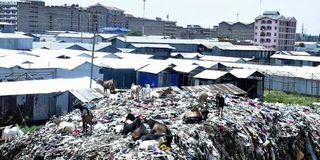
A heap of garbage piled up in-between homes uncollected for a long time at Zone 48 in Mukuru kwa Njenga located in Embakasi South Constituency on January 8, 2026.

In Mukuru Kwa Njenga's Zone 48A in Nairobi County, a mountain of rotting waste sits wedged between homes, churches and a large primary school. The smell is thick, sour and unrelenting, seeping into classrooms, living rooms and places of worship.
What was meant to be a temporary rubbish collection point has, over the past three years, grown into one of Nairobi's most dangerous illegal dumping sites - a place where toxic waste, criminal control and official neglect converge.
“This church has been here since 2016, but the dumping started around 2023,” said a local who attends the church next to the waste heap. He asked not to be named, fearing reprisals. We will call him Omolo.


“There's a cartel running this place. Even mentioning them is dangerous. If my name appears anywhere, there will be consequences,” he said, looking over his shoulders, as he spoke.
Residents and community organisers describe the dumpsite as a well-run business. Every handcart that offloads waste pays Sh200 to a youth leader. Locals believe the money is shared among the members of the gang controlling the site and county officials responsible for environmental enforcement.
On a typical day, residents say at least 50 carts dump waste here. Some rubbish is collected on Mondays, Wednesdays and Fridays, but far more arrives than ever leaves.
Residents say they have repeatedly reported the dumping to environmental offices, but nothing has changed. Some complainants have been threatened.
“Even the church cannot speak openly. If we do, the building could be demolished or our equipment stolen,” a churchgoer said.
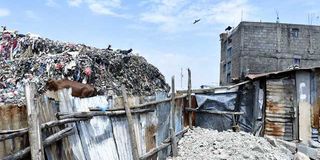
A heap of garbage piled up in-between homes at Zone 48 in Mukuru kwa Njenga located in Embakasi South Constituency on January 8, 2026.
The damage is visible everywhere. The church's blue-painted wall is streaked yellow and brown, stained by years of exposure to foul-smelling sludge. Four iron-sheet rental houses that once helped support church activities were abandoned after rubbish repeatedly spilled onto their roofs. Behind the dumpsite, many other homes have collapsed under the growing weight of waste.
About 70 metres away sits the Glorious Group of Schools, with a population of more than 500 pupils. The stretch leading to the school is lined with illicit brew dens and food kiosks operating amid filth.
Kenyan law prohibits the sale of alcohol near learning institutions. In Zone 48A, that prohibition exists only on paper.
The most disturbing scenes unfold when carts carrying food waste from nearby markets arrive.
"Children follow the carts. They know there will be fruits, especially mangoes," a resident said.
As soon as waste is dumped, children scramble onto the pile, digging through rotting refuse and eating spoiled food. Parents later rush them to chemists and small clinics, dealing with repeated cases of diarrhoea, skin infections and, at times, cholera.
But the waste here is not just food. The dumpsite contains pharmaceutical waste, detergents, cleaning chemicals, motor oil, electronic waste and old batteries containing lead and mercury. A thick, toxic liquid constantly oozes from the heap, pooling where children play and often fall.
A 2025 study published in the European Journal of Development Studies found that 80 per cent of Nairobi households discard batteries and electronic waste, 69 per cent dispose of unused drugs, and 41 per cent discard used needles and syringes.
For Mukuru residents, these statistics are piled up outside their doors.
Alex Mangwiro, Regional Coordinator for Chemicals, Waste and Air Quality at UNEP and Programme Management Officer at the Bamako Convention Secretariat, illegal dumpsites like the one in Mukuru Kwa Njenga pose serious environmental and public health risks.
“Waste management in Nairobi’s informal settlements remains a major challenge. Illegal dumping sites often mix household waste with hazardous components such as e-waste, batteries and medical waste,” he said.
When such waste is burned or left to decompose in open spaces, he explains, communities are exposed through contaminated soil, polluted water and toxic air.
“These exposures are particularly dangerous for children,” Mr Mangwiro added.
Where hazardous waste is involved, Kenya’s obligations under the Basel Convention also come into play, especially regarding the handling, movement and disposal of toxic materials.
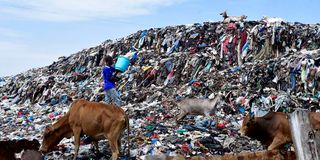
A young man dumps garbage onto a heap at Zone 48 in Mukuru kwa Njenga located in Embakasi South Constituency on January 8, 2026.
Mangwiro said UNEP supports Kenya through policy advice, technical assistance and capacity-building to improve solid and hazardous waste management, promote circular economy approaches and reduce community exposure - but stresses that UNEP does not enforce the law.
“Our role is technical and coordinating. Implementation and enforcement rest with national and county authorities,” he said.
At the Glorious Group of Schools, teachers say the dumpsite has profoundly affected learning.
"Some students skip lessons and hide at the dumpsite. They know once waste is dumped, they can salvage metal and sell it by the kilo,"Dismas Okhato, a teacher at the school, said.
The smell alone makes concentration impossible.
"Students complain of stomach aches and breathing problems. When they go to hospital, the diagnoses are almost the same - stomach complications or early asthma," he said.
During a cholera outbreak in 2025, many pupils were affected. “They should be in school, but the dumpsite is now their informal school,” he said.
When this reporter visited the site, Celina Mumbi, a Nairobi County employee overseeing slow clearing works, sat on a large rock overlooking the waste heap. She acknowledged the site should be fully cleared and filled with rocks for safer use.
“The challenge is resources and equipment. The contractor does not have enough machinery,” she said.
As dumping continues daily, whatever is removed is quickly replaced.
A 2023 BMJ Global Health study dubbed Asthma symptoms, spirometry and air pollution exposure in schoolchildren in an informal settlement and an affluent area of Nairobi, Kenya, that compared children's health in Mukuru and the more affluent Buruburu found significantly higher rates of wheezing and breathing difficulties among Mukuru children.
Pollution sources included waste burning, dust, fumes and exposure to refuse — all common around illegal dumpsites. The study also highlighted environmental injustice, underdiagnosis of asthma and limited access to healthcare in informal settlements.
Embakasi South Sub-County Environment Officer, Toroitich Micah, admitted the site was not meant to become a dumpsite.
“It was supposed to be a temporary holding point. Waste would be dropped and immediately taken to Dandora landfill,” he said.
But contractors stopped work due to non-payment. "From next week, we will add another excavator and more lorries," he said, while acknowledging the health risks
However, Nairobi’s waste crisis has been decades in the making. Dandora landfill filled up in 2014, yet it continues to receive hundreds of truckloads daily. Efforts to find alternatives have stalled, pushing waste into informal settlements.
Mr Micah denied allegations of collusion between county officials and dumping cartels.
"No one wants that site to remain as it is. Nairobi County is committed to getting this place cleared," he said.
Yet, in Mukuru Kwa Njenga, and many other informal settlements, hazardous waste continues to be dumped in the open.
Eric Ambuche, founder of the Slums Outreach Programme in Mukuru, said senior officials visited the site in 2025 and promised swift action.
"Nothing changed," he said.
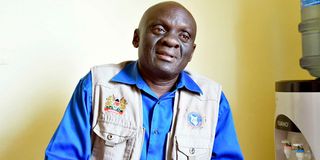
Mr Eric Ambuche, founder of Slums Outreach Programme, gestures during the interview on January 8, 2026.
The Slums Outreach Programme boss believes the lack of official dumping sites in areas such as Kware, Pipeline and Mukuru has allowed illegal holding points to mushroom.
In June 2025, Kenya submitted its instruments of ratification of the Bamako Convention, which aims to stop illegal dumping of hazardous waste. This Convention seeks to protect Africa by banning hazardous waste imports and strengthening controls on hazardous waste management.
On January 7, 2026, regional policymakers met in Nairobi to discuss strengthening hazardous waste reporting and it was in this forum that Somalia announced its plans to ratify the Convention.
For residents of Zone 48A, such meetings feel far removed from daily reality.
"What is written on paper is not what we live with," one resident said.
Meanwhile, in Mukuru Kwa Njenga, the community continues to suffocate under rubbish, fear and broken promises.
Follow our WhatsApp channel for breaking news updates and more stories like this.


