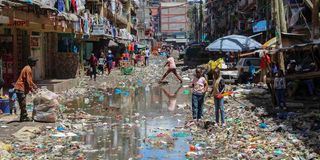
When the long rains arrived in March last year, they brought more than relief to parched ground. In Nairobi, Kisumu, Migori and Kwale, they brought cholera. In highland and coastal areas that had never been malaria zones, they brought mosquitoes. And in the north, where the rains barely came at all, the dry heat was doing its own damage, quietly fuelling an outbreak of a disease most Kenyans have never heard of.
Kenya is living through what scientists have long warned about: climate change is not just an environmental problem. It is a health crisis.
The evidence is in the Kenya Meteorological Department's State of the Climate report for 2025, which lays out, county by county and disease by disease, what an unstable climate is doing to people's bodies.
In late February 2025, the Ministry of Health officially declared cholera outbreaks in several counties. By May 22, 256 suspected cases and 13 deaths had been recorded, a case fatality rate of 5.2 per cent, well above the threshold that indicates people are getting treatment in time. That number matters: it means people were dying who might have lived if they had reached a health facility sooner.
Cholera follows flooding almost like clockwork. When drains overflow and pit latrines are submerged, clean water and contaminated water become the same water. The World Health Organisation stepped in to support case finding and contact tracing, but the outbreak had already taken hold.
Warmer temperatures are doing something that would have seemed unlikely a generation ago, expanding the range of malaria. The Met report is direct about it: "Warmer temperatures and erratic rainfall extend malaria and arboviral transmission seasons into previously marginal zones, raising epidemic risk in highland, coastal and transitional regions."
Areas that were once too cool or too dry for mosquitoes to thrive are now seeing transmission in seasons that never existed before. Stagnant water left behind after heavy rains makes it worse, creating breeding grounds not just for malaria-carrying mosquitoes but also for the vectors behind Rift Valley fever and other arboviruses.
While flood-hit counties were managing cholera, Marsabit and Wajir were dealing with Visceral Leishmaniasis, kala-azar, a parasitic disease spread by sandflies that thrives in prolonged heat and dry conditions.
By late March, Marsabit had recorded 267 suspected cases, 105 confirmed and four deaths. Wajir's figures were far worse: 1,280 confirmed cases and 41 deaths by July. The report notes that adult men bore the brunt of the disease, a pattern it attributes to "occupational and mobility patterns in pastoralist communities." Remote health facilities, already stretched thin, were overwhelmed. The report describes outbreaks that "strained the already limited diagnostic and treatment capacity in remote health facilities."
Drought in Kenya's arid and semi-arid lands was cutting crop yields and destroying pasture. The report says the dual pressures of flood-driven outbreaks and drought-induced vulnerabilities "strained public health systems with remote health facilities facing access barriers, supply chain disruptions and surges in demand for outbreak response and clinical care, often with limited surge capacity."
Acute malnutrition, particularly among children and pregnant women, does not just leave people hungry. It weakens immunity and makes every other disease harder to fight and harder to recover from. Livestock suffered too. Foot and mouth disease and lumpy skin disease, both linked to climate stress, were reported across the country, threatening the livelihoods of communities that depend entirely on their animals.
The Met Department's report calls for disease surveillance systems that connect climate forecasts with health data so that when forecasters see floods coming, health workers can be pre-positioned. It also calls for stronger water and sanitation infrastructure in vulnerable communities, expanded prevention campaigns in newly at-risk areas, and nutrition interventions in drought-affected regions.
In Homa Bay, some communities are not waiting. County Forest Conservator Sharon Cheluget says a 2022 survey showed the region has tree cover of 10.8 per cent and forest cover of 3.4 per cent, an improvement on previous years. "I believe there will be improvements in the next survey because of the interventions put in place to protect trees and the environment," she says.
At Wire Forest in Rachuonyo South, the Wire Forest Association has turned to beekeeping as both an income source and a conservation tool. The bees produce honey for sale while deterring people from entering and cutting trees. Association chairperson Christopher Osunga says families living on forest edges need to see conservation as a livelihood. "We need to embrace climate smart agriculture as a means of sustaining food security," he says. He also advocates for energy-saving stoves to reduce dependence on charcoal and firewood.
Nunu Masoud, who leads the Plant Trees for a Better Environment CBO, makes the case for fruit trees specifically, arguing they serve double duty as a food source and a conservation mechanism.