Don't leave us behind, children tell COP31 delegates
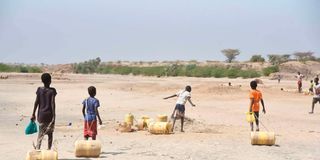
School-going children fetch water from a well dug in a seasonal riverbed, where the water table has receded deeper, at Kerio in Turkana Central Sub-County, Turkana County, on February 12, 2026.

What you need to know:
- With more than 100,000 delegates expected at COP 31, calls for the meaningful involvement of children and young people in climate diplomacy continue to grow.
IN ANTALYA, TURKIYE
Alana Chelangat navigates her way through the thousands of delegates attending the Conference of the Parties (COP31) in Antalya, Turkey, with remarkable ease and poise.
After all, she has been attending climate conferences since she was 10. She is now 14.
“I am here to meet new people from all parts of the world, engage in some sessions and learn new stuff that I can share with my peers. I am also seeking funding for my new project, Dunia alerts, an early warning system targeting schools,” she shares. “It can tell them when it’s going to rain, the air quality and if they need to prepare for high temperatures.”

Also watch: Youth in climate action
Her mother, Chemutai Ruto, says she noticed Alana's interest in conservation when she was barely 10 years old and decided to support her, despite arguments that climate activism is no place for children.
Since then, Alana has planted thousands of trees, authored books for young readers and started a podcast, Climate Gumzo with Alana.
With more than 100,000 delegates expected at COP 31, calls for the meaningful involvement of children and young people in climate diplomacy continue to grow.
Dr Antwi Amoah, chairperson of the African Group of Negotiators (AGN), said the youth agenda was part of the broader national negotiations.
“We need to make sure that we have a group of leaders within the continent that can be able to continue with the negotiations because our negotiators are getting old and will leave the space very soon.”
Also watch: Kenyan teens at COP 31
It is against this backdrop that Shirley Akinyi, 16, a climate activist, environmentalist, climate advisor and Miss Green Kisumu County ambassador, has also travelled for COP31.
“Being a climate advisor allows me to learn more about children's rights and why we should be in such spaces and being miss Green I make sure i create awareness and educate people from Kisumu County on matters of environmental conservation, plastic pollution and tree planting,” she says.
“ I have planted more than 1,000 trees in Kisumu County and I think that’s why the governor nominated me as the ambassador. It all started at eight years old when I was involved in fashion and modelling and we were doing recycling projects. I learned a lot on recycling and conservation.
At COP31, Shirley wants delegates to listen more closely to children and take their concerns seriously.
“I think the biggest space I've been to is COP 31 and I've been here for the past three days and I've already found a number of opportunities to speak about children's rights. I don't think people listen to us enough because recently I had an encounter with someone who told me we should be studying but right now we should be here talking about our rights because it's our future we are fighting for and we don't have another planet, we only have one planet and if we destroy this planet we have no other planet to go,” she says.
Shirley's call comes at a time when Kenya has joined 79 other countries in committing to put children and young people at the centre of climate change policies, decisions and investments.
Environment Cabinet Secretary Deborah Barasa signed the Intergovernmental Declaration on Children, Youth and Climate Action on behalf of the Kenyan government, in the presence of Unicef Representative to Kenya Shaheen Nilofer.
The commitment comes against the backdrop of growing climate vulnerabilities among children in Kenya. About 12 million of the country's 24.6 million children face moderate to very high risks from climate change and disasters.
Of these, 2.4 million live in seven counties classified as facing high climate vulnerability.
Floods and droughts expose children to multiple risks, including disrupted schooling, inadequate access to safe water and sanitation, poor nutrition, limited healthcare and threats to their protection. Girls and children with disabilities are particularly vulnerable, with the effects of climate-related disruptions potentially following them into adulthood.
Nilofer said Kenya's decision to sign the declaration was an important step towards ensuring that children's rights and concerns are considered in climate decisions. “Children bear the brunt of climate change through disrupted education, threats to their health and nutrition, displacement, and reduced access to safe water and other child-critical services. Kenya’s signing of this Declaration affirms that children’s rights, needs and voices must be central to climate policy, finance and action. In partnership with the Government, we will work to ensure
that children and young people, especially those facing the greatest
climate risks, has a chance to shape a climate-resilient future.”
Launched in 2019 at COP25, the declaration calls on governments to factor children's rights and vulnerabilities into national climate policies, plans and investments.
Countries that sign it also commit to giving children and young people opportunities to participate meaningfully in climate decision-making.
In Kenya, the government says it will implement the commitments through existing national climate policies and plans, with a focus on strengthening essential services against climate risks and directing resources towards vulnerable populations.
Progress will be assessed using child-focused climate risk evidence and indicators covering the resilience of essential services, climate financing directed towards these services and the participation of young people in climate policy processes.
CS Barasa said the government was committed to turning its climate policies into practical interventions that would protect children and other vulnerable communities. “Kenya is committed to ensuring that climate action delivers a
better, safer and more equitable future for all, particularly children and young people who will inherit the consequences of today's decisions. Guided by our National Climate Change Action Plan, Nationally Determined Contributions and Gender and Climate Change commitments, we are determined to translate policy into meaningful action by investing in climate-resilient essential services, mobilising accessible and inclusive climate finance, and strengthening the resilience of vulnerable communities. We recognise children and young people not merely as beneficiaries, but as active partners in shaping climate solutions and building a just, inclusive and climate-resilient future for all. Our commitment
is to leave no one behind.”