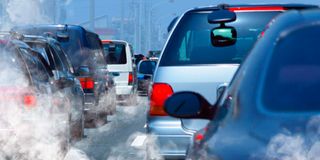
Every morning, Mombasa residents, like many across the country, brace themselves for the choking fumes that spew from aging exhaust pipes. Clouds of smoke and dust hang over the streets, the air thick with the scent of burnt fuel. For many, a single misstep behind a matatu or tuktuk can set off a cough that lasts the rest of the day.
Many wish that, just like in the movies or in fast-developing countries, vehicles would pass by without leaving behind a trail of smoke, or if they did, it would be the kind that doesn't sting the eyes or choke the lungs.
This struggle is not unique. Globally, almost 99 percent of the population breathes air that exceeds World Health Organization (WHO) guideline limits and contains high levels of pollutants (WHO, 2023).
In Kenya, the crisis is escalating: about 19,000 people die each year due to air pollution, and the United National Environment Programme (Unep) estimates Nairobi's pollution levels at 70 percent. Furthermore, respiratory disease cases jumped 21.9 percent between 2020 and 2021, according to the Economic Survey 2022.
Kenya’s legal framework requires adherence to the Environmental Management and Co-ordination Act (EMCA) of 1999, which grants the National Environment Management Authority (Nema) the power to set and enforce air quality standards. Nema guidelines require testing for pollutants such as carbon monoxide and particulate matter (PM2.5 and PM10), yet enforcement at the county level remains inconsistent.
It is this everyday struggle that Frederick Rariewa, the founder and chief executive officer of Blue Skies, hopes to change. With homes in both the United States and Kenya, he has seen firsthand how cleaner air is possible when strong policies and technology meet public will.
Earlier this year, he led a delegation of environmental officials from Mombasa County to the United States for a benchmarking visit to study how cities manage urban greenhouse gas emissions.
He said the team returned with a blueprint that inspired a mission to one day make the air around Changamwe roundabout feel as fresh as that of a quiet village deep in Kakamega, where only one vehicle passes and its fumes disappear into the trees.
“We had to go on the tour, and we witnessed how the states of Maryland and Virginia in the US had implemented strict emission standards,” Mr Rariewa said. “We were intrigued by how the Environmental Protection Agency (EPA) had set clear regulations, and how every driver ensured their vehicle was inspected for emissions and faulty parts that cause harmful fumes. Their statistics showed that they had reduced greenhouse gases by a significant margin.”
The idea, inspired by what was observed in the United States, was pushed locally through the Mombasa County Investment Corporation to pioneer the Blue Skies programme, which seeks to provide convenient access to affordable vehicle emission testing while reducing greenhouse gas emissions.
A trailer emits smoke on Mombasa Road. In Kenya, about 19,000 people die each year due to air pollution.
Photo credit: File | Nation
Transport accounts for about 50 percent of greenhouse gas emissions in Mombasa. The plan involves partnering with certified inspectors who will test fleets across Mombasa and issue stickers indicating whether vehicles meet acceptable emission standards.
“We will have a cleaner city once we agree to carry out regular inspections and fix our vehicles. The tests, which are computerised, show the amount of emissions from each vehicle and advise on what needs to be done to correct it. Once that is identified, the owner is given a month to fix the problem that is contributing to the high emissions," said Mr Rariewa.
A key component of the initiative is the installation of catalytic converters in vehicles to ensure cleaner emissions. “This filter works much like the one used in a cigarette,” he said, explaining that once installed, it ensures that what comes out of the vehicle is far less harmful to the environment. The filters will be supplied by AP Emissions, which has supplied more than 20 million catalytic converters in North America, while the inspections will be carried out by Opus Inspection.
The Governor of Mombasa, Abdulswamad Nassir, who attended the launch of the initiative, said his administration is committed to ensuring the project succeeds in making the county a model green city with lower emissions.
“God is good; He gave us clean air, and we went ahead and messed it up. We are keen on tackling pollution both on land and at sea, and whatever the county can do to make this a success, we are on board,” said the governor.
However, despite the proposal promising a cleaner city, partners and stakeholders warn that without strong policy support, it may remain an ideal that can only be achieved by a few.
Bayusuf Guyo, of Bayusuf and Sons Transporters, argued that while the idea is workable, the cause of pollution must be looked at holistically. “We have drivers using cheap oil instead of the required synthetic oils. The worst are those who buy adulterated fuels, which leads to even higher emissions,” he said. “Even as we install these filters, we need to discourage this behaviour.”
Mr Innocent Mbonigaba, Programmes Manager at the Rwanda Emission Inspection Program, explained that their company, which operates four stations in Rwanda and began operations in August, has tested over 10,000 vehicles. This has been possible as the Rwandan government pushed for the initiative, a suggestion he puts forward as a model to spur similar efforts in Mombasa.
“These inspections cost money, and some people may question the need for emission testing. In Rwanda, the government has mandated such testing. But as service providers, we have to educate the public on why they should embrace the inspections and the benefits they bring to the environment and climate change as a whole,” he said.
Emmanuel Nzai, CEO of Jumuiya ya Kaunti za Pwani, said the initiative would place Mombasa and other coastal counties at the forefront in the fight against carbon emissions and put Kenya on the map in terms of sustainability.
“With this the quality of life for our people will be enhanced and it will also position Mombasa as a green economy. The initiative is already promising and Nairobi is already asking if the piloting can be done with them as well,” said Mr Nzai.
Ms Bawazir Sahale, Managing Director of Mombasa County Investment Corporation, stated that efforts to reduce vehicle emissions and implement catalytic converters would help the county to significantly reduce carbon emissions, create jobs, and boost the economy.
“By actively reducing carbon footprints as a county, we will have the opportunity to breathe fresh air while also being able to sell carbon credits from the project, which would directly benefit our economy,” she said.
As the piloting is set to begin, the initiative’s founders say the idea may give Coast residents the cleaner air they crave, while setting a standard for tackling air pollution, which is blamed for many respiratory diseases.