Since 2019, Kenya has seen a quiet but significant shift in wildlife trafficking—from iconic animals to some of the smallest, most overlooked creatures.
Over the last two years, a new trend has emerged. Wildlife trafficking is no longer just about elephant tusks or rhino horns. Ants have now crept onto the list.
Authorities report a steady rise in the illegal trade of live insects moving through airports and courier systems, with Nairobi, Gilgil, and Naivasha emerging as key hotspots.
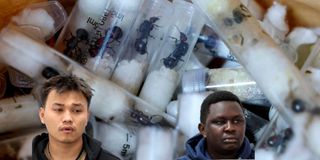
In 2023, three Kenyans were charged with attempting to export ants worth over Sh300,000. In April 2025, more than 5,000 live queen ants were discovered hidden in test tubes in what investigators described as a landmark bust.
By 2026, Kenya’s ant crisis shows no signs of slowing. In March, a Chinese national and a Kenyan associate were caught trying to smuggle more than 2,000 live queen garden ants out of the country.
Ant trafficking crisis in Kenya
The ecological significance of these insects is immense. At Nairobi National Park, entomologist Dr Dino Martins, during a recent interview with Climate Action, showcased a giant harvester ant colony more than 70 years old, which he has studied for over four decades.
What appeared to be an ordinary mound of soil concealed a complex, thriving ecosystem. Lines of ants moved with precision, carrying seeds, clearing pathways, and reinforcing their nest—demonstrating the critical role they play in maintaining environmental balance.
“2,000 years ago, King Solomon in Jerusalem was observing the same ants we are observing right now,” Dr Martins said.
“They are spread all the way from the Mediterranean, but are especially abundant in East Africa, particularly in Kenya, where they are one of our most important species.”
These ants are ancient, resilient, and deeply woven into ecosystems that humans depend on.
They farm, build, and defend. Worker ants carry stones to shield their nests from predators like pangolins, while others organise and store food. Larger ants crack seeds, ensuring the colony survives.
“It has existed for over 70 years,” he says. “Older than you and I, even older than Kenya.”
Harvester ants are what scientists call a keystone species, organisms so vital that their removal would trigger widespread ecological collapse.
“They are seed dispersers,” explains Dr Martins. “They keep ecosystems healthy and dynamic. Whether it is cattle or wildlife, we should say ‘asante’ to the ant.”
Samples of garden ants concealed in syringes are presented to court as two Belgian nationals, a Vietnamese and a Kenyan national appeared for the hearing of their case, after they pleaded guilty to illegal possession and trafficking of garden ants, at the Jomo Kenyatta International Airport Law Courts, in Nairobi, Kenya, April 15, 2025.
Photo credit: Monicah Mwangi | Reuters
They enrich soils, support vegetation, and sustain both livestock and wildlife.
Yet despite their importance, they remain largely invisible.
“Hawa siafu ni muhimu sana kwa maisha yetu sisi kama Wakenya,” he says. “Tunasherehekea wanyama wakubwa kama ndovu… lakini bila siafu, hatutakuwa na mazingira kama haya.”
“It was a huge surprise,” Dr Martins admits. “We knew people kept ants, but now they are becoming part of trafficking in a major way.”
The demand comes largely from international collectors. A single queen ant can fetch up to $300 abroad, while locally it may cost as little as Sh100.
“The people buying these ants are not using them for medicine,” he says. “They keep them as pets, investing in them and observing them.”
Harvester ants, known for storing seeds in their granaries, have become popular among exotic pet collectors in Asia and Europe due to their ability to build complex colonies. With over 10,000 species worldwide, enthusiasts often seek out different types, keeping them in terrarium-style habitats called formicariums.
These soil-filled, transparent structures mimic the intricate tunnels of anthills, allowing observers to watch the ants thrive in their artificial homes.
To him, it reflects a deeper issue: a growing disconnect from nature. What appears small carries enormous consequences. A single queen is the foundation of an entire colony.
“Millions of ants here are daughters of one queen,” Dr Martins explains.
“If someone collects 2,000 queens, that is robbing this ecosystem of a huge and critical part of how it functions.”
Without queens, future colonies cannot form. Grasslands weaken. Ecosystems destabilise.
“These spaces would not survive,” he warns.
Under the Wildlife Conservation and Management Act of 2013, insects are classified as wildlife, protected just like elephants and lions.
“All biodiversity is protected, and exporting it without a licence is illegal,” says Lekishon Kenana, Deputy Director and Conservation Scientist at the Kenya Wildlife Service (KWS).
Traffickers are becoming more sophisticated, hiding ants in specially designed tubes that keep them alive for weeks while avoiding detection.
“When you take so many queens, you are robbing us as Kenyans,” says Kenana. “You are taking away from the ecosystem that supports us.”
On one of the websites -- antderground.com - a queen ant of the garden ant species is sold at a discounted price of 180 Euros (about Sh26, 500).
Photo credit: Pool
The practice also violates international frameworks like the Nagoya Protocol, which governs access to genetic resources.
“People do not know about ants,” he adds. “Yet ecologically, they are vital. If you lose them, productivity goes down.”
“If you see them disappearing, something is wrong in the environment,” Kenana warns.
Despite the crucial role ants play in the environment, they remain largely overlooked, which may explain why the high demand for them in foreign markets often comes as a surprise.
“We live with them. Walk past them. Ignore them,” Dr Martins says. “But they quietly hold everything together.”
As wildlife trafficking shifts from elephants and rhinos to ants and other small species, the consequences remain serious. Each queen taken and every colony disrupted weakens ecosystems that sustain food, water, and livelihoods across Kenya. Authorities say public awareness and reporting will be key, warning that what disappears quietly today could reshape the environment for generations to come.