Floods, heat and lost lessons: How climate change is disrupting Kenya’s classrooms
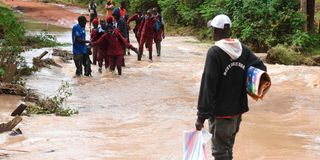
Members of the public help learner from St Michael’s Liyavo Primary and Junior Secondary School in Namanjalala, Trans Nzoia County, to cross a flooded Skubu bridge on March 24, 2026, following heavy rains.

What you need to know:
- A third of Kenyan learners already lack basic skills. Now floods and extreme heat are shutting classroom doors, with at least 1.9 million children kept from school by drought alone. As El Nino rains loom, the coming term could be another difficult one.
For weeks, Milka Njeri's 12-year-old daughter stayed home when she should have been in school playing, learning and interacting with her peers.
But how could she go? In April 2024, catastrophic downpours, amplified by an El Nino phenomenon, wreaked havoc across many parts of the country. In Mathare, the Nairobi and Mathare rivers burst their banks and flooded hundreds of homes, including Milka’s house. A nearby school, Valley Bridge Primary School, was turned into a temporary refuge for affected households.
"We could not save anything from the house. School uniforms, exercise books, and shoes were swallowed by the water. The schools were on holiday but with just a week to reopen," she shares.


In the days that followed, life for Milka and other parents at the shelter was consumed by the immediate humdrum of survival: finding a new house to rent and replacing essential household items. "Fortunately, we didn't have to worry about clothes because many well-wishers came through and supported us," she offers.
Happy to have received support at such a difficult time, yet a deeper, quieter anxiety weighed on Milka. She had no money left to buy school uniforms and other essentials for her two children, both in primary school. "I used to work as a day burg at someone's house. When our house flooded and we had to move temporarily to the shelter, I couldn't go to work because for one to get food, beddings and anything else there, you had to be physically present. So, I lost the job," she explains.
Milka's experience was not isolated; it was a reality shared by many parents. Across Kenya, the floods brought the national education system to a grinding halt. In late April 2024, the Ministry of Education repeatedly postponed the start of Term Two nationwide due to flooded roads, submerged schools, and destroyed bridges. A new report released in
June that year revealed that 15,000 students missed school due to deadly floods.
The ElimuBora Working Group survey covering 60 schools in nine counties painted a grim picture of the education sector following the disaster. "More than 62 primary schools were submerged, 34 cases of cholera were reported along the Tana River and more than 20,000 were damaged by the floods," read the report.
The findings also revealed that the surveyed schools posted a nine per cent decrease in overall student population, with female students and those with special needs disproportionately affected.
The World Meteorological Organization revealed that the 2023–2024 El Nino phenomenon triggered anomalous oceanic warming that resulted in torrential rainfall across East Africa during the March-to-May "long rains" season. The atmosphere, warmed by record global surface temperatures, held significantly more moisture, transforming routine seasonal rains into destructive floods: riverine, urban and flash floods.
But floods are only part of the story. While in places like Mathare children were forced to stay home as swollen rivers spilled into neighbourhoods and turned roads into muddy channels, hundreds of kilometres away in arid and semi-arid Turkana, children face a different climate threat: relentless heat. Under a scorching sun, classrooms can become unbearably hot, making it harder for children to concentrate, learn and remain in school.
Globally, 2024 was recorded as the hottest year on record, with average global temperatures reaching 1.55 to 1.6 degrees Celsius above pre-industrial levels (1850–1900). This marked the first full calendar year in history to surpass the 1.5 degree Celsius threshold.
A new analysis from 106 countries released by Unicef this month amplifies the scale of this disruption, showing how climate change is shutting classroom doors for millions of learners across the world. Climate hazards including storms, floods, heatwaves, droughts, and wildfires led to suspended classes, damaged schools, a shift to remote learning, shortened instructional time, reduced school attendance, and increased risk of dropout for millions of students worldwide.
Globally, at least 171 million students, from pre-primary to upper secondary education, experienced school disruptions due to climate events in 2025. Seventy-five per cent of the 171 million affected students are in low- and lower-middle-income countries. In Kenya, drought was the biggest disruptor, keeping at least 1.9 million children from school.
"For millions of children, climate hazards do more than disrupt lessons, they destroy schools, uproot families, and push the most vulnerable children, especially girls, out of the classroom for good," said Unicef Executive Director Catherine Russell.
The report comes at a time when children are already falling behind in reading comprehension, showing that an estimated two-thirds of children around the world cannot read with comprehension by age 10.
Usawa Agenda, a not-for-profit organisation, in findings released last month, noted that a third of students in Kenya transitioning to senior schools lack basic skills. With forecasters predicting above-normal rainfall alongside above-normal temperatures in many parts of the country during the October–November–December season, Kenyan learners could face another difficult school term, with heavy rains threatening to keep some out of classrooms while rising temperatures make learning increasingly uncomfortable for others.
The rains could also disrupt national examinations in flood-prone parts of the country, even as the government maintains that the examinations will proceed as planned. The situation could be particularly difficult in counties such as Migori, where the county government has said schools will not be used as temporary shelters for people displaced by floods, to protect the national exams calendar. In previous floods, schools have served as temporary refuge for families forced from their homes as they sought shelter and worked out their next move.
The Unicef report recommends an increase in and better targeting of financing for climate-resilient education. "Climate finance investments allocated to the education sector are starkly insufficient, remaining as low as 1.5 per cent. Meanwhile, steep global education funding cuts could force an estimated six million more children out of school by the end of 2026, 30 per cent of them in humanitarian settings. These pressures are converging at a time when extreme weather events are projected to rise in frequency and severity, placing more students at risk of dropping out and increasing the strain on already under-resourced education systems," read the report.


