Floods, cholera and hunger: The health toll Kenya is preparing for as El Nino looms
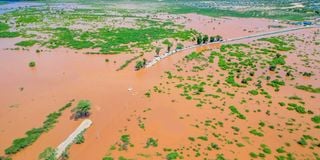
An aerial photo of flooded roads along the Garissa-Mombasa road in Tana River County taken earlier during the el-nino floods in October 2023.

What you need to know:
- Several counties across the country are at risk of waterborne diseases, diarrhoea, malnutrition and disrupted nutrition services, landslides, mudslides and injuries, as well as flash floods, drowning and trauma.
In various parts of the country, Kenyans are watching the sky the way they have watched it before in 1997, 2015, and 2023. This year, the watching carries a harder edge. The Kenya Meteorological Department (KMD) says there is an 81 per cent probability that the El Niño now building over the Pacific will be very strong, and a 97 per cent chance that the rains it brings will still be falling into the first months of 2027.
For the Ministry of Health, that forecast is not an abstraction. Principal Secretary for Public Health and Professional Standards Mary Muthoni wrote to every county government on September 1, transmitting an advisory listing cholera, typhoid, malaria and Rift Valley fever among the diseases counties must now prepare to fight even as the short rains are still weeks away.
The advisory cites the last El Niño season, September 2023 to February 2024, when 175 people died, 40 went missing, and 242 were injured nationally. Some 384,216 people were displaced into 170 camps. Of 1,434 health facilities assessed across 11 counties, 64 became inaccessible to patients. Cholera, Rift Valley fever and malaria all recorded an upsurge in the aftermath.
“Previous El Niño emergencies caused deaths, injuries, displacement, disease outbreaks and disruption of health services. All counties are requested to maintain minimum preparedness, while counties facing elevated flood, landslide, outbreak, injury or acute malnutrition risks should activate enhanced readiness measures without delay,” said PS Muthoni.
Several counties across the country are at risk of waterborne diseases, diarrhoea, malnutrition and disrupted nutrition services, landslides, mudslides and injuries, as well as flash floods, drowning and trauma.
The advisory annex names Mandera, Wajir, Marsabit, Garissa, Kitui, Makueni, Machakos, Lamu, Kilifi, Kwale, Tana River, Taita Taveta and Mombasa as counties at high risk of flooding. It flags recurrent riverine flooding risk in Kisumu’s Kano Plains, Busia’s Budalang’i and the Tana Delta, as well as urban flooding in informal settlements in Nairobi and Mombasa, particularly densely populated areas with inadequate drainage and vulnerable water and sanitation systems.
The Ministry of Health report also notes that communities living in Marsabit, Wajir, Isiolo, Mandera and Garissa near flooded river basins, and near Murang’a County’s swampy areas and quarry lakes, are at risk of Rift Valley fever, a viral zoonotic disease that spreads from animals to humans, primarily affects livestock, and is transmitted by mosquito bites or contact with infected animal tissues.
“Counties warranting the highest combined readiness include Garissa; Wajir; Marsabit; Mandera; Tana River; Lamu; Mombasa; Kwale; Kitui; Nairobi; Kisumu; Busia; Isiolo; Murang’a; Meru; Taita Taveta; West Pokot; Elgeyo-Marakwet; and Baringo. These counties combine one or more hazards, including riverine or flash flooding, urban flooding, malaria or Rift Valley fever risk, previous cholera occurrence, landslides, drowning, physical trauma and possible disruption of health-facility access,” said PS Muthoni.
“Nutrition preparedness should additionally prioritise Turkana, Samburu, Makueni, Kilifi, Kajiado, Narok, Laikipia and Tharaka Nithi, alongside the Asal counties already included above. Priority actions include nutrition screening, Community Management of Acute Malnutrition, supplementary feeding, treatment of severe acute malnutrition and continuity of maternal and child nutrition services. All 47 counties should maintain a minimum level of preparedness,” she added.
“County prioritisation must be updated continuously using Kenya Meteorological Department advisories, river and flood monitoring, disease-surveillance information, laboratory alerts, nutrition surveillance and county-level vulnerability assessments.”
David Koros, assistant director of Forecasting Services at the Kenya Meteorological Department, explained that the October-November-December seasonal forecast, issued earlier than usual this year, is being driven by the interaction of two climate systems.
“El Niño is a natural phenomenon that occurs roughly every two to seven years,” Koros said. Alongside it, he said, forecasters are tracking the Indian Ocean Dipole (IOD), a pattern of warming in the western Indian Ocean relative to the east.
“When we have a positive or neutral-to-positive IOD combining with the El Niño phenomenon, it enhances the rainfall; it pushes it toward above normal,” he said.
Koros said the signals are already visible on the ground, pointing to an extended dry spell across western Kenya that has stretched into September, and to a build-up of warming in the Indian Ocean consistent with a strengthening event. He said most of the country should expect the rains to intensify from the second or third week of October, with the northwest, Turkana, West Pokot and parts of Marsabit starting slightly later, in the final week of the month.
Rainfall distribution across the October-November-December season would be “fairly good” in most areas, he said, though Turkana was likely to be an exception.
Ahmed Idris, secretary-general of the Kenya Red Cross Society, said the humanitarian sector’s concern is less about whether an El Niño event will happen than about its scale. Drawing on comparisons with previous seasons, including the 1990s, he said the organisation is preparing for an impact beyond anything it has managed in the past two decades.
“What we are preparing for is something we have not seen,” he said, adding that the scale of readiness now being planned had not been required “in two decades.”
Also read: Revealed: Where El Niño will hit hardest
For the Ministry of Health's Director of Public Health and Sanitation, Dr Stephen Muleshe, the coming season is the fourth major El Niño event he has managed since joining the ministry.
"Right from 1997, when I started working with the Ministry of Health, through 2015 and 2023, those are the ones I have actively worked on in terms of the health response," he said. He described the recurring health burden as threefold: waterborne disease outbreaks linked to flooding, physical injuries, and disruption to nutrition services for vulnerable groups in high-risk areas.
Dr Muleshe recalled one of the more severe episodes of his career, when floodwaters submerged a health facility outright.
"When health facilities find themselves in that situation, submerged, patients are not able to access those facilities. The roads are destroyed, and that disrupts the continuation of essential health services," said Dr Muleshe.
Kenya's worst El Niño remains the 1997-1998 season. That season killed an estimated 2,000 people nationwide through floods, landslides and the waterborne disease outbreaks that followed. Roughly 1.5 million people were affected, and 77,000 were displaced. Flooding destroyed more than 100,000 kilometres of roads, cut off the Nairobi-Mombasa and Nairobi-Nakuru highways, and collapsed bridges. An estimated $1.2 billion (about Sh155.3 billion) in economic damage was recorded, with roughly 2.3 million livestock lost to drowning, hunger and disease. Cholera, typhoid, malaria and Rift Valley fever outbreaks swept the country as water and sanitation systems were contaminated or destroyed outright. None of the seasons since 2006-2007, 2015-2016, or 2023-2024 has matched that scale, though 2023-2024 killed hundreds and caused extensive damage across the region.
The pattern is not confined to Kenya. In Somalia, severe El Niño rains in November 2023 flooded a cemetery in the central city of Galkayo, unearthing human remains and sending traumatised families fleeing their neighbourhoods, in what the United Nations described as one of the worst flood crises the country had faced in a century.
The regional picture published this month by Save the Children adds hunger to the health threat. The organisation reports that acute child malnutrition in Uganda's Karamoja region has risen from 122,100 to 154,200 cases since June, a 25 percent increase it attributes to El Niño-linked dry spells, with 38,800 of those children suffering or expected to suffer the most severe form of malnutrition, which requires urgent medical treatment.
"Families tell us they have less food to put on the table, harvests have been poor, and more children are arriving at health facilities malnourished and in need of urgent support," said Martha Ddambya, Save the Children's Acting Country Director in Uganda.
In Narok County, one of the areas flagged for flood and landslide risk, preparations are already under way. County Director of Meteorological Services Stanley Kinyua told a county meeting of the Ad Hoc Cabinet Committee on El Niño Preparedness and Response that Narok town, Mosiro, Ewaso Ngiro, Kilgoris and Nkareta have been identified as hotspots. He cautioned that the strength of an El Niño event does not, on its own, determine how much rain a region receives.
"The 2015 event was a very strong El Niño, close to 1997, but because the Indian Ocean Dipole was only weakly positive, we did not experience as much rainfall as in 1997. The outcome of the season will largely depend on the strength of the IOD, which is expected to be positive this year," Kinyua said.
The Ministry of Health's advisory translates that general call for preparedness into a detailed twelve-point checklist. Counties are required to activate their health emergency operations centres and multi-sectoral flood-health task forces; map health facilities and access routes at risk of flooding or isolation; pre-position medicines, oral rehydration salts, zinc, intravenous fluids and malaria diagnostics with Kemsa and county commodity stores; and intensify surveillance for cholera, typhoid, dysentery, hepatitis A, malaria, dengue, chikungunya and Rift Valley fever.
Counties are also supposed to protect and chlorinate water sources; scale up distribution of insecticide-treated nets and vector-control measures; prepare surge capacity for emergency and referral services, including boats, four-wheel-drive vehicles or air support where roads are cut; screen for and manage acute malnutrition among children under five, pregnant and breastfeeding women and people with chronic illness; maintain continuity of maternal, HIV, tuberculosis and chronic-disease care; provide psychosocial support for displaced and bereaved families; and counter misinformation about outbreaks, hospital access and evacuation instructions through Community Health Promoters and local leaders.
The World Meteorological Organization has warned that the anticipated rainfall could have consequences reaching well beyond health, touching transport, agriculture and infrastructure across the region, the same combination of pressures that turned 1997's rains into Kenya's deadliest recorded flood disaster.