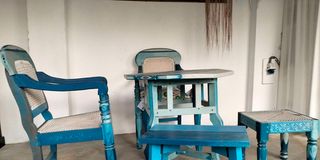
It is 2pm at Mnazi-Mmoja Cafeteria on Lamu Island. Ali Skanda and his friends are enjoying the sunny afternoon, seated around a modern, durable dining set crafted from bright, eco-friendly recycled plastic. The natural light streaming into the cafeteria enhances the space, creating an inviting, warm atmosphere.
Skanda, a renowned dhow and boat builder, woodcarver, carpenter, and environmentalist in the Lamu Archipelago, has spent nearly a decade championing the fight against plastic pollution through large-scale recycling initiatives, working in coordination with friends.
Flipflopi Head of Design Katharina Elleke displaying a plastic-based panel made purely from recycled plastic on February 9, 2026.
Photo credit: Kalume Kazungu I Nation Media Group
Through the Flipflopi Project, based in Kenya, Skanda and his team handcraft boats and furniture using 100 per cent recycled plastic waste collected from local beaches and towns across the Lamu Archipelago. The Flipflopi Project is a community-driven initiative and East African circular economy movement that has become a global model in the fight against plastic pollution. Known for building the world's first 100 per cent recycled plastic sailing dhow in 2016, the initiative now employs a 'full-systems' approach to tackling plastic pollution through education and awareness campaigns, waste-plastic innovation rooted in heritage, and advocacy for legislative change to ban single-use plastics.
The initiative uses traditional Swahili carving techniques on recycled plastic lumber to create eco-friendly, durable, sustainable furniture, including daybeds, sunbeds, chairs, tables, mirror frames, benches, and jewellery boxes, among other items.
Recycled plastic planks at Mnazi-Mmoja workshop in Lamu.
Photo credit: Kalume Kazungu I Nation Media Group
So far, more than 400,000 kilogrammes (400 tonnes) of plastic waste have been transformed, resulting in at least 100 furniture designs and the construction of four dhow boats. In the process, the project has built a fully community-led circular system on Kenya's coast.
This move has helped curb deforestation, preserving Lamu's forests and woodlands in contrast to the exploitation seen in past years.
During an interview with Climate Nation at Mnazi-Mmoja Cafeteria, Skanda noted that since the project began, recycling plastics into eco-friendly products like furniture and dhow boats has significantly protected indigenous trees from exploitation.
Recycled plastics have also helped conserve the environment and mitigate climate change by reducing the need for virgin fossil fuel extraction, lowering emissions from energy-intensive manufacturing, and decreasing landfill waste. It is worth noting that recycling one tonne of plastic saves significant energy and reduces carbon emissions compared to producing new plastic.
"These sleek, modern dining tables surrounded by comfortable chairs you're seeing here; all are manufactured from eco-friendly, recycled plastic materials," said Skanda.
Skanda, who is also co-founder and general manager of Flipflopi, explained that the first step was establishing a first-of-its-kind plastic recovery centre in Maziwani area of Lamu Island. This is where community members from across the Lamu Archipelago bring collected plastic waste ranging from used water bottles, jerrycans, milk jugs, laundry detergent bottles, food tubs, shampoo bottles, and rigid plastic trays.
The plastics are sorted by type and colour to achieve signature shades, then shredded and washed in preparation for extrusion or pressing.
According to Skanda, they implemented a complete waste collection system, also called a Material Recovery Facility, where raw plastic waste is purchased, sorted, and cleaned.
Furniture made purely from recycled plastic waste at Mnazi-Mmoja Cafeteria in Lamu.
Photo credit: Kalume Kazungu I Nation Media Group
The processed plastic is then transformed into plastic lumber, which becomes the raw material for their colourful furniture.
"Once extruded into lumber, it's ready for the final phase where our team of artisans, including myself, shape, carve and finish each piece by hand using traditional techniques, meticulously crafting durable furnishing from the recycled plastic. This unique approach combines traditional Lamu carving techniques with recycled materials. The result, once carved, is mind-blowing," said Skanda.
Davina Ngei, Flipflopi programme manager, noted that through recycled plastic furniture pieces made using traditional designs and techniques, they are not only preserving the heritage of Lamu Old Town but also turning an abundant problem: plastic waste, into part of the solution.
Ngei further explained that as they undertake plastic waste recycling, they are also offering training to young and keen craftsmen in Lamu, helping them master age-old skills in carpentry and boatbuilding using recycled plastics.
Flipflopi Head of Design Elleke expressed confidence that through the initiative, they will ultimately achieve their mission of ending plastic pollution.
On how they achieve the various colours of the eco-friendly products they manufacture, Elleke explained that the 100 per cent recycled plastic is transformed into lumber without any added dyes or paint. The unique colours and patterns come entirely from the sorted plastic waste itself. The planks are then handcrafted by local artisans using traditional carving methods.
"The vast quantities of plastic brought here for recycling every day, month, and year help reduce ocean plastic and tackle marine pollution. The waste collected is converted into eco-friendly planks, which are then used for making dhows, boats, and furniture. That means the need for wood timber is reduced; hence saving our forests," said Elleke.
Dipesh Pabari, co-founder and managing director of Flipflopi, said beyond cleaning the environment, the plastic recycling initiative is also providing income to local communities. Pabari explained that to motivate residents to bring more plastics to their collection point, they offer incentives ranging from Sh6 to Sh13 per kilogramme.
They also have a tractor that visits neighbourhoods to collect plastic directly from residents."Our collection point receives plastics from as far as Pate Island. It covers almost 70 per cent of the Lamu Archipelago population," said Pabari.
He called on residents to embrace the initiative, describing it as a key mechanism in the fight against plastic pollution in Lamu."Within the past three to four years, we have managed to collect 400 tonnes of plastic waste and recycle them into eco-friendly products like furniture. The issue of littering is still a challenge owing to very few options available to residents for disposing of their plastics and waste at large.”
He added: "There's still a need for greater responsibility by the government and everyone when it comes to matters of plastic waste disposal. It's disheartening seeing someone walking around and carelessly throwing their plastic bottles into the ocean just like that. Let's care for our nature since we depend on it for our survival."
In an interview with Climate Nation , Lamu Climate Change Chief Officer Mohamed Dirie termed the Flipflopi project a game changer in the fight against plastic pollution.
Dirie said by shifting from traditional mangrove poles to recycled plastic waste planks, the Flipflopi environmentalists are not only reducing deforestation but also creating a circular economy model that empowers local communities through sustainable waste management practices. "I applaud the Flipflopi Project's efforts to combat plastic pollution and promote sustainable development.”
When asked whether Lamu has put in place any waste management policy to help enforce pollution control, Dirie admitted that the county currently has none.
"But we're in the process of enacting the Lamu County Waste Management Bill 2025, which is under review by stakeholders, before it is subjected to public participation by March this year," he said.
As for Skanda, he closed with a call for Kenyans to fully embrace plastic recycling for their own good.
"I can attest that through recycling, one can turn plastic waste into value. Through the use of recycled plastic lumber, one can build a greener future. Through recycling, we can end the pollution cycle. We've proved beyond doubt that recycled plastics have today become building blocks for the future. Let's all embrace recycling.”