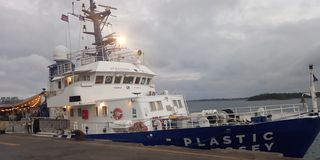
The Plastic Odyssey cuts through Mombasa's harbour waters with quiet purpose, her 40-metre hull gleaming white and blue in the hot sun. French and Kenyan flags flutter side by side in the ocean breeze, but this vessel carries a mission greater than the diplomatic courtesy her flags suggest.
This is no ordinary ship. The Plastic Odyssey is a floating factory, a travelling classroom, and an experiment in humanity's fight against plastic pollution.
For decades, Kenya's pristine coastline has waged a losing battle against an endless tide of discarded bottles, food wrappers, and shopping bags. Tourists flock to these beaches for their postcard-perfect beauty, but local cleanup groups know the darker truth: they witness firsthand what each tide deposits on their shores, day after day.
Simon Bernard, co-founder and CEO of the Plastic Odyssey organisation, believes his programme offers something different. Rather than simply cleaning beaches, they're attacking the problem at its root.
Some of the furniture made from recycled plastic waste at the Plastic Odyssey ship in this photo taken on September 17, 2025. The ship made a stopover in Mombasa as part of its global mission to combat plastic pollution.
Photo credit: Valentine Obara | Nation
"After sailing across the Indian Ocean, the Plastic Odyssey arrives in Kenya for a 25-day stopover," Bernard explains. "We're here for exploration of local recycling initiatives, awareness-raising activities, training sessions and exchanges with key stakeholders already committed to fighting plastic pollution."
Descend into the ship's lower deck, and the transformation becomes clear. Here, the familiar hum of machinery often drowns out the distant roar of engines. Industrial shredders grind plastic waste into uniform flakes. Extruders superheat these fragments, melting them into long, pliable strands that cool into raw material for building blocks. A hydraulic press stamps out sturdy tiles, each one born from what was once considered worthless trash.
This floating factory serves as a hands-on training ground. Each time the Plastic Odyssey docks, local entrepreneurs board for an intensive crash course in plastic recycling technology. The ship becomes their classroom, their laboratory, their glimpse into possibility.
In Mombasa, the programme attracted a diverse mix of small-scale recyclers, artisans, and startup founders already experimenting with plastic waste solutions. The intensive boot camp helps them refine existing ideas, prototype new products, and forge connections with mentors and potential investors.
Participants are guided through the complete recycling process, from waste collection to finished product. Throughout the vessel, visitors marvel at an impressive array of furniture, decorative tiles, and construction materials—all crafted entirely from recycled plastic waste.
The Plastic Odyssey's approach deliberately avoids the one-off cleanup model that dominates much environmental activism. Instead, the program plants seeds of sustainable change, equipping local innovators with practical tools, business models, and professional networks intended to outlast the ship's brief visit.
"By leveraging the energy of our youth and embedding sustainability practices, we can transform waste challenges into opportunities for jobs and a greener future," said Mombasa Governor Abdulswamad Nassir during his tour of the vessel. He was joined by French Ambassador to Kenya Arnaud Suquet and Kenya Red Cross Secretary-General, Dr Ahmed Idris.
Biodegradable alternatives
Africa Global Logistics (AGL), which partnered with Plastic Odyssey for the Kenya visit, says it is actively phasing out single-use plastics across its warehouses and supply chains, replacing them with reusable, recyclable, and biodegradable alternatives. Their facilities now feature electric forklifts and EV trucks, powered by solar energy and biofuels.
"Logistics is not just about moving goods," said Jason Reynard, Regional Managing Director for AGL East Africa. "It's about building resilient economies, unlocking opportunities, and empowering communities in Africa, for Africa, while safeguarding our environment. We must be an integrator for the future of logistics."
Since launching in 2022, the vessel has completed 30 stopovers worldwide, each one nurturing grassroots ventures to reshape local waste management systems. The program's core philosophy is revolutionary in its simplicity: plastic waste isn't trash—it's raw material waiting for transformation.
The ship is operated by a crew of approximately 20 professionals, comprising engineers, laboratory technicians, administrative staff, ship captains, and cooks. In keeping with their environmental mission, the entire crew maintains a strictly vegetarian diet and strives to minimise plastic usage by preparing meals from scratch, including producing their own cereal-based milk alternatives.
Earlier this year, the Plastic Odyssey captured international headlines with an "impossible cleanup" mission to Henderson Island, one of Earth's most remote locations in the Pacific Ocean. Despite being uninhabited, this tiny island had become choked with plastic debris.
That ambitious mission forged a partnership with Unesco, ensuring that future cleanup operations combine environmental restoration with scientific research and community education programs.
According to Unesco Director-General Audrey Azoulay, their partnership agreement, signed on June 10, 2025, aims to replicate Henderson Island-style operations at marine World Heritage sites worldwide.
Each mission will focus on four key objectives: removing accumulated waste, collecting vital scientific data, developing educational programs, and establishing sustainable, income-generating waste management systems that benefit local communities.