Government defends logging amid forest loss outcry, says only 5pc is for commercial use

President William Ruto waters a tree seedling he planted during this years’ Mazingira Day held at Kenya Seed Company’s Elgon Downs Complex in Endebess, Trans Nzoia County on October 10, 2026.

An undated video that surfaced online a few days ago shows what appear to be six white trucks loaded with logs making their way along a narrow forest path as onlookers watch in apparent shock.
Nation has established that the footage was taken in Kereita Forest, near Kimende town in Kiambu County. However, it remains unclear why the logs were being transported or whether the activity was legal.
The footage reignited debate over the state of Kenya’s forests just days before Mazingira Day on October 10, when the government launched another round of massive tree-planting exercise. The initiative is expected to continue during the October-November-December (OND) rainy season, with more than 17 million trees set to be planted across 31 counties.


But the ambitious tree-planting drive comes against a backdrop of mounting pressure on existing forests. The Economic Survey 2026 points to a decline in newly established forest plantations, accelerating biomass loss in some of the country’s critical water catchments and a near quadrupling of charcoal sales from government-managed forests in just four years.
The concerns have prompted a coalition of civil society organisations to collect more than 60,000 signatures from Kenyans protesting continued forest loss, even as the government pursues its tree-planting agenda.
Last Wednesday, the organisations marched to the Ministry of Environment, Climate Change and Forestry, demanding an end to deforestation, forest encroachment, illegal logging and forest degradation.
“But this year, the question Kenyans are asking your Ministry is not how many trees were planted in the last 12 months. It is what the government will do to protect the forests that are standing today. We ask that from this Mazingira Day onwards, the national conversation centres on forest conservation and protection,” read an excerpt from a letter presented by Greenpeace Africa, the Green Belt Movement, Just Act, Friends of Nairobi National Park and other civil society allies and environmentalists.
Also Read: Ruto development versus forests - The paradox of plant scientist accused of destroying trees
The organisations also highlighted threats facing forests and protected areas across the country.
In Imenti Forest, a gazetted forest and water tower that serves as a crucial dry-season refuge for elephants, they raised concerns over reports that construction of an airstrip was continuing despite a court order blocking the project.
They also cited plans to relocate the Nairobi Animal Orphanage and establish a parking facility for 1,300 vehicles, alleging that the projects had involved tree felling and clearance in an area designated a Low Use Zone under the park’s management plan.
The organisations said 4,642 Kenyans had gone to court to protect the park. They also claimed that petitioners had been excluded from a court-ordered site inspection in July.
The organsatiosns also questioned the lifting of the logging ban in the Mau Forest Complex, the largest indigenous montane forest in East Africa and one of Kenya’s five main water towers.
The forest lost about a quarter of its cover between 1973 and 2013, largely due to excisions, settlement, illegal logging and charcoal burning.
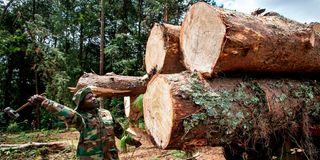
A Kenya Forest Service official uses a log-marking hammer to stamp freshly cut pine logs with information validating their purchase and source before they can be transported from a plantation in Sabatia forest in Eldama Ravine town.
On October 27, 2025, President William Ruto announced the lifting of the logging ban during the launch of a Mau conservation programme in Elburgon.
Greenpeace Africa and the Green Belt Movement subsequently raised concerns that the government had not publicly disclosed the transparent framework that the Environment and Land Court required in 2023 before logging could resume.
The organisations also cited illegal activities in Ngong, Karura, Aberdares and Suam forests.
“We are seeing a consistent attack on our forests, especially for private interests, as well as government projects that are going into forests. And this is public. In May, we had the amendments to Section 56(2), which basically gives the Kenya Forest Service the mandate to provide for wayleaves, roads and utilities across gazetted forests. So already, this is enshrined in our Constitution and just makes our fight even more difficult,” said Sherie Gakii, Kenya Forests campaign lead at Greenpeace Africa.
In an exclusive interview with Nation, Environment Cabinet Secretary Deborah Barasa defended the government’s approach, dismissing the public outcry as being driven by what she described as politicking and propaganda.
“Among all administrations, this administration has championed matters of forestry. Globally, we have champions. We are among the top five leaders in restoration. We have worked on the Forest Conservation Management Act to ensure that we are amplifying restoration. The previous administration talked about 10 per cent restoration. The current administration is talking about 30 per cent,” she said.
Dr Barasa acknowledged the tension between conservation and development, arguing that the country needed to balance forest protection with the economic benefits of commercial forestry.
“A tree grows, and after 25 years, it rots away. The global practice, and what is also being done in Kenya, is to ensure that we have five per cent of our forest as commercial and the rest will be for conservation. We have 2.6 million hectares of gazetted forest in Kenya, and 150,000 hectares are for commercial use. This is what you are seeing being cut down,” she said.
“Timber has a value chain. The person cutting it down, the one who transports it, the one who processes it and the one who produces furniture out of it will all benefit from it,” she added.
Dr Barasa argued that halting commercial logging would hurt jobs and raise the cost of timber, forcing Kenya to rely more on imports.
“If we stop this five per cent that is supporting a good proportion, you have heard there is a need for job creation and to boost the economy. If we stop that, what will happen? We will be importing timber to make chairs. Is that sustainable? It would mean more taxes for Kenyans. It is a balance, and the monetary implication is used to preserve the 95 per cent,” she said.
Dr Barasa said her ministry remained open to engaging the CSOs to find an amicable solution to the concerns raised.
Follow our WhatsApp channel for breaking news updates and more stories like this.