The chainsaws arrive long before seedlings.
First comes a road. Then an access track. Electricity lines follow, alongside contractor camps, parking lots and assurances that only a small section of forest will be affected.
By the time the first seedlings are planted elsewhere under Kenya’s ambitious tree-growing campaign, another fragment of mature forest has already disappeared.
That contradiction, conservationists say, has become increasingly difficult to ignore.
President William Ruto is not the leader many conservationists expected. Before venturing into politics, he studied plants, earning a bachelor’s degree in Botany and Zoology before completing a master’s degree and a PhD in Plant Ecology at the University of Nairobi. His doctoral research examined how human activity changes riparian ecosystems.
Today, conservationists say his administration finds itself at the centre of the same debate between development and environmental protection.
Since taking office in 2022, Ruto has made environmental restoration a cornerstone of his climate agenda, promising to grow 15 billion trees by 2032. But his presidency has also been marked by a series of disputes over roads, State facilities and other developments proposed inside forests and green spaces. Together, they have raised uncomfortable questions about whether Kenya is restoring its landscapes while steadily eroding some of its oldest ecosystems.
Forestry Principal Secretary Gitonga Mugambi says that an airstrip being constructed in Imenti Forest will be ready by June 18.
Photo credit: Nation
The net stocked area of government plantations grew modestly from 143,900 hectares in 2021 to 148,600 hectares in 2025. Tree planting accelerated after the launch of the 15-billion-tree campaign, rising from about 1,100 hectares annually before 2023 to nearly 5,000 hectares in 2024.
At the same time, commercial harvesting resumed after the government lifted a six-year logging moratorium on State plantations. Harvesting rose from zero hectares in 2022 to 2,800 hectares by 2025, although the decision to lift the moratorium was later suspended by courts.
For environmental organisations, however, logging is only part of the concern.
Across the country, they point to proposals for roads, railway corridors, airstrips, State lodges, utility corridors and tourism facilities inside protected ecosystems. Those concerns deepened after Parliament passed the Forest Conservation and Management (Amendment) Act, 2025, allowing the Kenya Forest Service to grant easements and wayleaves for roads, utilities and other public infrastructure in gazetted public forests.
“For the past two years, there has been a sustained narrative that forests are under increasing pressure from government-backed infrastructure projects,” said Friends of Nairobi Forests and Green Spaces.
“This is not a coincidence. It is a pattern,” he said after the Senate approved the Bill.
“First comes a road, then utilities, then temporary access, then commercial developments. Slowly, public forests disappear piece by piece until nothing remains.”
The Mau Forest Complex lost about a quarter of its cover between 1973 and 2013 through excisions, settlement, illegal logging and charcoal production. Karura Forest narrowly escaped widespread excisions in the late 1990s after public protests led by Nobel Peace Prize laureate Wangari Maathai.
Their concern is that the same process is unfolding again, only more gradually.
“Our fear is no longer about losing one forest at a time,” said Prof Karanja Njoroge of Friends of Karura Community Forest Association.
“It is that Kenya is gradually normalising development inside protected ecosystems. Once that becomes acceptable, every forest becomes vulnerable.”
Few projects illustrate that tension more clearly than the proposed Ihithe-Ndunyu Njeru road through Aberdare Forest.
The road, which would link Nyeri and Nyandarua counties, gained momentum in January 2024 when the National Environment Management Authority issued an environmental licence days after President Ruto declared that the project would proceed despite earlier reservations by the Kenya Forest Service, Kenya Wildlife Service and Nema itself.
Environmental assessment documents showed construction would require clearing about 75 hectares of bamboo forest, 14 hectares of montane forest and another 14 hectares of moorland. The Aberdare ecosystem supplies much of Nairobi’s water through Sasumua and Ndakaini dams and sustains more than half of Kenya’s hydroelectric power generation.
Environmental organisations argued that disturbing one of Kenya’s most important water towers could have consequences far beyond the construction corridor. In April last year, the Environment and Land Court halted the project through conservatory orders. The case is awaiting determination by a multi-judge bench.
Ngong Road Forest once stretched across more than 3,200 hectares between Bomas of Kenya, Karen and Dagoretti. Today, only about 1,224 hectares remain after decades of urban expansion.
Community forest managers estimate that nearly two-thirds of the original forest has already been lost to roads, settlements and public institutions.
About 79 hectares have either been earmarked for development or already allocated for projects linked to Talanta Stadium, including an access road, a contractor’s yard, a proposed railway corridor and an eco-lodge.
“The issue is what fragmentation does to ecosystems,” Friends of Nairobi Forests and Green Spaces said.
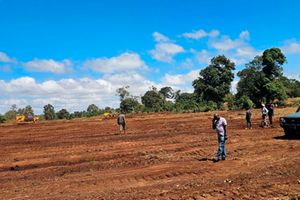
A cleared section of Imenti forest in Meru County where construction work is ongoing for the proposed construction of an airstrip.
Photo credit: Pool
In Imenti Forest, proposals for an airstrip, a State lodge and a golf course have triggered court cases after residents argued they had been given only 24 hours to review environmental documents before public consultations. Campaigners also questioned why consultation documents focused largely on the proposed airstrip while providing little information about the wider development.
Government agencies maintain that the projects remain part of lawful planning processes and will only proceed if they meet environmental safeguards.
George Tarus, Secretary for Forest Development in the State Department for Forestry, rejected accusations that the government is hostile to forests. “Had we been unfriendly to green spaces, the 15-billion-tree agenda would not have received the political and administrative support it has,” he said, saying the restoration programme extends beyond forests to include rangelands, farms, urban green spaces and other degraded landscapes.
He defended the proposed airstrip in Imenti, saying it would improve Kenya Forest Service’s ability to respond quickly to wildfires, which are becoming more frequent as temperatures rise.
A cleared section of the lower Imenti Forest on June 11, 2026.
Photo credit: Pool
“The main genesis around that is because last year we had a fire incident that burned almost 1,200 acres of land within that region,” he said. He said any infrastructure proposed inside public forests would still have to undergo environmental and social assessments before approval.
“The process that has commenced now is to either support that investment or not. As it is now, it is a proposal. It is an idea.”