For Teresia Waithera, the daily commute from Nyayo Estate to her Westlands office has transformed from a stressful gamble to a comfortable routine. She recalls waking early to join a restless crowd at the terminus, waiting anywhere from 10 minutes to over half an hour during peak times. Boarding a matatu was just the beginning. “On most days, I had to listen to music I didn’t want to at very loud levels,” she says. The unpredictable stops by buses along the route made it impossible to estimate arrival times.
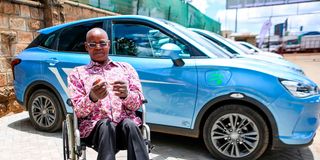
Director of Industries in the State Department for Industry Gideon Oele during the interview at Moja EV Kenya Limited offices in Nairobi.
Photo credit: Billy Ogada I Nation Media Group
Today, however, Teresia and her neighbours benefit from Embassava Sacoo’s initiative. Using the Jani Commute app, they can pre-book trips, pay digitally, and track their bus in real time, making the ride predictable and comfortable.
Kevin Kuria, another commuter on the route, values the quiet ride, spacious legroom, and comfortable seats. “Riding these specific Embassava buses allows me to work or read during my commute, something I couldn’t do in other matatus,” he says. “Even when I haven’t booked in advance, I always look out for the electric buses.”
Kenya’s growing electric mobility ecosystem
The electric buses in this initiative come from BasiGo, a Kenyan electric mobility company aiming to transform public transport. BasiGo’s innovative “Pay-As-You-Drive” model lets bus owners acquire new electric buses at the exact upfront cost as diesel equivalents, while charging the battery and infrastructure separately through a usage fee similar to fuel. They provide complete services, including charging, maintenance, and repairs, assembling the buses locally at the Associated Vehicle Assemblers plant on Mombasa Road.
BasiGo is part of a broader wave pushing Kenya’s electric mobility forward. Companies like Roam and eBee lead the electric two-wheeler market, offering motorcycles and bicycles tailored to local terrain. In the car segment, Moja EV and CFAO Mobility, the sole Build Your Dream (BYD) distributor, are increasing the availability of electric cars.
This expanding ecosystem includes service providers like Equator Mobility and Rideence Africa, offering electric vehicles for fleets, ride-hailing, and logistics through leasing models. Supporting infrastructure is growing too, with EVChaja and Kenya Power developing public charging stations, though the network remains sparse.
In ride-hailing, drivers like Hillary Otieno are switching to electric vehicles for lower operating costs. “I am a speed enthusiast, and with my car, I can afford to race without worrying about fuel,” he says. After researching online and witnessing a friend’s savings, Hillary fully committed to electric vehicles (EVs). Charging at home overnight with a standard charger, Hillary gets two and a half busy days per full charge. “I spend at most Sh2,000 to recharge, and that gives me 384 kilometres. In a petrol car, that same distance would cost me over Sh8,000 in fuel.” His car’s leather seats and legroom have attracted requests for long trips, placing him in the “Comfort” category on ride-hailing apps. For trips beyond Nairobi, he carries his charger or uses public stations in places like Nakuru.
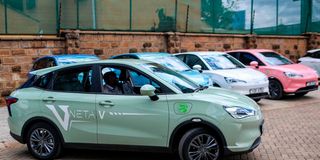
Rebecca Kimuma in her Neta V electric vehicle on October 9 at Moja EV Kenya Limited offices in Nairobi.
Photo credit: Billy Ogada I Nation Media Group
For Loise Mwangi, who has been in the taxi business for seven years, switching to an EV was a business decision. Her ride-hailing provider had announced that newly bought petrol cars would be excluded from the lucrative “Comfort” category. “I remembered a seminar I had been invited to on EVs and immediately sold my new car before it was locked out,” she recalls. After waiting three months for her EV, she noticed drastic savings. “I used to refuel with Sh8,000 every Monday and top up later in the week. These days, I charge at home overnight. The most I’ve spent at a public charger in a week is Sh900.”
Asked about rising electricity bills, Loise smiles, “It’s like buying an extra appliance. You notice a slight increase, but it’s nothing compared to what I was spending on petrol.”
Despite operational savings, the high upfront cost is the greatest hurdle for most Kenyans. Hillary and Loise’s EVs cost roughly Sh4.5 million, far above the price of popular taxi models, which range from Sh1 to Sh2 million. A typical EV can cost about $38,000 (Sh5 million), compared to reliable internal combustion engine (ICE) cars that sell for a fifth of that. Though the government has reduced excise duties and exempted VAT on EVs, the initial financial push remains challenging for ordinary consumers, despite long-
The price gap reflects global EV supply chain costs, battery technology pricing, and limited local manufacturing. Kenya’s EV market remains dependent on imports, which adds shipping and tariff costs even after government incentives.
To address this, innovative financing models are emerging. BasiGo’s pay-per-kilometre plan for buses and Roam’s electric motorcycles offer alternatives without steep upfront costs. Moja EV introduces leasing and payment plans, especially for taxi businesses.
Achieng Anam, Moja EV’s sales director, says leasing-to-own, with a 10 per cent deposit followed by monthly payments, is the most popular model. “We have a payment plan targeting taxi operators, requiring as low as Sh100,000 deposit with a repayment period of 60 months,” she adds.
Moja EV’s taxi model, NETA, costs Sh4.5 million, but through flexible leasing, operators pay about Sh4,000 daily or Sh120,000 monthly over five years. Their portfolio also includes the Skyworth EV (Sh7.3–7.5 million), vans (Sh8.5–9.5 million), and heavier vehicles like lorries, priced up to Sh11 million, depending on specifications.
Achieng notes plans to launch a more affordable, roadworthy EV priced at Sh3.5 million by January next year. While currently importing fully assembled units, the company is arranging to import kits for local assembly, which should lower costs.
Beyond taxis, EVs have growing corporate customers like HFC and Rabai Power Ltd.
To facilitate individual taxi financing, Moja EV has partnered with Caritas Micro-Finance Bank. Martin Kirimi, head of Retail Banking at Caritas Microfinance Bank, highlights significant challenges: high upfront EV costs mean larger instalments for borrowers; sparse public charging infrastructure adds income uncertainty; shortages of skilled technicians and absence of long-term battery data increase risks.
These challenges are particularly acute for informal sector workers like taxi drivers, who often lack conventional credit history. Lenders face uncertainty about EV resale values and battery durability in Kenya’s conditions—factors that international markets have data on, but Kenya does not.
To address this, the bank may extend repayment periods and is collaborating with Moja EV to understand supply chains and provide technical support. Kirimi stresses the need for a robust government regulatory framework for EVs, particularly around imports and local assembly, to stabilize the sector.
Peter Otieno, the Institutional Banking Segment Head at Caritas MicrofinanceBank, sees EV financing as aligned with the bank’s green energy commitments and as a necessary step toward reducing emissions and promoting a healthier nation. “Our ecosystem provides a unique reach, allowing us to serve communities even in remote areas, with ethical and green financial solutions,” he adds.
Despite lower running costs, charging remains a daily challenge. Though Kenya’s electricity is over 90 per cent renewable—primarily from hydropower, geothermal, and wind sources—public charging stations, especially outside Nairobi, are few and crowded. Free charging at Stima Plaza is popular but often results in long queues, with drivers moving their cars after reaching 85 per cent charge.
Paid stations, still limited, exist at The Well in Karen, Unga House, Sarit Centre, in Hurlingham, and along Thika Road. These stations use 50 kW fast chargers that replenish batteries within 30–45 minutes, compared to typical 5+ hours at home.
Charging costs vary by location. Hurlingham is the priciest at Sh60 per kWh. In Nakuru, fast charging costs Sh42 per kWh, while slow charging costs Sh4 per minute. Though more costly than home charging, public stations are cheaper than petrol refills. However, the sparse network means long-distance travel remains logistically challenging for
The patchy infrastructure and high upfront costs fuel skepticism. Taxi operator Boaz Wekesa chooses to stick to internal combustion engine vehicles, doubting the longevity of EVs. “We are told the battery could last over seven years, but no one has tested EVs in Kenya that long,” he says, adding that servicing and maintenance facilities are still inadequate.
This skepticism is not unfounded. A cautionary example is Nopea Ride, an all-electric taxi company that folded in 2022. High down payments and lease costs, coupled with scarce charging points leading to downtime, shrank driver incomes below what conventional taxis earned. Financial troubles forced the company’s shutdown.
The Nopea Ride collapse demonstrates that ambitious EV ventures can fail without adequate supporting infrastructure. It underscores the chicken-and-egg problem facing Kenya’s EV sector: drivers hesitate to adopt without charging networks, but investors are reluctant to build networks without driver demand.
Official sentiment remains optimistic. Gideon Oele, director of Industries in the State Department for Industry, reports massive interest in local EV assembly, with nine out of 10 assembly applications now for electric vehicles, spanning two-wheelers to buses.
“Government incentives waive customs and excise duties for local assemblers, reducing costs by around 40 per cent. This gives local assembly a competitive edge over imports,” says Oele.
Local assembly could significantly lower EV prices if scaled up as it reduces import duties and shipping costs. The government’s strategy aims to build Kenya into a regional EV manufacturing hub.
The Kenya Bureau of Standards is developing charging compatibility standards to ensure interoperability across different charging networks—a crucial step toward a cohesive charging ecosystem. The State Department of Energy is expanding public charging infrastructure. The government also plans to include electric buses in the Bus Rapid Transit system, aiming to achieve a carbon-neutral economy by mid-century.
However, for tourism, a key sector, the EV business case remains weak. Consumer Bent Vistisen has sought an electric alternative to diesel Toyota Land Cruisers for safari use, but found prices prohibitively high despite charging solutions being in place. Safari vehicles must operate in remote areas without charging infrastructure and require the power and range of diesel engines for rugged terrain.
He criticises tax policies that protect local assembly plants and favour fossil-fuel vehicles, slowing the shift to cleaner, more powerful EVs capable of replacing diesel workhorses. Vistisen suggests large tax breaks on clean electric car imports could benefit Africa in the long term, potentially funded by reductions in fossil fuel imports—an argument reflecting tension between local manufacturing goals and faster electrification.
Two-wheelers dominate the market
While cars and buses show growing success in urban areas, data from the Electric Mobility Association of Kenya reveal that two-wheelers dominate Kenya’s EV market. As of December last year, 95.2 per cent of the 9,144 registered EVs were electric motorcycles and bicycles, while buses, minibuses, and cars accounted for only 2.7 per cent (247 units).
This represents a notable 1,048 per cent increase from just 796 EVs three years earlier—demonstrating rapid market growth, though from a small base. Two-wheelers have lower upfront costs, minimal infrastructure requirements, and appeal to delivery and logistics operators seeking operational savings.
Government incentives for two-wheelers include lower charging tariffs, reduced excise duty from 20 per cent to 10 per cent, and VAT exemptions. Yet, infrastructure remains limited, with about 300 charging stations nationwide, though a project to add 10,000 more is underway to accelerate growth and address the infrastructure gap that has