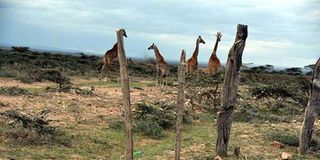
The steady expansion of farmland into traditional wildlife migratory corridors is triggering human-wildlife conflict across counties in Western Kenya and other wildlife-rich regions in the country.
Migratory routes are increasingly being carved up for agriculture, human settlement, and infrastructure, leaving wildlife with limited options and often forcing them into farms and homesteads.
“Wild animals have for generations moved along these routes in search of pasture, water, and breeding zones, but the routes are now being cleared, causing human-wildlife conflict and translating to losses,” said Dr John Chumo, conservation secretary at the State Department for Wildlife.
He decried the blocking of the Rimoi-Nasolut national reserve along the Kerio Valley belt, a migratory corridor for elephants and other wildlife moving between Kenya and Uganda, which has left animals straying into farmlands.
“The encroachment and obstruction of migratory routes disrupt breeding patterns and reduce genetic diversity among wildlife populations. There is need to protect these corridors for the survival of wildlife,” Dr Chumo added. He noted that blocking migratory corridors undermines conservation gains and the promotion of tourism as an alternative revenue source.
According to Dr Chumo, most wetlands in the country also face extinction due to increased demand for land for agriculture, settlement, and hydropower development. These wetlands, home to endangered aquatic animals like sitatunga antelopes and rare plants, are under serious threat from encroachment for crop production and human settlement.
State departments, including the Kenya Wildlife Service, Kenya Forest Service, and the National Environment Management Authority, have partnered with county governments to save wetlands from further destruction. They support surrounding communities through afforestation programmes and protect wetlands against agricultural encroachment.
“The increased demand for land for farming, resettlement, and water extraction for domestic and industrial use poses a serious threat to the survival of wetlands, despite them being home to rare wildlife species like sitatunga and crocodile,” Dr Chumo said.
He lamented the drying up of Lake Kamnarok Game Reserve in the Kerio Valley, Baringo County, due to rampant human activities such as charcoal burning and indiscriminate tree cutting for farming and settlement.
“It is unfortunate that we have lost rare white crocodiles due to massive environmental destruction. More wetlands are likely to face extinction unless conservation efforts are put in place,” Dr Chumo added.
Lake Kamnarok, which covers 87.7 square kilometres, was gazetted as a game reserve in 1983. It was once celebrated as the second largest ecosystem in Africa after Lake Chad, boasting over 10,000 white crocodiles, 15,000 elephants, and more than 13 other mammal species. But due to rampant human activities, the animals have either perished or relocated to areas such as Rimoi Game Reserve in neighbouring Elgeyo Marakwet County.
“We have embarked on aggressive conservation efforts, including planting indigenous trees to protect wetlands, as per the government goal of planting 15 billion trees by 2032,” said Dr Chumo.
He named Yala, Nyando, Lorian, Ondiri, and Shompole swamps among the wetlands being reclaimed with the support of county governments and local communities.
“Wetlands are responsible for keeping rivers at normal level. They hold water then release it to the river when needed. They act in climate regulation, water purification, and waste treatment, but face threats from human settlement,” Dr Chumo explained.
The swamp is home to the rare sitatunga antelope and is classified as an Important Bird Area by the Kenya Wildlife Service, yet it faces the threat of disappearance due to massive encroachment for farming, grazing, and settlement.
“The change of land use for crop production, overgrazing, and siltation are some of the challenges that need to be addressed in wetland conservation,” said Joshua Koech, a conservationist.
According to statistics from the Kenya Wildlife Service, Kesses swamp in Uasin Gishu has about 60 semi-aquatic antelopes, Saiwa National Park in Trans Nzoia County hosts over 100 sitatungas, while King’wal swamp in Nandi County has the highest number of the rare antelopes, with a population exceeding 200.
The shy antelopes emerge from their natural habitats around 6pm to graze, a defined period for animal watchers and scientists to observe the beasts, which face extinction due to human-wildlife conflict despite their tourism attraction. The males are brown, large, with semi-twisted sharp horns, and sporadically fight for territorial dominance.
But encroachment of the wetlands poses serious threats to exceptional wildlife and plants. Environmentalists want the government to introduce strict measures to protect wetlands from massive destruction.
“Water volumes in most wetlands have drastically declined due to massive destruction, despite wetlands forming 3–4 per cent of the country’s land mass and supporting soil formation and nutrient cycling,” said John Kosgei, an Eldoret-based environmental expert.
The marshlands play other important roles, including flood control, soil erosion prevention, water purification, and nutrient and toxic retention.