How football is confronting extreme weather

Teenagers playing football at Kibera Dc Grounds, Nairobi on Sunday, July 4, 2021.

At 10 pm, you'll probably be exactly where millions of others will be, glued to a screen as Spain and Argentina battle it out for the 2026 FIFA World Cup winner.
Football, as I have come to learn about it over the last few weeks, thrives on raw emotions. It is exhilarating, unpredictable and intensely dramatic, drawing fans into 90 minutes of hope, heartbreak and sheer ecstasy.
In some matches, the referee’s whistle is preceded by a nerve-shredding penalty shoot-out.

A view of the stalled Austin Grounds redevelopment project in Mathare's Kambi Safi area along Juja Road, Nairobi, on July 17, 2026.
In many ways, this has not been a typical world cup, which is played every four years. In every match, players and match officials have been pausing for hydration breaks. A World Weather Attribution report released ahead of the tournament predicted that 26 of 104 matches would take place in locations where heat strain could pose risks to the players at the pitch and those in the stadiums. While no game has been postponed due to extreme heat as suggested by the FIFPRO, the worldwide representative organisation for professional footballers, there has been multiple heat advisories. Two matches (Uruguay and Cape Verde) and (Uruguay v Saudi Arabia) were among the most severe humid-heat contests in World Cup history.
FIFPRO use the Wet Bulb Globe temperature, a metric that measures a variety of climatic conditions such as heat and humidity.
Long-term shifts
To understand the extent of global warming, experts looked into ten cities that also hosted the matches in 1986 and 1994. They found out that in those cities, extremely hot June and July days are now around three times more likely than when they last hosted the tournament. In Miami and Mexico City, they occur around seven times as often.
“This World Cup returned to many of the same cities as 1986 and 1994, but it did not return to the same climate. Extreme heat is much more frequent, and wildfires and storms are more severe, because humanity is still burning colossal amounts of coal, oil and gas, which is baking our planet.
So the climate crisis is hitting the things we all need like a stable climate, clean air and affordable food as well as the things we love, like football and other sports,” said Simon Stiell, UN Climate Change Executive Secretary.
When tonight’s game ends, the hydration breaks introduced to protect players from extreme heat may seem like a World Cup-specific measure. In reality, they are part of a much bigger story.
A year before Kenya co-hosts AFCON 2027, new analysis has found that extreme weather is already disrupting grassroots football. In Mathare, heavy rainfall is making pitches unplayable, while climate projections show major storms could deliver 68 per cent more rain by 2100.

Susan Mudongoi, coach of the Waliobobea women's football team and a former footballer, poses for a portrait at Austin Grounds in Mathare's Kambi Safi area along Juja Road, Nairobi, on July 17, 2026.
Ask Susan Mudongoi, a football coach for Waliobobea FC, and she’ll tell you that when the rains come, football stops. Waterlogged pitches become unplayable, training sessions are cancelled, and players are forced off the field until the ground dries.
“ I have been playing here in Mathare for the last 20 years. But I have since retired from young football. I now play with my age mates and work with Kayole starlets as their physiotherapist,” says the 38-year-old.
On a Friday morning, Susan Mudongoi leads us to Austin Grounds in Mathare’s Kambi Safi area, along Juja Road. From a distance, it hardly resembles a football pitch. Mounds of soil and stones cover what was once the playing surface. A group of men idle there as piles of garbage begin to accumulate. The site bears all the hallmarks of a construction project that has stalled.
“This used to be our playground,” she says, looking across the uneven ground. “We haven’t been here for the last year.”
When heavy rains fall, the few playgrounds in Mathare quickly become waterlogged and unplayable, leaving young footballers with even fewer places to train.
The community raised funds to rehabilitate the pitch, but work has since ground to a halt, forcing her team to train elsewhere. “We can’t train here anymore,” she says. “If we want to train, we have to find another field.”
Without football, Susan Mudongoi says, she would not be where she is today. The game has shaped her life, first as a player, then as a coach, and ultimately inspired her to train as a physiotherapist.
“Football is what made me who I am,” she says. “That is why seeing the state of community pitches is deeply painful. “It makes me feel bad when I see what is happening,” she offers.
With their home ground out of use, her team has had to move to another pitch where they must pay to train. For a community club operating on limited resources, that is not always possible.
To understand the scale of the challenge, Climate Action met another grassroots football coach whose team also contends with pitches made unplayable by extreme weather.
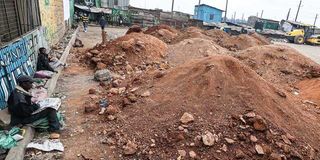
A view of the stalled Austin Grounds redevelopment project in Mathare's Kambi Safi area along Juja Road, Nairobi, on July 17, 2026.
Coach Gilbert Aseka trains Slum Soccer teams. The club has boys’ and girls’ teams across several age categories, making the pitch a vital community space.
“We’re used to the pitch flooding. When that happens, we can’t play,” he says.
With training cancelled, the team is forced to improvise. “We resort to gym activities or walking because the pitch is completely unusable.”
However, they caution against attributing the problem solely to climate change. While heavier rainfall is increasing the risk of flooding, poor drainage and inadequate planning have amplified the impacts, leaving pitches waterlogged long after the rain has stopped.
Urbanisation
As apartment blocks continue to replace open spaces in many urban areas and some schools lack adequate playgrounds, community pitches like the ones in Mathare have become increasingly important. They serve as a lifeline for children who rely on them to play football on weekends, during school holidays and outside school hours. For many, these grounds are their only access to organised sport.
“We live in an apartment, and I enrolled my eight-year-old son with a local club so that he can go out there and play. But whenever it rains, they cannot play. Sometimes they don’t play for weeks, even during school holidays,” explains Beatrice Kananu, a resident in Mathare.
Their experiences are backed by a report released last month, which warns that climate change is increasingly threatening grassroots football. By 2050, nearly 78 per cent (14 of 18) of the grassroots locations where football legends began their journeys are projected to experience days with WBGT levels above 32 degrees Celsius, conditions that require adjustments to training and match schedules, including cooling breaks. Collectively, these locations are expected to record about 1,250 such days, a 45 per cent increase compared with 2025.
The report, “Pitches in Peril” projects that 67 per cent (12 of 18) of the grassroots locations will experience days with WBGT levels above 35 degrees Celsius, conditions that pose a high risk to player health and can make outdoor football unsafe without significant precautions.
By 2100, rising temperatures could result in 17 days each year when extreme heat disrupts football activity, while water stress is projected to increase by 345 per cent, creating additional challenges for maintaining community pitches.
The findings were unveiled during the screening of Pitches in Peril: Mathare 4A, a documentary produced by UK-based non-profit Football for Future and Danish humanitarian organisation DanChurchAid. Hosted by the British High Commission in Nairobi, the event convened climate experts, football administrators and representatives from the governments of Denmark, Kenya and the United Kingdom to discuss how AFCON 2027 could leave behind not only sporting infrastructure, but also a legacy of climate resilience.
It focuses on the devastating floods that swept through Nairobi’s Mathare community in 2024, destroying homes, claiming hundreds of lives and submerging Mathare 4A, one of the area’s most important grassroots football pitches.
For decades, Mathare has produced athletes who have gone on to compete at the national and international level.
The documentary is centred on Meschack Ochieng, a professional footballer who currently plays for Sofapaka FC. “For many of us, pitches like Mathare 4A are where everything begins. It’s where young people find purpose, build friendships and believe in themselves. Communities like Mathare are strong and resilient, but when those spaces are affected by extreme weather, it’s not just football that is lost - it’s opportunity. Protecting these pitches means protecting the next generation of talent.
Elliot Arthur-Worsop, founder, Football for Future, said: “Mathare 4A reminds us that the future of football is not only decided in stadiums. It is shaped on community pitches, in local neighbourhoods and through the opportunities football creates for young people every day. As East Africa prepares to host AFCON 2027, we have a unique opportunity to ensure the tournament leaves a legacy that strengthens and protects the places where the game begins.”
“How can a football pitch help drive climate action in Kenya? A pitch is more than a place to play. This event reflects the UK’s commitment to work with Kenya to support communities adapt to climate change. We have brought together governments, sport, and community foundations in partnership to help shape a legacy: of how these pitches, the grassroots and foundations of our sport, are protected for the future.”
Follow our WhatsApp channel for breaking news updates and more stories like this


