How the solar revolution is transforming agro processing
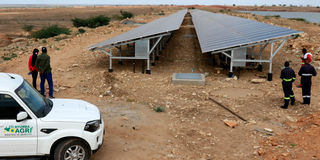
Solar Panels installed at the Galana- Kulalu Farm, which is managed by Nyumba AGRI, a private company operating in Tana River and Kilifi counties, in this photo taken on July 6, 2026.

What you need to know:
- Kenya’s energy reserve margin stands at a worrying 3.3 per cent, according to the Energy and Petroleum Regulatory Authority, well below the levels required to provide sufficient resilience to a growing power system
- One of the persistent weaknesses of agricultural value chains across Africa is that too much value addition takes place elsewhere
In the heart of Nairobi’s Industrial Area, beside the world-renowned Nairobi National Park and Kenya’s largest international airport, stands a modest, tucked-away building full of activity. Inside, energetic women in crisp white dust coats move briskly across the warehouse floor, packing horticultural produce bound for dinner tables around the world. French beans, snow peas and avocados are among the products aggregated, packed and preserved at peak freshness for customers thousands of miles away seeking nutritious, fresh food.
Yet behind this story of Kenyan enterprise sits a fundamental constraint. Kenya’s energy reserve margin stands at a worrying 3.3 per cent, according to the Energy and Petroleum Regulatory Authority, well below the levels required to provide sufficient resilience to a growing power system. Unless additional capacity comes online at pace, the country risks increasing pressure on the grid as electricity demand grows. Energy, therefore, remains central to Kenya’s industrialisation challenge.

As we walk through the agro-processing packhouse, one piece of equipment ubiquitous in manufacturing across Africa is conspicuously missing: a diesel genset.
“We moved that out months ago to our Tanzanian operations, and even that will not stay there for long,” says Dixon Mulwa, Finance Manager at Kandia Fresh Produce, beaming with pride.
Walking cautiously towards the back of the warehouse, the noise recedes, and bright lights suddenly illuminate the central control unit of the company’s solar and Battery Energy Storage System, or BESS.
This is the renewable energy dividend in motion before our eyes.
Touchscreens on the 120 kW inverters show green electrons flowing from the sun into the facility. With strong solar radiation, excess power moves swiftly into the batteries for use later. The utility switch is visibly off. At that moment, nothing is coming from the grid.
For a facility consuming more than 15,000 kWh each month, driven predominantly by power-hungry cold storage operating below zero degrees, the economics are compelling. The savings generated by the installation are expected to deliver a payback period of approximately two and a half years.
Across the world, the solar revolution is taking root. Once associated largely with expensive installations in wealthier economies, solar technology has become global, increasingly affordable and remarkably efficient. Since 2010, according to energy think tank Ember, solar panel costs have fallen dramatically, while battery prices have followed a similar trajectory.
China now dominates global solar and lithium-ion battery manufacturing capacity. Its enormous manufacturing base and resulting economies of scale present an opportunity for developing economies to leapfrog into a new era of green industrialisation.
Kenya should be particularly well positioned to take advantage of this shift. Sitting astride the equator, the country enjoys abundant solar irradiation throughout the year, yet much of this resource remains untapped for productive use.
The solar revolution is, however, beginning to reverberate across the continent. New solar installations are rising rapidly, led by markets including South Africa, Egypt and Nigeria. What was once seen primarily as an energy access technology is increasingly becoming an industrial competitiveness technology.
At FSD Kenya, in partnership with the Micro Enterprises Support Programme Trust, we initiated the Green Energy Transition for Agro Processing in Kenya programme to demonstrate exactly this opportunity. The initiative sought to develop practical financing models that enable agro processors to install solar and battery energy storage systems within their factories, reducing their dependence on expensive and sometimes unreliable grid-connected electricity.
The programme has also enabled processors to displace diesel generation, reducing both operating costs and carbon emissions as businesses move towards cleaner production.
The results are increasingly visible in the numbers. Many participating agro processors are achieving projected payback periods of less than four years through electricity savings, while reducing their carbon footprint at the same time.
Perhaps even more important is reliability. Access to clean and affordable electricity throughout the day enables processors to operate with fewer interruptions, improve production efficiency and reduce their exposure to volatile diesel and electricity costs. For businesses competing in international markets, energy reliability is not simply an environmental issue. It is a competitiveness issue. The ability of Kenyan agro-processors to take advantage of falling solar and battery costs represents a significant opportunity to make the sector more competitive both domestically and internationally. At its heart, this is a story about value capture.
One of the persistent weaknesses of agricultural value chains across Africa is that too much value addition takes place elsewhere. Market failures, high energy costs, infrastructure deficiencies and limited access to affordable capital have historically contributed to the offshoring of processing and manufacturing. The green industrialisation opportunity gives us a chance to reverse some of this. By combining affordable renewable energy with domestic processing capacity, countries such as Kenya can retain a greater share of the value generated by what they already produce, while simultaneously reducing Scope 1 and Scope 2 emissions.
Coffee provides a striking illustration of the economics of value addition. Switzerland grows virtually no coffee of its own, yet through roasting, branding, processing and its strategic position within European markets, it captures significant value from coffee grown elsewhere. According to the University of St Gallen’s Swiss Trade Monitor, the difference between the value of imported green coffee and exported processed coffee demonstrates just how powerful value addition can be.
The lesson for Africa is not simply that we should export more. It is that we should process more. Affordable green energy makes that increasingly possible. Combined with a young talent pool, competitive labour costs, high levels of education and improving infrastructure, countries such as Kenya are beginning to assemble some of the ingredients that supported the industrial transformation of the East Asian economies several decades ago.
It should therefore come as no surprise if we begin to see a gradual shift in the economic sands towards an African agro-processing revolution. Such a transition would strengthen agricultural value chains from the processor all the way down to the smallholder farmer, the silent army of hands sustaining a sector that contributes more than a quarter of Kenya’s GDP and supports the livelihoods of a majority of the country’s rural population.
The technology is ready. The economics are increasingly proven. The business models are emerging. The question now is how we scale these solutions across the sector and ensure that the value created is captured not only by processors, but by farmers, workers, consumers and the wider Kenyan economy.
Mugwe Manga is the Climate Finance Lead at FSD Kenya.