How Engineer Jennifer Gache helped shape Kenya’s wind and nuclear energy journey
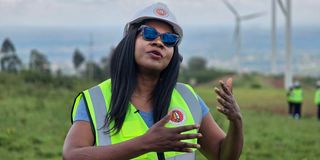
Eng Jennifer Gache explains her role in the establishment of the Ngong’ Wind Farm on April 7, 2026. She laid the foundation for the region’s wind energy sector by holding several engagements with renewable energy stakeholders to demonstrate the viability of the resource and guide the project through its development cycle.

What you need to know:
- Kenyan engineer Jennifer Gache has spent decades transforming renewable energy, industrialisation and women’s leadership across East Africa.
- From Ngong' wind turbines to nuclear energy planning, Jennifer Gache continues shaping Africa’s sustainable engineering future today.
The morning mist over the northern part of the green Ngong' Hills embraces the white clouds that seem to hesitate, as if deciding whether to let the sun warm the smoothly gliding turbines into rhythm.
By the time the sun reaches the ground and warms the turbine poles, the Kenya Electricity Generating Company (KenGen) will already have counted hours of glory in clean energy. KenGen’s Ngong Wind Farm was the first wind power project to be developed in East Africa.
It began with two wind turbines commissioned in 1993 as a donation from the Belgian government. However, the two turbines have since been retired. Before that, KenGen had, for 14 years, observed a favourable wind regime measured through two experimental wind turbines installed on the hills in the early 1990s.


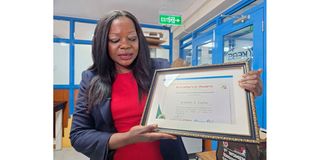
Eng Jennifer Gache displays a certificate among a collection of recognitions for her exemplary work at the leather testing laboratory at the Kenya Bureau of Standards on April 7, 2026.
According to KenGen’s website, as of 2022, it generated 25.5MW of electricity from wind energy at the Ngong' plant. A separate brief on its website indicates that today it has about 26MW of wind energy, which accounts for about two per cent of its total installed capacity.
In 2023, the State Department for Energy’s overview of the wind energy sector indicated that the installed capacity of grid-connected wind energy stood at 25MW, nearly all of it from the Ngong' Wind Farm.
The candle against a storm
Behind this flagship development in Kenya and Africa is Eng Jennifer Gache, who completed her six-year mechanical engineering degree (Production Technology option) at Jomo Kenyatta University of Agriculture and Technology in 1995, at a time when there were barely any female engineering graduates. A woman stepping into engineering then was like lighting a candle against a storm.
In 2017, figures from the Engineers Board of Kenya showed that women accounted for 8.8 per cent of graduate engineers, 5.4 per cent of professional engineers, and only 2.3 per cent of consulting engineers.
It was not much better four years later. A 2021 survey by Women in Real Estate revealed that, of the 1,974 engineers registered by the Engineers Board of Kenya, only 155 were women — just seven per cent. The disparities were even wider in leadership and ownership, with only two of the 132 local consulting firms being women-owned, representing 1.5 per cent.
Jennifer has become a light that no storm could extinguish. She is the flame behind the gliding Ngong' turbines. She worked as Chief Energy Planner at KenGen, where she was responsible for proactively planning and updating supply and demand forecasts for Kenya and the region, conceptualising the capital pipeline, and driving the strategic aspects of the annual planning cycle.
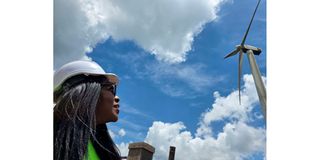
Eng Jennifer Gache looks towards a wind turbine at Ngong’ Wind Farm on April 7, 2026. She worked as chief energy planner at KenGen, where she was responsible for proactively planning and updating supply and demand forecasts for Kenya and the region, conceptualising the capital pipeline, and driving the strategic aspects of the annual planning cycle.
“I kicked off the installation of the 5.1MW wind farm at Ngong' Hills, thus establishing the wind sector in the region,” she says. “During this time, I held numerous meetings with stakeholders in the renewable energy sector to assure them of the viability of the resource and to work through the project cycle.”
This was alongside working with the Ministry of Energy to establish a wind energy map. In greenfield sites such as Bubisa in Marsabit and Loiyangalani in Turkana, her footsteps are evident. She developed the technical specifications for the 50-metre-high wind masts distributed across 12 sites in these regions.
“I had key responsibility for the management of the entire project,” she explains. “I developed technical specifications, project and contract documents, procured all inputs, including wind measuring masts and transport, and physically identified sites through collaboration and negotiation with local authorities.”
With her impact on wind energy firmly established, she moved into another complex and highly technical space: nuclear energy, where she once again lit the path forward.
Again lighting the path forward in nuclear energy
Nuclear energy ranks among the cleanest power sources when assessed across its lifecycle, according to the International Atomic Energy Agency (IAEA). It provides access to reliable, affordable electricity and accounts for about nine per cent of global electricity and 25 per cent of low-carbon electricity, without emitting greenhouse gases at the point of generation.
“Working closely with the National Council for Science and Technology, the International Atomic Energy Agency, and the Ministry of Energy, I served for five years as the focal person for the IAEA at KenGen,” she says.
In 2009, she served as project coordinator for a regional coordination meeting aimed at increasing awareness among decision-makers of the requirements and challenges of developing a feasible nuclear power programme.
Her role also involved building capacity: helping people and organisations gain the skills, knowledge and resources they needed to work more effectively. She trained and equipped teams on the key steps needed to develop a national nuclear power infrastructure.
In December 2009, she moved on to a higher regional role, leaving with her head held high, but her work had already set major wheels in motion.
“I left the role to colleagues, and since then the roadmap towards the development of nuclear energy has taken shape,” she says. “My efforts led to the establishment of Nupea (Nuclear Power and Energy Agency), and the conversation on nuclear energy is now well established in the country.”
Higher East African regional role
She later joined the East African Community (EAC) Secretariat as a Senior Industrial Engineer, where she developed the EAC Industrialisation Policy and Strategy (2012–32) and the EAC Industrialisation Action Plan (2012–17).
She also prepared a five-year work plan and roadmap and mainstreamed programmes under the Industrialisation Pillar of the EAC–Comesa–Sadc Tripartite Free Trade Area.
“I also worked on regional value chains such as agroprocessing and renewable energy; cotton, textiles and apparel; leather and leather products; dairy and sugar; fruits and vegetables; and nuts,” she says.
A trailblazing mentor
Beyond energy and industry, she is committed to uplifting younger women engineers as a trailblazer and mentor. She is a council member of the Institution of Engineers of Kenya (IEK), a role that has given her an influential platform.
In 2022, she successfully vied for a council member seat at the IEK. This opened another leadership responsibility: chairing the Women Engineers Committee (WEC), which she served from 2024 to 2025.
She leaves behind a strong legacy, including the first-ever WEC Summit. Fellow engineers also remember her structured mentorship programme, from webinars on job hunting and contract skills to “She to She” meet-up walks at Nairobi Safari Walk and Karura Forest.
Her performance has earned her multiple awards, including the 2025 IEK Advocating for Women in Engineering Award, the 2024 EAC–GIZ Extraordinary Performance Award, and the 2023 Exemplary Leader Award by the IEK.
“These milestones came through strategy,” she says. “It was through networking, having a good team, trusting them, and working collaboratively. It was also about creating win-win situations for all partners.”
Linda Lichuma, a graduate civil engineer and engineering intern at the Kenya National Highways Authority (Kenha), is among those she has mentored. Linda is part of a team designing a 200km road project at Kenha, an experience she describes as demanding and transformative.
Fresh from graduating from the University of Nairobi in September 2024, Linda says the transition from classroom learning to practice was far from seamless. On a scale of one to 10, she rates her engineering training at 7.5, noting the gap between theory and practice. “Nothing really fully prepares you for how difficult it is going to be,” she says. “But what sustains you is passion and the belief that you belong in Stem (science, technology, engineering and mathematics).”

Eng Linda Lichuma, a graduate civil engineer and engineering intern at the Kenya National Highways Authority, shares how Eng Jennifer Gache has mentored her and the impact it has had on her career so far, including reshaping her confidence.
Under Jennifer’s mentorship, Linda has grown beyond technical exposure. Through the Women Engineers Committee at the IEK, she has been introduced to decision-making spaces where projects are shaped. She now helps coordinate forums that bring together engineers and industry professionals.
“That opportunity showed me that young people need to be brought into rooms where decisions are made,” Linda says. “When you are given real responsibility, you learn by doing. By the time the baton is passed to you, you already know what to do.”
She credits the mentorship with reshaping her confidence: “It has taken away my imposter syndrome. It has affirmed my public speaking skills and shown me that capability is not defined by age or experience.”
Jennifer, too, is a product of mentorship from both male and female engineers. She began her career as a graduate engineer at Kenya Power and Lighting Company Limited (1998–99), attached to field teams across departments. Before that, she worked at the Kenya Bureau of Standards (1997–98) as a standards officer in the Mechanical Engineering Department, focusing on specifications, quality assurance, metrology and calibration. There, she was mentored by Eng Phillip Okundi and Eng Erick Nyamunga.
At Kenya Power, she was anchored by a leading female engineer from Uganda, Rosemary Tamusange, alongside Eng Rosemary Gitonga from Kenya.
Operating at another level
Today, as an EAC regional consultant for Gesellschaft für Anlagen und Finanzierungen (GFA Consulting Group GmbH) and as a consultant for Physikalisch-Technische Bundesanstalt (German National Metrology Institute), roles she has held since September 2023, she is operating at another level.
“My role is to look at a value chain and see how to upgrade it so that we undertake value addition within it,” she says.
She cites her work on the cashew nut value chain, where support is given to small and medium-sized processors through equipment that improves efficiency. She is also involved in promoting industrial testing standards and strengthening laboratories, including those at the Kenya Bureau of Standards.
“I identified a critical gap, one which, if addressed, would enable the bureau to perform its work more effectively, particularly in testing leather for shoes and other articles. With support from the German National Metrology Institute, we were able to provide equipment that strengthened the testing of leather products,” she says.
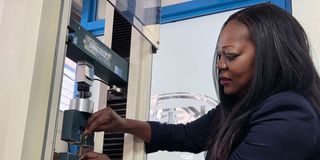
Eng Jennifer Gache at the leather testing laboratory, Kenya Bureau of Standards, on April 7, 2026. As a consultant for the German National Metrology Institute, she facilitated the equipping of the laboratory with tools that strengthened leather product testing.
“This was important because we don’t want a situation where a citizen buys shoes that pinch, or where a pair falls apart after just two weeks or a month of use. By filling this gap, the bureau can ensure higher quality standards and protect consumers from unreliable products.”
Role of women engineers in promoting development
Nzambi Matee, a materials engineer and founder of Gjenge Makers, which converts recycled plastic waste into paving blocks, illustrates the vital role of women engineers in driving development. She argues that this transformation requires intentional investment in women and the deliberate creation of opportunities.
“The first fundamental step is investing more in development spaces for women engineers,” she says. “That needs to be intentional. A lot has been done, I agree, but it must continue.”
She notes that progress is already visible at entry level, with more women entering engineering schools. “In our class, there were 52 students and only 12 women. By the time I was finishing, we were almost 40 women. When I looked later, it had grown to almost 60 students, and the gender balance was almost equal,” Nzambi says.
She joined Jomo Kenyatta University of Agriculture and Technology in 2011 for a degree in physics (pure and applied), completing it in 2014. Yet she insists representation alone is not enough: “Sometimes you just can’t wait for that space to be given to you. Sometimes you have to take it.”
By this, she means excellence: “Being so good at your work that no one can question your presence or your position.”
She recalls early career experiences where she had to prove herself repeatedly. “I had to work three or four times harder than my male colleagues just to be taken seriously,” she says. “Some would ask, ‘Do you even know what you’re asking for?’ and I would think, ‘Would they ask a man that way?’”
She adds: “At first it was painful. But now I’ve become thick-skinned.”
A future without limits
Jennifer wants to do more to change that. She is set to vie for the position of IEK treasurer in the next elections, with her sights later set on the presidency. No woman has ever held the presidency of the IEK.
“In all this, my goal is to inspire a generation of engineers, especially women, to see no limits to what they can achieve, while leaving behind structures that make it easier for them to succeed,” she says.
This story was supported by Bird Story Agency.