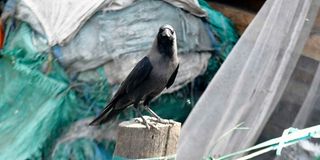
A trader at Burma Market noticed them first. Birds that did not belong; loud, dark, unfamiliar, working the stalls the way pigeons work a park bench. He chased them off and did not think much more of them. Then someone took a photograph, and that photograph landed on the desks of conservationists who had been dreading this exact moment for years.
The Indian House Crow, one of the most destructive invasive birds anywhere in the world, has reached Nairobi.
For most Kenyans, this is a coastal problem, something that happens in Mombasa. That has been true for the better part of a century.
They raided the nests of native birds for eggs and chicks. They took over garbage sites. They multiplied fast, with almost nothing on the coast willing or able to eat them.
Indian House Crows outside Burma Market on August 5, 2026.
Photo credit: Francis Nderitu | Nation Media Group
Now they are in Nairobi, a city more than four hundred kilometres inland, and the question everyone wants answered is the same one the Nation put directly to a scientist working the case: did nobody see this coming?
"It's been making its way inland because the population exploded along the coastal region all the way from Diani to Lamu, and now they have been following the linear infrastructure like roads. They breached the buffer zone we had set in Tsavo, ended up in Makindu, and then they came to Nairobi from there," said John Musina, a research scientist with the National Museums of Kenya.
Indian House Crows at the Mwakirunge dumpsite in Mombasa on October 4, 2021.
Photo credit: Kevin Odit | Nation Media Group
It is, he explained, a textbook invasive species.
"It suppresses native birds by raiding their nests and eating their chicks and eggs, outcompeting them for the same patch of habitat, because it simply reproduces faster than local species can keep up with," he said.
There is a mundane reason for that speed, and it has less to do with the bird's biology than with ours.
"One of the things that supplements the population is the extra food that they find at dumpsites," Musina said.
"This makes them reproduce more than they would in nature. If you have been to Mombasa, you know just how destructive this bird can be."
Threat to Nairobi National Park
What makes Nairobi's case different from Mombasa's is proximity to something the coast does not have to worry about in quite the same way: the Nairobi National Park, one of the only parks of its kind anywhere in the world, sitting inside the boundaries of a capital city. Wildlife biologists have warned that an established Indian House Crow population could threaten the park's native birdlife, and that growing numbers near Jomo Kenyatta International Airport and Wilson Airport could raise the risk of bird strikes on aircrafts.
A joint team from the National Museums of Kenya and the Kenya Wildlife Service is now surveying the city to determine exactly how many birds have arrived. So far, the sightings have remained confined to the Shauri Moyo-Burma Market area.
That containment is the one piece of the puzzle, and officials are treating it as a narrow window of opportunity.
"We intend to learn from the culling success in Mombasa and replicate that here in Nairobi in order to control the numbers," Musina said.
Kenya is not approaching this blind. Musina said the country is studying successful control programmes in Durban, South Africa, and in Sri Lanka, both places that faced the same bird and brought it under control. But he was careful to add a regional caveat.
"Eradication only works if neighbours cooperate. As we control the crows here, we need to talk to our neighbours, because they are all the way in Tanzania, the coastal cities, including Dar," he said.
"It is important that we coordinate, so that we don't eradicate them here and then they come in from our neighbours."
Between January and April this year, the Kenya Wildlife Service and its partners killed more than 140,000 house crows along the coast using Starlicide, a poison that breaks down in a bird's system within ten to twelve hours. But some conservationists warn that poisoning alone may not be enough. Crows are intelligent, and when one dies after eating something, the rest of the flock learns to avoid it, a phenomenon researchers call bait shyness. It is part of why Tanzania, despite large-scale culling of its own, has struggled to bring its coastal population under control.
No eradication effort has begun in Nairobi yet. But researchers are unanimous an early start, while the population is still small enough to count, may be the only real advantage the capital has.