The collapse of a 16-storey building in Nairobi’s South C estate, which killed two people, has exposed deep-seated failures in the country’s construction sector, with professional bodies warning Kenya is sitting on a crisis fuelled by corruption, poor oversight, counterfeit materials and political interference.
Professionals in the construction sector warn that these factors have combined to turn many residential buildings in the country into potential death traps. They say that without stricter enforcement of building codes and professional accountability, many of Kenya’s buildings remain unsafe for occupation, adding that some structures are dangerously vulnerable to minor tremors.
The sector’s professional bodies said that all members of a building’s development team should be accountable as per the National Building Code 2024.
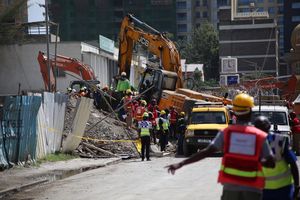
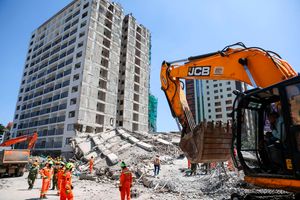
Search and rescue operations by National Disaster Management Unit, Nairobi City County, the National Police Service and the Kenya Red Cross at the site of the collapsed building in South C, Nairobi.
Photo credit: Billy Ogada | Nation Media Group
The success of a construction project depends on a chain of players who include developers, professionals, county governments and state agencies like the National Environment Management Authority (Nema) and the National Construction Authority (NCA). This chain is as strong as its weakest link.
The 2011 decision of the government to establish NCA to control the construction sector has not helped much.
On Wednesday, the professional lobbies, including the Institution of Engineers of Kenya (IEK), The Architects Alliance (TAA), Kenya Institute of Planners (KIP), Institution of Surveyors of Kenya (ISK), Institute of Quantity Surveyors of Kenya (IQSK), said the South C tragedy should serve as a catalyst for urgent reforms.
Rescue efforts underway as four people trapped under collapsed building in South C
“Many investigations have been done. There is no evidence that we have implemented the lessons learnt from the dissections and investigations. We are aware that different players are involved in building projects from planning, design, construction, maintenance and demolition. These include counties, regulators, ministries, departments, state and also involve independent consultants. We are aware that the law puts responsibility on all parties to take responsibility.. The failure to make people take responsibility makes this culture of impunity entrenched and there is no way to stop it,” the lobbies warned.
Describing the sector as a “ticking time bomb”, the bodies warned that it is only a matter of time before another disaster strikes—raising the troubling question of how many more lives could be lost. In a joint statement, the eight registered professional bodies blamed authorities at both national and county levels for approving unsafe developments.
Addressing the media in Nairobi on Thursday, the leaders of the professional bodies said the built environment—particularly in Nairobi County—was unfit for habitation.
“The state of the built environment in Kenya is dire. We are living by the grace of God. If a tremor, even a minor one, were to happen today, many buildings would come down,” warned Architectural Association of Kenya (AAK) President Prof George Ndege.
“How many buildings have natural light during the day? How many have fresh air, family-friendly spaces, proper sanitation and access to open areas for children to play? The number of buildings that are not fit for human habitation is extremely high,” he said.
He added that many developers flout planning laws with impunity, often shielded by powerful political connections.
As investigations into the South C collapse continue, the professional bodies demanded scrutiny of officials in Nairobi County’s Urban Planning Department, NCA and all agencies involved in approving the project.
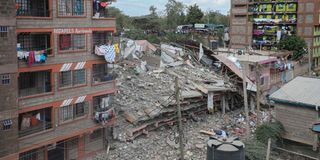
A seven-storey building that collapsed in Kahawa West, Nairobi County on October 20, 2024.
Photo credit: Dennis Onsongo | Nation Media Group
At the same time, a human rights activist has petitioned the High Court to remove NCA Executive Director Maurice Akech, alleging regulatory failures that contributed to building collapses in Nairobi. Mr Francis Awino argues that Mr Akech is unfit for office due to alleged negligence, incompetence and failure to enforce construction laws despite repeated warnings issued to developers.
He further states that investigations by the Nairobi City County and NCA revealed multiple violations, including a lack of approved structural plans, missing statutory inspections, and failure to obtain required geotechnical reports before construction of the collapsed building began.
“The building was non-compliant at the time of collapse,” Mr Awino states in his affidavit, noting that construction exceeded approved floors and proceeded without oversight from a structural engineer.
The case questions whether Mr Akech neglected his statutory duty to stop illegal construction and penalise developers violating safety standards.
Rescue teams retrieve body of one person from collapsed South C building
Despite enforcement notices issued by Nairobi City County in May, July and December 2025, construction allegedly continued unchecked by NCA.
According to AAK’s preliminary findings, the project exhibited multiple regulatory breaches, including the issuance of NCA registration before securing mandatory approvals from the county government and Nema. The association further noted that additional floors were approved without proof of structural review or inspection of ongoing works, raising concerns over how approvals were granted.
It also pointed to weak documentation of site supervision by the professional team, mid-project changes in consultants—including the structural and civil engineer—and the apparent disregard of enforcement notices and stop orders issued by both NCA and the county government.
“The incident points to failures across approvals, professional practice and enforcement,” Prof Ndege said.
TAA President Senator Sylvia Kasanga pointed to substandard construction materials and the presence of quacks as key contributors to building failures.
“The contractor must present certificates proving that the materials used met the required standards. We worry about counterfeit alcohol because it kills, yet our buildings are killing us silently. We don’t know the quality of materials being used and that is the harsh reality professionals are grappling with,” she said.
It has also emerged that the developer of the collapsed building was listed as the engineer, raising further questions about conflict of interest, approval procedures and quality control.
IEK President Shammah Kiteme said preventing future disasters would require insisting on competent and qualified professionals at every stage of construction.
“The audit must go beyond this incident to examine systemic failures. If we do not address this mess comprehensively, we will forget this tragedy and another building will collapse,” he warned.
Association of Construction Project Managers of Kenya President Ephraim Kakui said many developers collude with rogue engineers to erect structures without involving residents or resident associations, who could raise concerns such as poor design, lack of natural lighting and inadequate ventilation.
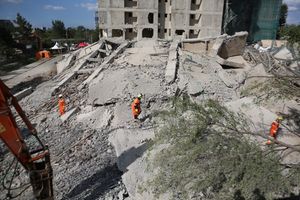
Search and rescue operations by National Disaster Management Unit, Nairobi City County, the National Police Service and the Kenya Red Cross at the site of the collapsed building in South C, Nairobi.
Photo credit: Billy Ogada | Nation Media Group
Corruption was repeatedly cited as a major driver of non-compliance, with approvals allegedly being fast-tracked through bribery.
Professionals also raised alarm over developers who add extra floors mid-construction without redesigning foundations, noting that such changes significantly increase structural load and risk of collapse.
While issuing a statement on Wednesday, Lands and Public Works Cabinet Secretary Alice Wahome said those responsible for the building collapse would be held accountable.
“A building that is professionally designed and constructed using the right materials should not collapse and kill people. Those responsible will carry the burden of punishment, and we will crack down on rogue developers, contractors and quacks,” she said.
Ms Wahome said investigations had already yielded crucial details pointing to shortcuts taken during construction and approval.
Lands CS Wahome: Collapsed South C building was illegally extended by four floors
“Looking at the rubble, it is clear this was a poor job. Everybody involved took shortcuts. The county bears responsibility for approving four additional floors when the building was nearly complete,” she said.
Attempts to obtain comment from Nairobi County’s Urban Planning Department were unsuccessful as calls and messages to Chief Officer Patrick Analo and the County Chief Executive Officer for Urban Planning, Patrick Mbogo, went unanswered.
Earlier, the Nairobi County Assembly Committee on Urban Planning had raised concerns about the pace at which new building approvals were being granted, warning that due process was being compromised.
A report by NCA cited an audit carried out in 2018 by the National Building Inspectorate covering 14, 925 buildings that revealed that 723 are very dangerous, 10,791 are unsafe, 1,217 are fair, and 2,194 are safe.
“These unsafe and dangerous buildings eventually collapse,” stated the study report titled Research on failure and collapse of buildings in Kenya.
“It is estimated that over 200 people have lost their lives since the first building collapsed in 1990, with thousands injured. The economy has equally lost over Sh2.4 billion worth of investments,” it stated.