KWS rejects claims luxury lodge blocks wildebeest migration routes
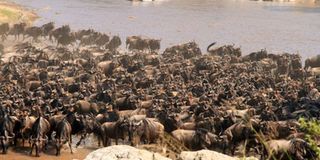
Wildebeest cross the sand river from Serengeti National reserve in Tanzania to Maasai Mara Game Reserve in Kenya on July 22, 2020.


Months of acrimony over the Ritz-Carlton Masai Mara Safari Camp took a dramatic turn on Thursday when the country's top wildlife authority issued a sweeping defence of the luxury lodge.
The Kenya Wildlife Service (KWS) defense contradicts claims that the lodge obstructs one of the world's most critical migration routes for wildebeest and other species on the Maasai Mara.
The Kenya Wildlife Service statement provides the most comprehensive official backing yet for the camp, which opened in August, amid fierce opposition from conservationists and Maasai leaders.


"All ecological, environmental, and regulatory requirements were thoroughly met and validated prior to approval," reads the statement.
It comes as Dr Meitamei Olol Dapash, the conservationist who has waged the loudest campaign against the development, has been silenced by court-issued gag orders.
The camp, managed by the Ritz-Carlton brand and owned by the private Kenyan company Lazizi Mara Limited, sits on an islet along the Sand River inside the Masai Mara National Reserve.
Each of its 20 tented suites commands nightly rates starting at around $3,500 (Sh454,000) per person, offering what Marriott International has described as a front-row seat to the Great Migration.
But what the property promises as a luxury experience, Dr Dapash and other conservationists argue is an ecological disaster. His legal challenge, filed days before the camp's opening in August, alleged it blocks a vital wildlife corridor used by over 1.5 million wildebeest, zebras and other species crossing between Kenya's Mara and Tanzania's Serengeti.
Thursday's KWS statement directly contests that claim. The agency states that long-term GPS collar data collected from more than 60 migratory wildebeest between 1999 and 2022 shows the Sand River site is not within a migration corridor. Each GPS collar, the statement explains, represents herds of between 2,000 and 100,000 animals, suggesting the dataset captures the full scope of wildebeest movement patterns across decades.
"Several of the images, pictures, and narratives circulating online relate to historical events that were addressed in previous years, around 2018 and 2020. These materials are outdated, misleading, or presented without proper context, and may also reflect opposing and competing commercial interests surrounding tourism investments in Mara," KWS said in the statement.
Zoning framework
"The integrity of the wildebeest migration corridors has been scientifically verified," KWS said, adding that the site sits within a designated tourism investment low-use zone as outlined in the Maasai Mara National Reserve Management Plan 2023-2032.
The zoning framework, it says, was established through joint scientific assessments by national and county governments.
In court filings and public statements, Dr Dapash has insisted that the Sand River is a historically crucial wildebeest crossing where animals have crossed for decades following ancestral paths.
Yet the government's position finds an ally in the developer's own public stance.
In a response to Nation Media Group's questions in August and provided by Lazizi Mara Limited, the company said that no trenches or artificial mounds have been constructed to disrupt wildlife movement. "The lodge follows a low-impact design that works with natural land contours," the developer's statement said. "To date, there have been no incidents of wildlife disruption, injury, or death caused by the development."
The developer further maintained that the project aligns with the Maasai Mara Management Plan 2023-2032 which, it notes, "recognises existing designated sites, including Sand River, for sustainable tourism." Lazizi Mara also pointed out that five permanent safari camps and over two seasonal camps already exist along the Sand River, none of which have attracted similar opposition.
"Therefore, the long-term monitoring data conclusively indicates that the location of the Ritz-Carlton Safari Camp and the other five safari camps along the Sand River camps do not fall within, obstruct, or interfere with any wildebeest migration corridors," KWS said.
The broader Mara ecosystem faces mounting pressures from tourism expansion. Camp numbers have surged from 95 in 2012 to 175 by 2024, according to conservation experts. The rapid growth has prompted new regulatory approaches. In August 2025, the Masai Mara implemented stricter vehicle management rules around Mara River crossings during migration months. Visitors are no longer allowed to park within prescribed distances from the river banks, and more than five vehicles at any sighting are restricted to ten-minute viewing windows.
However, enforcement of existing rules has proven inconsistent. In 2015, authorities temporarily ordered several camps to close and submit documentation after concerns emerged that they were operating without proper environmental compliance.
The Maasai Mara Management Plan, adopted in 2023, acknowledged the problem, placing a moratorium on new lodges and camps through 2033. Notably, the Ritz-Carlton received a one-time presidential exemption from that moratorium, a decision critics argue undermines the planning framework. The plan also included proposals to potentially close camps that exceeded capacity limits or violated environmental codes, though specifics on which facilities might be targeted have not been made public.
In August 2025, video footage emerged showing tourists blocking wildebeest attempting to exit the Mara River near Purungat Gate. Officials clarified that the animals had been swept downstream from their intended crossing point by flooding, but the incident reignited scrutiny on vehicle management and visitor conduct at critical river crossings.
KWS, meanwhile, has said the government's broader commitment to protecting wildlife corridors. The agency cited recent Cabinet approval to secure the Nairobi National Park to Athi-Kapiti wildlife corridor as evidence of that dedication. The wildebeest migration, KWS notes, was recently recognised by the World Book of Records and World Tourism Market as the world's greatest annual terrestrial wildlife migration and leading African tourism destination respectively.
In response to allegations of encroachment, Lazizi Mara rejected claims that the development proceeded without proper environmental review. The company said that a full Environmental Impact Assessment was conducted in 2022 by a Nema-licensed expert, covering ecological surveys, wildlife assessments and socio-economic impacts. "Following due diligence, Nema reviewed, approved, and issued an EIA licence," the developer's August statement asserts.
However, questions about transparency in that process persist. Dr Dapash has questioned why no public notice of the environmental assessment was published in Kenya's official gazette, as required by law. Some allegations have emerged that community consultation documents contain signatures from individuals who claim they were never consulted, though these claims remain contested.
Follow our WhatsApp channel for breaking news updates and more stories like this.