Fourteen governments have united to promote global fisheries transparency and intensify efforts against illegal, unreported and unregulated fishing in what they termed as the Mombasa Declaration, as Kenya affirms its active role in ocean conservation.
During the official opening of the 11th Our Ocean Conference, President William Ruto in his video speech highlighted the ocean’s importance in powering industries and feeding families.
The President however noted that the water body faces threats like global warming, plastic pollution, illegal fishing and the silent disappearance of life beneath the waves.
He affirmed Kenya’s active role in ocean conservation saying government is committed in conserving ecosystem.
“Kenya is already at work. We are restoring mangroves, cleaning our waters, reforming fisheries, and strengthening ocean governance. We are opening doors to blue finance, science, and innovation so that conservation creates opportunities," said President Ruto.
Deputy President Kithure Kindiki called for accelerated efforts to protect marine biodiversity, address climate change impacts, and safeguard sensitive ocean ecosystems.
He reaffirmed the government’s determination to preserve Kenya’s ocean to secure better economic benefits now and for future generations.
"The ocean is key to Kenya’s economic growth, hence the interest in guarding it against destructive activities, including climate change and related challenges. We have an obligation as the current generation to return the ocean to our children cleaner, richer, and more resilient than we found it. That is how profound our obligation is,” said Prof Kindiki.
On the sidelines of the conference 14 countries from Africa, Asia, the Caribbean, Europe and the Pacific adopted the Mombasa Declaration, a commitment to improve transparency in fisheries worldwide and strengthen the fight against Illegal, Unreported and Unregulated (IUU) fishing.
The Mombasa Declaration calls on coastal and flag States to enhance fisheries transparency, focusing on better collection and sharing of vessel information and improved access to fisheries data.
It supports the Global Charter for Fisheries Transparency, which outlines 10 low-cost or no-cost policy principles for governments to adopt globally, both legally and practically.
Countries which endorsed the coalition include Belgium, Cameroon, the Dominican Republic, France (on behalf of its overseas territories), Gambia, Ghana, Guinea, Liberia, Panama, Papua New Guinea, Peru, Somalia, South Korea, and the Republic of Congo, the declaration unites nations committed to strengthening ocean governance and leading global fisheries transparency efforts.
Signatory countries will begin implementing the declaration and launch a campaign encouraging other nations to join before the next Our Ocean Conference in 2027. IUU fishing severely impacts coastal communities, small-scale fishers, and economies reliant on marine wildlife by threatening livelihoods, food security, and ocean health.
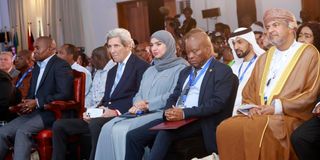
Delegates, including former US Secretary of State and Our Ocean Conference founder John F. Kerry, applaud Deputy President Kithure Kindiki during the official opening of the 11th Our Ocean Conference, where he represented President William Ruto, in Mombasa on June 17, 2026.
Photo credit: DPCS
The Mombasa Declaration advances practical transparency measures from the Global Charter to improve access to vessel ownership, licensing, and fishing activity information. It also champions for measures to strengthen accountability and enable more sustainable and equitable marine resource management.
During the event, former US Secretary of State and founder of the Our Ocean Conference, John Kerry asked all port states to adopt and implement Port State Measures (PSMA), the world's first legally binding international treaty specifically targeting illegal fishing.
Mr Kerry said currently, 75 countries are parties to the agreement and there's need to push for universal adoption.
"The treaty will help in conserving environment and ecosystem, and it aims to prevent vessels involved in illegal fishing from using ports and landing their catches, effectively denying them access to international markets," said Mr Kerry.
International cooperation
Mr Emelia Arthur, Ghana’s Minister of Fisheries and Aquaculture, said his country is proud to be among the first states to sign the Mombasa Declaration, which provides a platform for governments to unite internationally to fight for transparency in fisheries.
“In my country, our very existence depends on fish. Sixty percent of our animal protein comes from fish, and 10 percent of our population depends on the fisheries value chain for livelihood. Fisheries are a matter of culture and national security for us," he said.
France’s Minister Delegate for the Sea and Fishery Catherine Chabaud said the initiative is based on the conviction that combating IUU fishing effectively requires greater transparency and international cooperation.
"The Declaration offers an important opportunity for governments to demonstrate political commitment to improving fisheries governance. We hope many more will join and implement the commitments, making transparency the norm,” said Ms Chabaud.
Developed with support from the Coalition for Fisheries Transparency and its partners, including academics and practitioners, the declaration commits signatory countries to reforms like modernizing vessel registries, publishing fishing authorizations, and strengthening information-sharing to support enforcement and accountability.
IUU fishing is a global challenge costing the economy up to $50 billion (Sh6.5 trillion) annually, depriving legitimate fishers especially in low- and middle-income countries of income and access to resources.
It contributes to declining fish stocks, threatens food security, and is linked to human rights abuses such as unsafe working conditions and forced labor.
Limited transparency in vessel ownership, tracking, fishing activity, and supply chains allows these practices to continue, making reliable fisheries data and accountability mechanisms essential to protecting marine ecosystems and dependent communities.
Director of the Coalition for Fisheries Transparency Maisie Pigeon said a productive and sustainable blue economy depends on strong ocean governance, effective monitoring, and accessible data.
"The countries signing today represent diverse economies and geographies, showing that momentum for transparency at sea is truly global. We look forward to working with them and others to advance meaningful fisheries reforms," said Director.
For too long, fisheries have operated far from shore with inadequate oversight and opaque supply chains. These practices have depleted fish stocks, undermined coastal communities, and enabled illegal fishing and human rights abuses.
The Mombasa Declaration signals that governments worldwide are ready to act against illegal fishing and work together for a more transparent, equitable, and sustainable ocean.
“Transparency exposes abuses, supports coastal communities, and rebuilds trust that fisheries can be managed sustainably and fairly. I applaud every state endorsing the Mombasa Declaration and urge others to follow," Steve Trent, CEO and Founder of the Environmental Justice Foundation, added.
Mombasa Declaration is a turning point when governments commit to transparency in sharing vessel identities, ownership, and tracking data they build an interconnected network where bad actors have nowhere to hide.