Former US Secretary of State John Kerry has challenged Commonwealth nations to take a leading role in accelerating global ocean conservation efforts, saying the world is running out of time to protect marine ecosystems and address climate change.
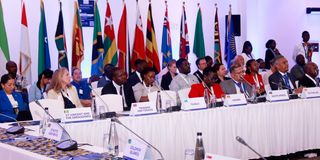
Speaking at the Commonwealth Ocean Ministers Roundtable in Mombasa on Tuesday, Mr Kerry who is founder of the Our Ocean Conference (OOC), described the gathering as historic, noting that it marked the first time a major global conference focused on oceans had been hosted on African soil.
The annual conference that convenes governments, Non-Governmental Organisations, the private sector and the academic community to identify action-based solutions and make tangible commitments, is taking place in Mombasa this week.
"It is really a privilege for me to be able to share with you a few thoughts as you convene this meeting on African soil, the first time in history where there's been a global conference regarding the oceans in Africa," said Mr Kerry.
The roundtable was hosted by Cabinet Secretary for Mining, Blue Economy and Maritime Affairs Hassan Ali Joho.
Mr Kerry, who launched the first conference in Washington, US in 2014, reflected on the initiative's growth into a global platform for marine conservation and sustainable ocean management.
"None of us had any idea how it was going to turn out. It was an experiment, if you will, but countries from all over the world came together and we decided to continue it," he said.
He said the central role oceans play in sustaining life and regulating the global climate system, warning that current conservation efforts remain insufficient. Mr Kerry championed for the global goal to protect 30 percent of the world's oceans by 2030 through effective conservation measures and marine protected areas (MPAs), popularly known as the 30x30 initiative.
"The progress on 30 by 30 is real, but it's not enough. We're not doing it fast enough," he said.
Although more than 10 per cent of the world's oceans are now under some form of protection, the former US Special Presidential Envoy for Climate noted that only three per cent are fully or highly protected.
Former US Secretary of State John Kerry addressing the Commonwealth Countries Ocean Ministers Conference in Mombasa during the kickoff of the 11th Our Ocean Conference in Mombasa on June 16, 2026.
Photo credit: Kevin Odit | Nation Media Group
He also called on countries to ratify and implement the High Seas Treaty, which entered into force earlier this year and provides the first legal framework for creating protected areas in international waters.
"My ask now is very simple, ratify it if you haven't and move immediately to implementation," he urged.
Mr Kerry praised African nations for championing transboundary marine conservation initiatives and cited commitments by Gulf of Guinea countries to sustainably manage all their waters by 2030.
"We owe it to future generations to fulfill the promises that have been made.This is the moment to make a difference," he said.
The Commonwealth Ocean Ministers Roundtable on the margins of Our Ocean Conference in Mombasa, discussed key priorities, including progress on the Apia Commonwealth Ocean Declaration and the Biodiversity Beyond National Jurisdiction (BBNJ) Agreement.
CS Joho said the conference presents a critical opportunity for countries to review commitments made since the initiative was launched in 2014 and translate them into concrete action that benefits communities dependent on marine resources.
The CS noted that more than 2,900 commitments valued at over $160 billion 9Sh20.6 trillion) have been made through previous editions of the conference.
"What we want to achieve here is to close the gap and move into tangible action where conversations are turned into concrete and implementable plans so that communities and Beach Management Units (BMUs) can feel the impact," said Mr Joho.
Mining Cabinet Secretary Hassan Joho briefs the Media ahead of the Kick off of the 11th Our Ocean Conference in Mombasa in this photo taken on16th June 2026.
Photo credit: Kevin Odit | Nation Media Group
According to the CS, the discussions come at a time when countries are grappling with increasing threats to ocean ecosystems, including pollution, climate change, biodiversity loss and illegal fishing.
The CS described the conference as a major achievement for Kenya, saying it provides an opportunity for the country to learn from global best practices while showcasing its leadership in the blue economy sector.
Beyond environmental conservation, Mr Joho said the conference offers practical benefits for coastal communities whose livelihoods depend on fishing and marine resources.
Mr Joho revealed that delegates are discussing the possibility of establishing a global blacklisting system for vessels involved in illegal fishing activities. Under the proposal, vessels found engaging in illegal fishing in one country would be prevented from operating freely in other waters.
He also called for greater sharing of surveillance technology, enforcement mechanisms and fisheries data among countries to improve monitoring and compliance.
"We need data sharing, information sharing and surveillance technology so that we know who is operating in our waters and whether they are licensed and regulated," he said.
At the same time, Mr Joho highlighted significant progress Kenya has made in developing its blue economy sector. He said that the number of Kenyan-owned and Kenyan-flagged fishing vessels operating in local waters has increased from about seven a year ago to more than 50 today.
The government is also pushing for increased fishing quotas through the Indian Ocean Tuna Commission (IOTC), where Kenya currently holds a quota of about 3,200 tonnes. The CS said discussions are ongoing to nearly double that allocation, particularly for highly valuable tuna species found along Kenya's coastline.
To support the sector, the government has invested heavily in fish landing sites, modern fish markets, research centres and fishing ports including Shimoni and Liwatoni. He said additional investments are planned in Lamu and other coastal counties as part of efforts to unlock the country's vast blue economy potential.