Premium
Ordinary citizens are fuelling climate action through grassroots fundraising
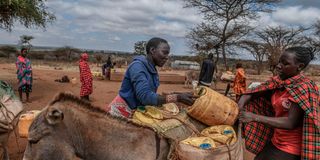
Locals with their animals in a drought affected area on August 29, 2025 in Bisil town, Kajiado County. Kenya is struggling with drought due to climate change and irregular rainfall. The drought poses a serious threat to agriculture, water supply, and livelihoods. The depletion of water resources is adversely affecting the local community, who rely on livestock for their livelihood.
What you need to know:
- Environmental organisations, in particular, are said to be capitalising on growing public awareness of climate change, using small but consistent contributions from citizens to fund rapid-response initiatives, grassroots activism, and sustainable development projects.
At shopping malls, office complexes, and public events across Africa, encounters with fundraisers are a familiar part of urban life.
Shoppers are often approached by young men and women requesting to discuss their causes, and, if possible, donations. Others stand behind neatly arranged booths, tablets in hand, inviting passers-by to sign up for monthly contributions.
Until recently, this was not common with environmental organisations. However, they are now increasingly turning to face-to-face appeals to sustain their operations, reflecting a changing fundraising landscape where they are seeking more direct engagements with the public amid tightening funding channels and shifting donor priorities.
Environmental organisations, in particular, are said to be capitalising on growing public awareness of climate change, using small but consistent contributions from citizens to fund rapid-response initiatives, grassroots activism, and sustainable development projects.
Across the African continent, local fundraising is proving that even modest donations, whether for a school, a community farm, or a renewable energy pilot, can collectively mobilise significant resources.
For the climate sector, this model allows organisations to respond faster to disasters, support local innovators, and implement projects that might otherwise be stalled by slow or conditional international funding.
Africa’s climate crisis is unfolding alongside a deeper financial failure. While the continent contributes less than four per cent of global greenhouse gas emissions, it receives under 12 per cent of global climate finance, a disparity that experts say is crippling efforts to respond to climate shocks and transition to clean economies.
Speaking during the African Climate Investment Summit in Nairobi in 2025, Environment and Climate Change Cabinet Secretary, Deborah Barasa, described climate finance as both a tool and a weapon. She argued that the very institutions mandated to support vulnerable countries have instead erected barriers that keep funding out of reach.
“The imbalance is not accidental, it is the result of a system that continues to prioritise profit and paperwork over people and climate justice,” she explained.
The impact of this imbalance is particularly stark for innovators and community-level actors. Less than two per cent of global climate finance currently reaches African entrepreneurs, despite their central role in renewable energy, climate-smart agriculture, and waste management solutions. Funding models that rely heavily on commercial loans systematically exclude women, youth, and marginalised communities, who often lack collateral or financial buffers.
Delays in funding approval have tangible consequences
By the time proposals navigate international bureaucracies, climate-related disasters have often already struck, turning promised support into a post-crisis gesture rather than a preventive lifeline.
Policy experts described the system as dysfunctional, noting that inefficiency has become a direct threat to adaptation and resilience efforts.
For Kenya alone, the funding gap is vast. The country estimates it needs Sh8 trillion to meet its emissions reduction targets by 2030. To bridge the gap, the government seeks Sh5 trillion from international and private-sector partners, alongside domestic investment. Yet officials insist the issue is not charity but equity.
“This is not aid we seek. It is a direct and transformative investment opportunity,” CS Barasa said, highlighting frustration with a global system that demands climate commitments while withholding the resources to implement them.
Shift to local fundraising
Across major African cities, fundraising has moved from donor conferences and diplomatic pledges to shopping malls, public events, and digital platforms, where organisations engage directly with citizens willing to contribute small but consistent amounts.
For Greenpeace Africa, local fundraising is both a strategy and a necessity.
Meshack Mofolo, Greenpeace Africa’s Acquisitions Manager, told Climate Action that the organisation prioritises individual donors over corporate or government funding to maintain independence and ensure campaigns remain critical and uncompromised.
Globally, Greenpeace counts approximately three million individual donors. In South Africa alone, the organisation has more than 30,000 registered donors, even though fewer than 20,000 donate consistently.
In Kenya and South Africa, contributions start from as little as Sh500 and 300 rands, respectively.
“Relying on local donors ensures our work reflects African priorities, while also protecting us from sudden funding shocks and bureaucratic delays,” said Mr Mofolo. “Even small contributions, when combined, allow us to launch rapid-response campaigns and support grassroots activism, particularly for women, youth, and marginalised communities often excluded from conventional climate financing.”
Greenpeace’s funding model combines individual giving with trusted foundation support. Individual giving occurs mainly through face-to-face engagement (70 per cent), telemarketing (25 per cent), and digital platforms (5 per cent).
Representatives target controlled environments such as malls and organised events, prioritising areas with middle- and upper-income populations more likely to sustain monthly donations. Foundation support is carefully vetted and restricted to campaigns that align with Greenpeace’s environmental and ethical principles.
Beyond Greenpeace, other African organisations have embraced local fundraising.
Green Belt, for instance, relies primarily on support from partner organisations, including donors connected to the late environmental champion Wangari Maathai. Funds are used for restoration projects and advocacy, while online platforms facilitate contributions from supporters willing to support environmental initiatives.
The Green Belt Movement in Kenya combines tree planting and environmental restoration with community empowerment, particularly for women, supporting sustainable livelihoods, climate adaptation, and environmental advocacy.
Meanwhile, Seed Savers Network (SSN) generates 90 per cent of its funding from donors, while the remaining 10 per cent comes from community-driven projects.
These include value addition initiatives, farmer training on seed banking, and providing working spaces for small-scale entrepreneurs.
“These initiatives help farmers preserve indigenous seeds, establish seed banks, practice sustainable farming,” Julia Kamau from SSN said, “and provide workspaces for small entrepreneurs, like our hub in Baringo,” she added.
The move toward local contributions is driven by both necessity and principle. International funding is often slow, tied to restrictive conditions, and inconsistent, while reliance on local donors ensures that funding decisions reflect African priorities.
“Local funding ensures our work reflects African priorities and protects us from sudden funding shocks and bureaucratic delays,” Mofolo said.
According to Greenpeace Africa, the small monthly donations from allow organisations to maintain rapid-response campaigns, support grassroots activism, and amplify the voices of women, youth, and marginalised communities often excluded from conventional climate finance.
Local fundraising also allows organisations to strengthen community engagement, cultivate long-term support networks, and build a sense of collective ownership.
In South Africa, security concerns and safety risks have led Greenpeace to prioritise controlled spaces such as shopping malls and organised events, rather than traditional street fundraising. At the same time, targeting areas with higher Living Standard Measures (LSM) ensures higher conversion rates for monthly donations while still raising awareness among broader communities.
Telemarketing and digital platforms complement face-to-face engagement, generating leads primarily through social media and websites, which are then converted into recurring support. Digital giving, though still a small portion of total donations, has grown steadily over the past two years, showing potential for future expansion.
Despite these successes, challenges persist.
Market saturation and donor fatigue are significant issues, with many NGOs competing for attention in malls and public spaces.
Economic realities, including high unemployment and rising costs for operational logistics such as mall space and event fees, further constrain fundraising outcomes.
As a result, the organisations invest heavily in staff training, improve engagement quality, and maintain donor retention programs.
Funds raised through local contributions directly support the communities and ecosystems that these organisations aim to protect. The donations are used to fund initiatives such as deforestation prevention, reduction of plastic pollution, renewable energy advocacy, and policy influence.
Similarly, SSN invests in community development through farmer training, seed banking, and small-scale enterprise support, creating opportunities for economic growth alongside environmental conservation.
Green Belt’s restoration projects and advocacy campaigns protect natural habitats while empowering local communities to engage in sustainable practices.
“Fundraising is not just about money, it is about building a community committed to environmental justice,” Mofolo said. “Each contribution strengthens the movement, allowing us to act independently, respond quickly, and empower communities to claim their right to a greener, healthier future.”
As international funding often arrives too late, African organisations are turning to grassroots, locally driven contributions as a practical, effective and sustainable path.
For African communities and ecosystems, street-level fundraising has become a practical way to secure resources and respond to environmental challenges locally.
[email protected]