Drought puts 25 million at risk across Kenya, Somalia, Ethiopia
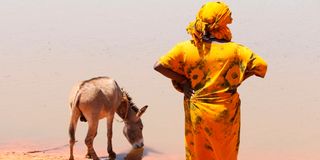
A woman watches as her donkey drinks water at Abaqiq dam in Garissa County on December 6, 2025. Most water sources in North Eastern region have dried up.

What you need to know:
- In Kenya, the government announced that at least 2.1 million people across 32 counties are facing food and nutritional insecurity after the October-to-December short rains underperformed.
Millions of people across the Horn of Africa are facing deepening food insecurity following one of the driest October–December rainy seasons on record that severely disrupted crop production, pasture and water availability.
A new regional alert by the Famine Early Warning Systems Network (FEWS NET) has warned that between 20 and 25 million people in Kenya, Somalia and Ethiopia are now in need of humanitarian food assistance, with drought accounting for more than half of the crisis.
This unfolding disaster comes barely three years after the devastating 2020–2023 drought, leaving communities with little time to recover fully and drastically reducing their ability to cope. Seasonal rainfall across much of the region has been less than 50 per cent of average and in some areas below 30 per cent.
The FEWS NET reports that many water points are now at near-dry or alert levels, while vegetation conditions in the worst-affected zones have dropped to below 60 per cent of the normal.
The network projects substantial harvest losses in January and February that will reduce household food stocks and incomes from crop sales and farm labour.
"Substantial losses are anticipated for the October-November-December rainy season harvests in early 2026," the alert states.
"This will sharply limit household food availability in cropping and agropastoral livelihood zones and reduce access to food as market supplies tighten regionally and food prices rise."
The alert places pastoral communities at "under severe strain" as pasture and water sources dry up. So far, the report says livestock body conditions are deteriorating rapidly, including among others drought-tolerant camels, leading to declining milk production.
Migrations in search of grazing pasture have increased disease outbreaks and heightened the risk of resource-based conflict, particularly along border areas of Kenya and Somalia, the alert states.
Malnutrition
FEWS NET says that malnutrition rates are already elevated, particularly among children under five, and are expected to worsen during the January–February dry season as families reduce meal sizes, rely on less preferred foods and withdraw children from school to cope.
Further, the alert cautions that the outlook hinges heavily on the performance of the March–May 2026 long rains.
In Kenya, the government announced that at least 2.1 million people across 32 counties are facing food and nutritional insecurity after the October-to-December short rains underperformed.
Deputy President Kithure Kindiki noted that failed rains have left millions in urgent need of food, nutrition and health support, warning that both human livelihoods and livestock are at risk over the next six months as the country waits for the March to May long rains and the subsequent harvest.
According to assessments by the Kenya Meteorological Department, the affected counties will require sustained humanitarian and non-food interventions until at least mid-2026, when crops from the long rains season are expected to ease pressure on households grappling with hunger and malnutrition.
"The October–December short rains have underperformed, exposing an estimated 2.1 million people across 32 counties to food and nutritional insufficiency," DP Kindiki said in a statement last week following a high-level government meeting on the drought situation.
The situation is compounded by poor pasture regeneration and drying water sources, placing pastoralist communities and their livestock at heightened risk of starvation.
Projections show that the situation may worsen if dry spells persist in the coming months.