Report: A sustainable future demands new thinking, not business as usual.
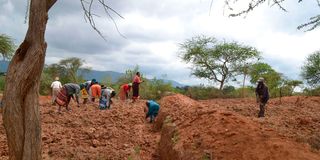
Men and women members of Umiisyo wa kwa Kathee join hands to rehabilitate degraded land in their village

What you need to know:
- Published every six years, the GEO is regarded as one of the most authoritative assessments of the threats confronting the planet.
- A multidisciplinary group of 287 scientists from 82 countries warns that the combined weight of climate change, land degradation, biodiversity loss, plastic pollution and waste is inflicting costly damage on the planet, its people and economies, running into trillions of dollars.
Time is running out.” When you hear those words, they can spark an alarm or signal that urgent action is needed. The latter is what scientists pressed on early this week as they launched the seventh edition of the Global Environment Outlook (GEO-7) at the sidelines of the ongoing United Nations Environment Assembly (UNEA). This is the seventh session of the assembly, which meets biennially to set priorities for global environmental policies.
Published every six years, the GEO is regarded as one of the most authoritative assessments of the threats confronting the planet. The sixth edition was released in 2019, and the seventh, unveiled this week and dubbed “A future we choose”, is considered the most comprehensive yet, spanning more than 1,200 pages.
It is the first time that indigenous people and traditional knowledge holders from across the world have been involved in the report-making process, shaping its outcome.
Now, a multidisciplinary group of 287 scientists from 82 countries warns that the combined weight of climate change, land degradation, biodiversity loss, plastic pollution and waste is inflicting costly damage on the planet, its people and economies, running into trillions of dollars.

Also read: https://nation.africa/kenya/health/un-report-maps-path-to-profit-from-waste-management-4541842
“These interconnected crises, which are undermining human well-being and primarily caused by unsustainable systems of production and consumption, reinforce and exacerbate each other and need to be addressed together,” reads the report.
Key findings
The climate crisis, the report details, may be worse than assumed. Between 20 and 40 per cent of the land area globally is considered degraded, directly or indirectly affecting at least three billion people. Biodiversity loss has also increased over the years, with one million of an estimated eight million species being threatened with extinction. Further, nine million deaths are attributed to some form of pollution.
The GEO-7 report emphasised that a business-as-usual pathway will result in a loss of trillions of dollars, revealing that unsustainable food production and fossil fuel production are already causing Sh646.3 billion ($5bn) of environmental damage every hour. On matters of health, the scientists noted that health damages from air pollution alone were about Sh826 trillion in 2019.
Many parts of the world are experiencing land degradation, with the new report indicating that this is expected to continue at current rates. Unless tangible action is taken, the world could lose “fertile and productive land the size of Colombia and Ethiopia annually, at a time when climate change could reduce per person food availability by 3.4 per cent by 20250.”
According to the World Resources Institute, not affiliated with the GEO-7 report, Kenya is among the countries whose food security is under threat, a result of land degradation. A report by the organisation shows that more than 30 per cent of the agricultural land is degraded.
Prof Robert Watson, the co-chair of the assessment, argues that these issues can no longer be simply thought of as environmental issues. “ They're economic issues, development issues, security issues, social, moral, and ethical issues. And most of the agreed international targets, environmental and social, the SDGs, we are not on a pathway to meet them. One really serious issue is, we're close to some very severe climate tipping points.”
The scientist believes that the Intergovernmental Panel on Climate Change (IPCC) may be underestimating the severity of climate change. The IPCC, the UN body that assesses the latest climate science, sets the global benchmark for understanding warming trends and their risks.
“If we were to achieve the Paris targets, and we’re not on a pathway to them, we will pass many of those tipping points. And if the world were to warm 2.4 to 3.9 degrees Celsius, as we predict it could, we will probably pass nearly all of these tipping points, with really severe consequences for life on earth.
“The report makes a very compelling case for a whole-of-society and whole-of-government approach to transform the systems of economy and finance, materials and waste, energy and food, and the environment. Doing so could, by 2050, avoid nine million pollution-related premature deaths, lift 200 million people out of undernourishment, and move 150 million people out of extreme poverty,” said Inger Andersen, the Executive Director of the United Nations Environment Programme (UNEP).
She added that the avoided damages and the longer-term returns on investments more than make up for the investment needed. “It continues to transition to circular economic models of rapid decarbonization of our energy system and a shift towards sustainable diet, reduced waste and improved agricultural practices, and expanding protected areas and restoring degraded ecosystems, all backed by behavioural and social and cultural shifts.”
The report comes at a time when there is a lot of geopolitics and a dwindling of finance to support climate action. For instance, since its first publication in 1997, the UNEP’s reports have been published alongside a summary to guide policymakers, distilling the science into plain language for governments.
However, during a meeting in October, Climate Action learnt that member states did not reach a consensus on what to include in the summary. A section of experts argues that some countries objected to the language on phasing out fossil fuels.
A better path
The GEO-7 report provides two transformational pathways. In fact, the GEO report shows that the costs of climate action in the short term are much less than the costs of inaction in the long term.
“It could be worth US dollars 20 trillion a year by 2070 and US dollars 100 trillion by 2100,” it reads.
The report calls for comprehensive changes across five critical sectors: economy and finance, materials and waste, energy, food systems, and the environment. The document stresses the need to transition away from traditional growth metrics like GDP and adopt inclusive wealth measures that properly account for both natural capital and societal well-being. It also advocates for pricing the positive and negative impacts of goods and services, phasing out harmful subsidies, and shifting financial incentives toward more sustainable practices.
In the realm of materials and waste, the report urges a transformation towards a circular economy. This includes redesigning products for longevity and recyclability, increasing transparency in the supply chain, and fostering investment in regenerative business models. The shift in consumption patterns, underpinned by new societal mindsets, is vital to reducing waste and promoting sustainability. The energy sector also faces critical change, with the report calling for a complete decarbonization of the energy supply, heightened energy efficiency, and sustainable practices in the extraction and use of critical minerals. Additionally, addressing energy poverty and ensuring equitable energy access for all remain top priorities.
The food systems section highlights the need for healthier, more sustainable diets, better resource efficiency in food production, and significant reductions in food waste. A focus on circularity in agriculture, combined with stronger climate resilience strategies, will be key to safeguarding both human and environmental health. Meanwhile, the environment chapter emphasises accelerating biodiversity conservation and ecosystem restoration, alongside bold climate mitigation and adaptation measures, particularly through Nature-based Solutions.
Further, the report highlights the importance of collaboration across all sectors of society. It stresses the need for inclusive policy-making that integrates Indigenous and Local Knowledge, ensuring that all voices are heard in the drive toward sustainability. Governments, businesses, NGOs, and local communities are called to join forces, co-designing and co-implementing strategies that protect the planet and improve human well-being. With an urgent call to action, the report urges stakeholders worldwide to rise to the challenge of securing a sustainable future for all.
[email protected]