Report: Habitat loss puts Kenya’s migratory birds at growing risk
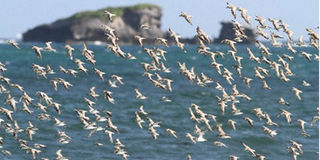
Birds flying over a house at the beach.

Kenya’s birds are facing a growing threat as forests, wetlands, grasslands and other habitats that sustain them come under pressure.
The warning is particularly stark for migratory birds, for which Kenya is a critical stopover and breeding ground.
More than 1,100 birds moving across continents pass through or depend on the country, making the health of its habitats part of a wider ecological chain.


A new State of the World’s Birds report has found that 45 per cent of migratory bird species have declining populations, while one in nine is threatened with extinction.
The findings underline the vulnerability of birds whose survival depends on a network of breeding grounds, stopover sites and non-breeding areas spread across countries and continents.
In Kenya, the pressure is visible in species with increasingly restricted habitats.
Dr Paul Matiku, Executive Director of Nature Kenya, says Kenya has nearly 50 bird species on the International Union for Conservation of Nature (IUCN) Red List.
“That means they are classified as in danger of extinction at various levels.”
Among the most threatened is the Taita apalis, a small bird found only in the Taita Hills. Its remaining forest habitat has been reduced to about 400 hectares,
He further added that five vulture species found in Kenya are also under threat, adding to concerns over the country’s declining bird populations and the wider ecosystems they represent.
According to the report, one in nine migratory bird species is threatened with extinction and seven species have been confirmed or suspected to have disappeared during the past 150 years.
The extinction announced in 2025 of the slender-billed curlew, last recorded at a Moroccan lagoon in February 1995, was identified as the first bird extinction in mainland Eurasia and Africa in recent centuries.
Seabirds and shorebirds are among the groups faring particularly poorly, while habitats including marine environments, forests and coastal wetlands face increasing degradation and fragmentation.
The report identifies the main drivers as largely human-caused.
They include invasive species and diseases, agricultural expansion and intensification, climate change, hunting and trapping, pollution, expanding energy infrastructure, urbanisation, human disturbance, logging and deaths or injuries caused by fisheries bycatch.
“For migratory birds, the problem is compounded by the length of their journeys.” The report states. “A bird may survive threats at one location only to encounter another hundreds or thousands of kilometres away.”
A damaged wetland, cleared forest, dangerous power line or heavily altered agricultural landscape is said to weaken one link in a chain on which the species depends.
Dr Stuart Butchart, Chief Scientist, BirdLife International, said the decline should be understood as a warning about the condition of natural systems.
“Unless we start turning things around,” Butchart warned, “we are going to lose more and more of the world's migratory birds and the ecosystems that they rely on.”
He added that nature supports economies, livelihoods, jobs and human health, making the decline of birds more than a conservation concern.
BirdLife International describes migratory birds as indicators of environmental health because their movements expose them to pressures across large geographical areas.
“Their decline can therefore reveal changes taking place across forests, wetlands, grasslands, coastlines and other habitats.” The report cautioned.
The journeys themselves are among nature’s most remarkable phenomena.
Arctic terns are said to have a possibility of travelling from pole to pole, covering up to 100,000 kilometres each year.
Great snipes fly at almost the height of Mount Everest while crossing the Sahara, while ruby-throated hummingbirds, weighing about three grams, can cross the Gulf of Mexico nonstop.
These journeys follow broad routes known as flyways.
Every country is connected to others through bird migration, making protection of migratory species a shared conservation challenge rather than the responsibility of individual states alone.
That reality was at the centre of the Global Flyways Summit held in Nairobi, where governments, scientists, conservation organisations and financial institutions adopted the Nairobi Flyways Declaration.
The declaration commits stakeholders to coordinated protection of migratory routes and critical habitats across borders.
Its adoption came alongside more than Sh778.1 billion ($6 billion) in conservation finance commitments made by three multilateral development banks since 2021.
Martin Harper, Chief Executive Officer (CEO) of BirdLife International, said the financial commitments are intended to support conservation at sites along migration routes.
“The division of labour is quite simple in a way. Banks mobilise the finance,” he said.
The financing includes a commitment by the Asian Development Bank to mobilise about Sh388.95 billion ($3 billion) over the next decade to protect at least 50 priority wetlands across the East Asian-Australasian Flyway.
“The ecosystems support nearly 200 million people,” BirdLife International said.
Safeguarding flyways
In addition, the Development Bank of Latin America and the Caribbean is mobilising between Sh388.95 billion ($3 billion) and Sh648.25 billion ($5 billion) through 2050 to safeguard more than 30 landscapes and seascapes.
The World Bank and BirdLife are also mobilising billions of dollars across Africa, Europe and Asia along flyways used by more than two billion migratory birds.
According to Birdlife International, conservation responses need to extend beyond individual protected sites and address entire flyways.
“So that we can maintain connectivity, we need to protect key biodiversity areas, restoring degraded ecosystems and retaining intact habitats in working landscapes are among the measures.” Birdlife International said.
Agriculture and forestry practices also need to reduce pressure on habitats, while infrastructure development should minimise harmful effects on birds.
The report calls for action against invasive species, overexploitation and illegal killing, as well as measures to prevent fisheries bycatch.
Climate change is another pressure said to affect the birds by altering species distributions and migration patterns.
Pollution, disease outbreaks and human disturbance can compound these stresses, leaving many migratory species exposed to several threats along the same route.
Follow our WhatsApp channel for breaking news updates and more stories like this.