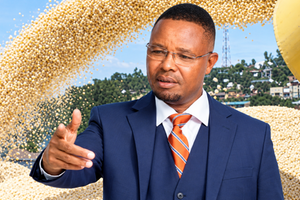
Mr Bret Tate, Agricultural Attaché and Counsellor at the US Embassy speaks to Seeds of Gold on how Kenya can bridge its maize deficit and meet the food needs of its growing population.
How serious is Kenya’s maize deficit, following the latest US Department of Agriculture Foreign Agricultural Service (FAS) assessment that sharply cut the country’s 2026/27 maize production forecast?
Well, the report shows that Kenya was expecting maize harvest this year to reach about 4.5 million metric tonnes. Kenya normally produces around 4 million metric tonnes, so we expected a larger harvest.
However, June and July were extremely dry, particularly in western and northern Kenya. Our experts who track weather conditions using satellite imagery indicate that June and July were the driest the country has experienced since 1981. That means Kenya experienced its longest mid-growing-season dry spell in about 45 years.
The maize crop was at a critical stage of growth when the dry conditions set in. The plants wilted, and much of the crop was lost. Instead of the expected 4.5 million metric tonnes, production is now projected at about 2.3 million metric tonnes, almost half of what had been expected.
Kenya normally produces around 4 million metric tonnes of maize. Roughly 3.5 million tonnes are used for human consumption, while the remainder goes to animal feed, including chicken and cattle feed.
If the country needs between 3.5 million and 4 million tonnes for human consumption and production is only about 2.3 million tonnes, there is clearly a deficit. Kenya will have to import maize to meet the shortfall.
We looked at maize availability around the world to identify potential suppliers. Zambia has about 1.4 million metric tonnes, so it has some maize available. The challenge is that Zambia may also want to retain part of its production for domestic use, and its surplus may not be enough to meet Kenya’s needs.
Ukraine has substantial supplies, but its ports are under constant bombardment because of the war. It is therefore a possible supplier, but it is not a certain one.
South Africa is another potential source, although it often produces genetically modified maize (GMO), which presents a challenge under Kenya’s current policies.
Tanzania has enough maize largely for its own needs, but does not have a significant surplus. Uganda faces a similar situation.
That leaves countries such as Brazil, the United States and Argentina as major potential suppliers. All three produce genetically modified maize.
That is the difficult question. If Kenya does not buy genetically modified maize and there is limited non-GM maize available on the international market, where does the food come from? There are creative options, particularly for animal feed. Kenya could import alternative feed ingredients instead of maize. Sorghum can be used for chicken feed. Distillers’ grains and soybean meal can also be used in animal rations.
These alternatives could help ease pressure on maize supplies by freeing some maize for human consumption. But they do not solve the entire problem.
For human consumption, Kenya still needs millions of tonnes of maize. Whether the maize is white or yellow does not change the basic arithmetic. The country needs to produce more maize or import it.
Sirare-sourced maize grains, packed in sacks after drying under the sun, at the Railways Grounds in Nakuru City on July 8, 2026.
Photo credit: Boniface Mwangi | Nation Media Group
Kenya has the second-largest cattle herd in Africa and is a major dairy-producing country. The demand for animal feed is therefore significant. If Kenyan dairy farmers fed their cows at the level European farmers do, they would require about 12 million tonnes of feed just for dairy cows. That is not including chickens, goats or other livestock.
When you compare that with Kenya’s normal maize production of about 4 million tonnes, you can see the scale of the challenge. People need roughly 3.5 million to 4 million tonnes, while livestock also require large quantities of feed. If Kenya wants to expand livestock and dairy production significantly, it will need to increase feed production as well.
The country needs to do two things. It needs to plant more and produce more, while also having the ability to buy maize from international markets when there is a shortage.
The country has a growing population and rising demand for food and animal products. That means production has to increase if Kenya is going to meet its needs. Additionally, the country needs to explore modern technologies in agriculture as well as embrace growing yellow maize to reduce human-animal maize competition.
There is also a need to think beyond maize. Alternative crops and feed ingredients can help reduce pressure on maize. Sorghum, soybean meal and distillers’ grains, for example, can play a role in animal nutrition.
I would not say what Kenya should or should not learn from the United States, but I can point to a mistake we made. When the first biotechnology for maize came out in the United States in 1994, the technology allowed the plant to protect itself against a pest that normally attacked corn. Because of that, farmers did not have to apply pesticides to the crop. The companies presented it to the public mainly as genetically modified or biologically engineered corn. People became concerned because they were unfamiliar with the technology.
If the companies had instead explained that the technology meant farmers did not have to apply as much pesticide, I think people might have adopted it more quickly. They could have understood the environmental and farming benefits.
Farmers dry maize in Elburgon town, Nakuru County.
Photo credit: File | Nation Media Group
There are benefits that are sometimes overlooked. Some genetically modified crops can reduce the need for herbicides and pesticides, depending on the technology and how it is used.
In the United States, our chemical use has declined significantly with the adoption of some of these technologies.
That is a positive story for the environment, consumers and farmers. It is important to have an open conversation about both the concerns and the potential benefits of agricultural biotechnology.
Kenya has to make its own decisions, but it should consider all the available evidence and technologies as it looks for ways to produce more food, deal with climate shocks and reduce pressure on its food system.