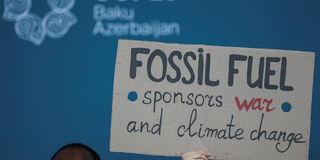
As the world prepares for COP30 in Belém (November 10–21), ActionAid International's new report, 'Climate Finance for Just Transition: How the Finance Flows' , paints a grim picture: less than three percent of global climate finance actually supports just transition initiatives.
An analysis of the Green Climate Fund and Climate Investment Funds, the world's two largest sources of climate financing, reveals the disparity. For every $35 (Sh3,500) in climate finance, only $1 (Sh129) funds measures to protect workers and livelihoods, from retraining programmes to building greener local economies.
Even more troubling: only one in every 50 climate projects adequately considers people's needs during the global shift away from fossil fuels.
“The world urgently needs climate action, but it's the polluters, not the workers and communities, who should pay the price,” said Arthur Larok, Secretary-General of ActionAid International. “If just transition continues to be overlooked, inequalities will deepen.”
‘Just transition’ means that when countries shift away from fossil fuels and harmful industries toward cleaner economies, the workers and communities who depend on those industries don't get left behind.
In Kenya's context, imagine this scenario: The government phases out oil drilling in Turkana in response to climate commitments. But what happens to the workers at the site, their families, and the small economies built around those oil fields? A just transition would entail retraining programmes for affected workers, investments in new industries in those regions, income support during the transition, and genuine consultation with communities before decisions are made.
It would mean a tea farmer transitioning to regenerative agriculture gets support, financing, and training, not just a directive to change or go bankrupt.
Teresa Anderson, ActionAid's Global Lead on Climate Justice and author of the report, warned that ignoring just transition doesn't just harm workers, it threatens the entire climate agenda.
“No one should have to choose between a secure job and a safe planet,” she said. “Without just transition approaches, climate action risks pushing people deeper into poverty and sparking social backlash.”
The report documents real-life harm in communities on the frontlines. In Maranhão, Brazil's Amazon region, families who have lived for generations harvesting the babassu coconut palm now face eviction and pesticide attacks from industrial agriculture interests seeking to expand soybean and cattle farms.
“They want to push us out to grow corn, soya or cattle,” said one babassu coconut breaker, who requested anonymity.
Despite local bans on pesticide spraying, enforcement remains weak, leaving communities sick and ecosystems damaged. Jessica Siviero, Climate Justice Specialist at ActionAid Brazil, said the pattern is repeating across the Global South.
“The Amazon and Cerrado regions are at breaking point,” she said. “It's time to move away from destructive industrial agriculture and embrace agroecology that feeds people and cools the planet.”
Kenya faces similar pressures. As the country commits to climate targets, expanding renewable energy, phasing out fossil fuels, and shifting agricultural practices, workers and communities dependent on current systems lack protection.
Ahead of COP30, ActionAid is calling for the establishment of a “Belém Action Mechanism”, a coordinated global framework to finance and monitor just transition strategies.
“COP30 is a historic opportunity to correct course,” Anderson said. “The world must commit to a fair, inclusive, and just transition; one that truly puts people at the heart of climate action.”