Kenya has moved a step closer to establishing a Sh5 trillion infrastructure fund, part of an ambitious plan to transform the country into a First World economy.
The Cabinet on Monday approved the creation of the National Infrastructure Fund (NIF) and the Sovereign Wealth Fund (SWF) to spur long-term development and economic transformation, even as critics have termed the move a “misplaced priority.”
In a dispatch to newsrooms, the Cabinet explained that the initiative aims to reduce reliance on borrowing and taxation while unlocking large-scale private sector capital to finance priority investments.
“Under the new framework, all privatisation proceeds will be ring-fenced and invested strictly in public infrastructure projects that generate and preserve long-term value,” the despatch stated.
“Every shilling invested through the fund is expected to attract up to Sh10 in additional capital from long-term investors, including pension funds, sovereign partners, private equity funds, and development finance institutions.”
The NIF will be overseen by a competitively appointed board and CEO, while the SWF will operate under a robust policy framework to ensure prudent investment, fiscal discipline, and inter-generational equity.
“This financing architecture marks a decisive shift toward a sustainable, investment-led development model that mobilises capital, accelerates delivery, preserves national value, and secures lasting prosperity for present and future generations,” the Cabinet added.
However, Kiharu Member of Parliament Ndindi Nyoro questioned the rush to establish the fund when critical sectors, such as education, are struggling.
Kiharu MP Ndindi Nyoro.
Photo credit: File| Nation Media Group
The development comes amid pressure on President Ruto’s administration to meet full capitation for learners this financial year amid budget constraints. The government is also struggling to confirm 20,000 Junior School teachers on permanent and pensionable terms at the end of their internship. The Ministry of Education has said that it can only be done in the next fiscal year, starting from July 2026, instead of January 2026 as previously promised.
Mr Nyoro said that Kenya has built roads through taxes in the past. He questioned why the government is rushing the NIF when it has constructed less than 1,500 km of roads since taking office.
“Focus on growing the economy to increase revenue, just as President Mwai Kibaki did. This securitisation is illegal, and the law will soon catch up with those involved,” Mr Nyoro warned.
The Cabinet said that together with the SWF, the NIF will finance Kenya’s transformation agenda by strengthening food security, modernising transport and logistics, expanding energy generation, and promoting industrialisation and the digital economy.
In support of national priorities, the Cabinet approved funding for major transport projects, including the Naivasha-Kisumu Standard Gauge Railway Phase 2B, the SGR link to Uganda, Nairobi Railway City Central Station, Bus Rapid Transit Lines 2 and 3, commuter rail, and non-motorised transport initiatives.
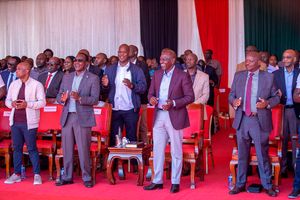
President William Ruto, (centre) Deputy President Prof Kithure Kindiki (left), Health CS Aden Duale (right) and other Cabinet secretaries after a Cabinet meeting at State House, Nairobi, on December 15, 2025.
Photo credit: PCS
On food security, the government plans to build 50 mega dams, 200 mini-dams, and over 1,000 micro-dams, bringing an additional 2.5 million acres into production to support agro-industrialisation and rural livelihoods.
Transport infrastructure will be expanded through the dualling of 2,500km of highways, tarmacking 28,000km of roads, extension of the SGR to Malaba, expansion of regional oil pipelines, and modernisation of airports and the ports of Mombasa and Lamu.
Energy generation will be scaled up, with a new capacity of 10,000 megawatts expected over the next seven years to support manufacturing, digital expansion, and emerging technologies.
The SWF policy establishes a framework for prudent management of revenues from minerals and petroleum, dividends from public investments, and a portion of privatisation proceeds, ensuring inter-generational savings, protection against external shocks, and strategic investments with commercial returns.
The government also approved a national energy policy to guide sector reforms, improve electricity access, promote renewables, and ensure sustainable energy.