Hello

Your subscription is almost coming to an end. Don’t miss out on the great content on Nation.Africa

Ready to continue your informative journey with us?

Hello

Your premium access has ended, but the best of Nation.Africa is still within reach. Renew now to unlock exclusive stories and in-depth features.

Reclaim your full access. Click below to renew.

Sh 6 million range lands re-seeding project flops as climate change take toll

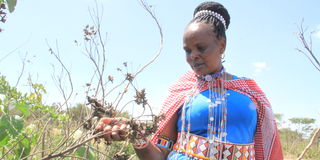
Ms Alice Sironka in Ipomea weed invested range lands adjacent to the county environment department grass reseeding project in Mashuru Sub-County on November 21, 2025. Photo| Stanley Ngotho

What you need to know:

  • The Sh6 million re-seeding programme was among the Sh 200 million projects funded by the World Bank in conjunction with the Kajiado devolved unit under the Financing Locally-Led Climate Action Programme (FLLoCA) in the financial year that ended in June

In March, the Kajiado County Environment Department embarked on an ambitious 50-acre rangeland reseeding project as a climate change mitigation programme.

Also read:  https://nation.africa/kenya/health/why-some-counties-risk-missing-out-on-climate-funds-and-the-way-forward-4710290
The Sh6 million re-seeding programme was among the Sh 200 million projects funded by the World Bank in conjunction with the Kajiado devolved unit under the Financing Locally-Led Climate Action Programme (FLLoCA) in the financial year that ended in June. The FLLoCA programme focuses on capitalising the National and County Climate Change Funds; building county-level capacity for planning, budgeting, reporting and implementation of local climate actions in partnership with communities.


In addition, the reseeding initiative aligned with one of Kajiado’s core development pillars—Modulated Pastoralism—which seeks to enhance sustainable livestock farming by improving pasture availability and resilience to climate shocks.


The environment department had identified two demo farms within Mashuru Sub-County, both measuring at least 50 acres each. Initially, different member groups had been engaged in uprooting the Ipomea weed for three days, earning Sh 1,000 each. After uprooting the invasive weed, the herders were enlightened on mixing the seeds with livestock manure before dispersing them in the fields. The manure-mixed seeds are said to disperse evenly.


Under the programme, each of the 10 pilot groups benefited from 300 kilogrammes of both improved Maasai love grass and bush rye grass species to be shared among them. Maasai love grass (Eragrostis Superba) is a perennial grass species that is native to the savannas of East Africa. This grass is particularly important to the Maasai people, who use it for various purposes, including as a symbol of love and as fodder for their livestock.

Also read: https://nation.africa/kenya/health/africa-climate-summit-secures-150bn-in-commitments-urges-global-action-5189268
According to the Kenya Agricultural and Livestock Research Organisation (KALRO), bush rye grass has a high germination rate and high nutritional levels. It’s also drought-tolerant and fully covers the ground within a few seasons, thus low weed infestations in subsequent seasons. However, the much-anticipated April season rains failed in most parts of the vast county, followed by long dry spells spelling doom to the ambitious re-seeding project.


A spot check on Monday in the demo farms indicated the grass seeds never sprouted, while the rangelands remain barren with minimal green vegetation, dry and cracked earth, and a significant loss of biodiversity. In adjacent fields to the demo farms, Ipomoea weeds are seeding heavily.

Mr Naftali Mopel, a herder, told Climate Action that the idea that was long overdue to eradicate Ipomea, which was declared a county disaster by Governor Joseph Ole Lenku in 2024, had flopped due to the consistent lack of rain.

"Most parts of Kajiado have been experiencing little or no rain this year, affecting pastoralism. The much-anticipated April rains were minimal. At least the ipomea weed is no more where it was uprooted, but the rangelands remain bare, "Said Mopel.

 
Ipomea -The rangeland pasture coloniser weed known as "oltiameleteti" in Maa dialect is said to have spread to 3 million acres in the entire Kajiado County since 1997, when it was first discovered after El Niño rains, according to the Department for Livestock Development's recent data.

The plant has heavy seeding ability, heavy foliage, a well-spread and developed root system, aggressive natural pasture competitor, and smothers natural pasture in its proximity. The weed can grow to a height of more than two meters, and one stool can spread up to four metres in diameter.


Apart from undergoing research to eradicate the weed currently conducted by University of Nairobi researchers, a group of youths who had begun an Eco-friendly paper and basket enterprise from the weed slowed down. Despite the current dry spell, the weed is seeding with swirling wind blowing in barren range lands, spreading the seeds far and wide to the chagrin of dejected herders.

 
Environment Chief Officer James Ngugi told Climate Action that most of the pilot three tonnes of the grass seeds were affected by harsh climate conditions that culminated in little rain in most parts of the targeted areas. He further said the department was optimistic the grass seeds were still viable and could sprout once the region experiences enough rain.


"Restoring our range lands was in line with the county police towards modulated pastoralism. Kajiado County is currently grappling with erratic climate conditions that have affected the re-seeding projects, "said Mr Ngugi.  “We have some reserve seeds to disperse in the next April seasonal rains. We have also put up climate change adverse effects mitigation measures to cushion our farmers."

According to KALRO, Maasai love grass (Eragrostis superba) seeds in the soil can remain viable and germinate readily for at least 14 months, and potentially up to three years if stored in cool, dry conditions. The seeds usually begin to germinate within five to eight days of planting under favourable conditions.