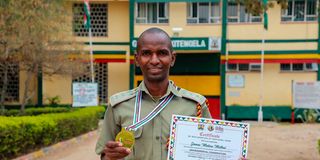
Senior Superintendent of Prisons James Muthui was among the names celebrated during this year’s Mashujaa Day celebrations.
The farm manager at GK Prison Kitengela was honoured by the President on Mashujaa Day for his outstanding contribution to environmental conservation, proving that profound change can blossom even behind bars. In a system synonymous with confinement, Muthui has, through his leadership, made prisons breathe, transforming barren compounds into thriving hubs of green innovation and ecological restoration.
James Muthui attends to goats.
Photo credit: Lucy Wanjiru I Nation Media Group
From the semi-arid landscapes of Kajiado, Tana River, and Garissa, his work has turned correctional facilities into models of resilience, producing food, shade, and, most importantly, hope in the environmental sector.
Born in 1986 in Mwingi West, Kitui County, Muthui’s journey began far from the confines of prison walls.
After attending Makueni Boys Secondary School, he joined Moi University, where he graduated in 2010 with First-Class Honours in Agri-Economics and Resource Management.
His fascination with soil, seasons, and sustainability would later define his career and ultimately lead to his national recognition.
“I was employed in 2015 as a cadet and an expert in agriculture,” he recalls, his voice calm yet certain.
His first posting was at Malindi GK Prison, where he quickly noticed a glaring gap in Kenya’s reforestation efforts. "Everyone was focusing on high-rainfall areas like the Mau and Karura forests," he recalls. "But very little attention was being paid to the semi-arid zones, which are losing the most vegetation."
Tree seedlings at GK Prison Kitengela nursery.
Photo credit: Lucy Wanjiru I Nation Media Group
Determined to change that narrative, he partnered with the Kenya Forestry Research Institute (Kefri) to identify resilient indigenous species that could thrive in dry regions.
Greening the semi-arid lands
In 2023, Muthui was transferred to GK Prison Kitengela, a correctional facility sitting on a vast tract of semi-arid land in Kajiado County. There, he found dusty fields, underutilised land, and inmates with untapped potential.
“I discovered that people here planted trees without considering the climate,” he says. “They were forcing nature instead of working with it. I decided to start with indigenous trees that could survive the heat and wind.”
He mapped out the land, studied soil types, and matched tree species with their ecological functions.
“Every tree must have a purpose,” he explains. “If it is for fodder, choose the right species. If it is for soil erosion control, plant accordingly.”
He introduced species like Acacia tortilis and Croton megalocarpus, which survive the harsh climate, enrich the soil, and provide fodder during droughts.
A solar-powered water tank installed at GK Prison Kitengela School to support irrigation on the farm.
Photo credit: Lucy Wanjiru I Nation Media Group
His insight was forged in experience. "During the 2022 drought in Garissa, I saw people selling Acacia pods as animal feed. That’s when I realised these trees could be the key to surviving dry spells."
A farm that feeds and teaches
Today, Kitengela GK Prison is an agricultural classroom. Its farms, powered by a solar-powered irrigation system installed in partnership with AGRA in 2024 to pump water from a well to drip lines, produce vegetables, beans, and onions that feed inmates and supplement the feeding programme at the neighbouring Kitengela GK Primary School.
"We thought, why not use our land to support the school feeding programme? When pupils get meals, they stay in class and learn better."
Inmates provide the labour, gaining valuable agricultural skills in return.
“They learn how to prepare land, install drip systems, and control pests,” he says. “When they leave prison, they can use those skills to start over.”
The farm’s success is a testament to smart agriculture: crop rotation maintains soil fertility, and the use of open pollinated varieties, a cost-effective choice compared to expensive hybrids, keeps costs low. The first harvest yielded seven 90kg bags of beans per acre; while the second produced 15 tonnes of onions after just three and a half months.
The third cycle focused on cowpeas and mixed vegetables, selected for their nutritional value and ability to feed large numbers of children in the neighbouring schools.
As the fourth planting season begins, Muthui says they are confident of another successful bean harvest.
For inmates, the farm is more than work, it’s redemption through growth.
“They learn that not all seeds germinate the same way,” he says. “Some need soaking, others need sunlight or boiling to break dormancy. They understand that life, just like seeds, sometimes needs the right conditions to thrive, says Muthui.
Over time, this philosophy has taken root. Some former inmates have returned to Kitengela, not as prisoners but as partners.
“One man who served a short sentence came back with a friend,” Muthui recalls with a smile. “He said he wanted to start his own tree nursery at home. That is the real impact when rehabilitation meets transformation.”
To date, Kitengela GK Prison has planted over 20,000 trees, organised into five phases corresponding with Kenya’s biannual rainy seasons.
“The trees have changed the air quality here,” he says. “You can actually feel the freshness,” says Muthui.
He believes that real change happens when communities work together. Under his leadership, Kitengela GK Prison has partnered with local schools, the Kenya Forest Service, Kefri, AGRA and the National Heroes Council to extend environmental awareness beyond the barbed wire.
The partnerships have resulted in joint tree-planting drives, environmental education sessions, and seedling donations to neighbouring communities. Students and teachers visit the prison’s demonstration farms to learn about sustainable agriculture and water conservation.
“It’s about demystifying prisons,” says Muthui. “People think of prisons as closed, hostile spaces. But we’re showing them that change can start anywhere — even behind prison walls.”
The heroes’ national recognition
The national recognition caught him by surprise. "I was in a meeting when a friend sent me a screenshot of the Heroes Council website with my name and face on it among the shortlisted candidates to be awarded as 2025 heroes. I honestly thought it was a prank," he laughs.
A visit by the National Heroes Council officers led by CEO, Charles Wambia, had preceded the announcement. "They told me they had heard about our work—the farms, the school projects, the awareness campaigns. They said I was creating a culture." It was their first time visiting Kitengela Prison.
“This is my first national recognition. It feels humbling. We rarely get attention because prison work happens behind fences. But now, the whole country knows what we are doing.”
Despite the personal accolade, Muthui is quick to share the credit. "This award is not mine alone. It belongs to Kitengela GK Prison. I am just the driver, but it takes the entire team to move the vehicle."
His boss, Officer-in-Charge Stephen Kimei, was among the first to congratulate him.
“He called me personally,” says Muthui. “He told me, ‘You’ve made us proud.’ That meant a lot.”
For Muthui, climate change is not an abstract debate, it is something he lives with daily.
“Climate change is when nature’s normal behaviour changes,” he explains. “We used to know when the rains would come. Now they come late or too heavy. Last year, Kitengela flooded, something that had never happened before.”
He has turned uncertainty into innovation by combining solar power, drip irrigation, and indigenous crops to build resilience into the prison's ecosystem. Even during drought, its farms remain productive.
Turning parking lots into arboretums
Among his latest innovations is an arboretum built outside the main prison’s gate on what was once a parking lot. The transformation began after a conversation with Mr Wambia.
“He asked if we had land for a demonstration site,” Muthui recalls. “I told him, ‘Let’s turn that car park into a green space.’ We fenced it, planted trees, and made it a living symbol of our partnership.”
He describes the arboretum as a serene oasis for officers, inmates, and visitors to reflect—a living proof that “even the most unlikely spaces can be reborn.”
However, convincing both colleagues and the community that trees can grow in Kitengela has been an uphill task.
“When I started, people told me, ‘Kitengela is dead; nothing grows here.’ Even mobilising people to plant trees was difficult. But when they saw our first and second phases succeed, their minds changed.”
Today, the prison’s gates often welcome curious visitors, teachers, villagers, and students who are eager to learn how to make green thrive in dry soil.
Speaking to Climate Action, he explains a clear distinction between landscaping and afforestation.
“Most people plant trees for appearance, to beautify their spaces,” he says. “But afforestation goes deeper; it is about restoring ecosystems. We don’t plant for looks, we plant for purpose.”
Moreover, he is critical about the growing trend of planting ornamental trees that disregard local ecological realities.
“People are planting pines and cypress from Kakamega here in Kitengela,” he says. “These lifeless trees provide no habitat, and the morning bird songs are disappearing. True conservation isn't about green cover; it's about reviving ecosystems.”
Under the State Department for Correctional Services, led by PS Salome Beacco, green initiatives—from tree planting to renewable energy—are being integrated into prison operations.
“These programmes show that rehabilitation and environmental restoration can go hand in hand,” said PS Beacco during the Correctional Service Week 2025 in Nairobi. “They build discipline, skills, and responsibility.”
Looking back, Muthui is proud of his work. He pauses near the orchard where schoolchildren’s names are tagged to fruit trees.
“Each student has a tree to care for,” he says. “They’ll remember this even after they leave school.”
For him, that continuity; from prison to community, from punishment to purpose; is the essence of his mission.
“Environmental conservation is not a one-day job,” he says. “It’s a lifetime calling. And if we can do it in a place like this, then anyone can.”
Such initiatives are taking part during a time when the country is pushing towards its 15-billion-tree target by 2032.