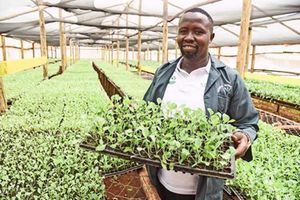
At first light in Nairobi’s Utawala, 35-year-old Mercy Munene steps into her small urban nursery — a lush, verdant microcosm tucked between concrete walls.
Amid containers brimming with managu (black nightshade), terere (amaranth), cherry tomatoes, and fragrant lemongrass, she breathes in the green promise of each leaf.
“I grew up in Nairobi, where my parents farmed small plots to feed our family. I remember eating purple sweet potatoes for weeks and taking maize to the posho mill. As a child, I saw farming as exhausting work — tilling, weeding, and hauling water, and could not understand its appeal,” she says.
Mercy could not imagine a life ingrained in that kind of labour. She yearned instead for the clean-cut, air-conditioned world of office work. She pictured herself in a sleek suit, not bent over fields. Farming, she thought, was for “other people.”
And for years, that was exactly the life she lived. She carved out a successful career in banking, rising through roles in sales, marketing, strategy, and quality assurance. The corporate world offered structure, predictability, and a sense of purpose far removed from the soil she once dismissed.
“The turning point came through a personal health struggle,” she recalls. “I battled chronic anaemia. Hospital visits became routine, with doctors prescribing iron supplements and the familiar advice: ‘Eat more iron-rich foods like beans and leafy greens.’”
But every time she ate vegetables from the local market, she suffered painful stomach upsets that lasted for days. Curiously, when she ate the same vegetables from her rural home upcountry, she felt perfectly fine.
The contrast was too obvious to overlook, prompting deeper questions about the food we consume and its origins.
Digging deeper, she was shocked by what she uncovered. Many vegetables sold in local markets are grown in contaminated areas near sewage lines or polluted riverbeds, and sprayed with excessive, sometimes banned, pesticides.
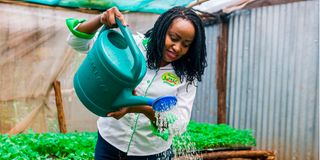
Mercy Munene waters her vegetables at her home in Utawala, Nairobi on April 04, 2024.
Photo credit: Billy Ogada | Nation Media Group
“In the rush to meet demand, some farmers harvest crops just hours after spraying, ignoring safety intervals. Then there is the long, unhygienic supply chain, handled by multiple people, stored in poor conditions, and exposed to dust, dirt, and pathogens. It became clear why the market produce was making me sick,” she notes.
At the time, she was running a small side hustle, delivering fresh fruits and vegetables to colleagues.
She sourced the produce from local markets and took pride in offering convenience. But when Covid-19 hit, customers began asking difficult but necessary questions: Where is this food coming from? How safe is it?”
Those questions lingered, and they began to intersect with her own growing health concerns. She realised she could no longer rely on a food system she did not fully trust. So, she decided to grow her own vegetables.
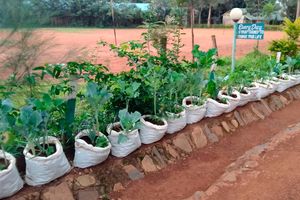
“I started with the only space I had — my urban flat. I got creative, using recycled containers and locally available materials to build a small kitchen garden. To maximise space, I experimented with vertical setups and relied solely on organic inputs to nourish my crops,” she said, adding that the first time she harvested vegetables she had grown myself, she was proud, reassured, and felt in control.
She knew exactly what had gone into the soil and onto the leaves—no chemicals, no shortcuts. At first, the garden was just meant to feed her family. But soon, it began producing more than they could eat.
She started sharing the surplus with friends and colleagues, who did not just enjoy the fresh vegetables but were curious. Many wanted to know how to grow their own and began asking her to help set up gardens in their homes.
That is how Shamba Connect started. Armed with Sh100,000 from her savings, she invested in recycled plastic containers, compost, rabbit manure, and seedlings.
But Mercy acknowledges that convincing people about her new path wasn’t easy. Many questioned why she would leave a “good job” for something as unpredictable as farming.
“From the onset, I committed to being fully organic, no chemical pesticides, no synthetic fertilisers, just living, nutrient-rich soil,” she says.
She chose rabbit manure and urine as her primary inputs, not only because they are rich in nutrients, but also because they naturally deter pests.
Mercy Munene, the founder of Shamba Connect, displays a rabbit at her home in Utawala, Nairobi
Photo credit: Pool
Not everything went smoothly. Her first season did not turn a profit, she had underestimated how much work it takes to grow for the market rather than just for home use. But the lessons learned were invaluable.
She came to understand crop cycles, pest control, watering schedules, and the importance of harvesting at the right time.
“My first customers were people who had tasted my vegetables. They trusted the produce because they could see exactly where and how it was grown. That transparency quickly became my most powerful marketing tool,” she says.
Today, Shamba Connect operates through three main streams: selling fresh produce (including rabbits and rabbit by-products), installing gardens, and offering training.
They have installed more than 500 kitchen gardens across homes, schools, and institutions, some in Nairobi’s informal settlements. The designs, whether vertical, wall-mounted, or round, are customised to fit verandas, patios, and other small urban spaces. Most are built using recycled materials, making them both affordable and sustainable.