Premium
Study: More renewables built, fewer jobs created
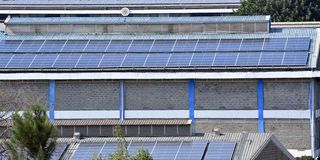
Solar panels installed on the rooftop of warehouses within Baba Dogo Area on October 02, 2025. A number of manufacturing companies have opted to install solar panels in an effort to cut down on their electricity bills and also as part of their sustainability company policy. Photo | Francis Nderitu

What you need to know:
- The report, “Renewable Energy and Jobs Annual Review 2025”, released on the sidelines of the 16th Assembly of the International Renewable Energy Agency (IRENA), showed that Africa created 344, 000 jobs in the sector, accounting for less than three per cent of the global share.
In Abu Dhabi,
United Arab Emirates
There are only four years left before we reach a year that will decisively shape the future. A year that most global institutions have set aside as a ‘deadline’ for meeting different goals. One of the global goals that was agreed on by countries in 2023 at the 28th Conference of the Parties (COP28) was tripling renewable energy power capacity by 2030.
The specific target is to get to 11,000 gigawatts (GW) from renewable energy such as wind, solar, hydropower and geothermal. Data released in 2024 shows that the world’s renewable energy capacity is about 4,432 GW.


Kenya’s electricity demand, which hit a new high last year, is about 2,362.28 megawatts (MW).
The report, “Renewable Energy and Jobs Annual Review 2025”, released on the sidelines of the 16th Assembly of the International Renewable Energy Agency (IRENA), showed that Africa created 344, 000 jobs in the sector, accounting for less than three per cent of the global share. Job growth was held back by large-scale operations, automation and new technologies, limited manufacturing capacity, and bottlenecks in the power grid.
Despite record additions for capacity for renewable installation, the report highlights a paradox that lies in the sluggish growth of jobs.
IRENA’s Director-General, Francesco La Camera, told delegates at the Assembly that despite the booming renewable energy deployment, the human side of the story is as important as the technological one.
“Governments must put people at the centre of their energy and climate objectives through trade and industrial policies that drive investments, build domestic capacity, and develop a skilled workforce along the supply chain,” he said.
He acknowledged the geographical imbalance of job growth, saying that it is a reminder that there needs to be international collaboration on track.
“Countries that are lagging in the energy transition must be supported by the international community. This is essential not only to meet the goal of tripling renewable power capacity by 2030, but also to ensure that socio-economic benefits become lived realities for all, helping to shore up popular support for the transition,” he said.
The report lauded Kenya for its strategy to include people with disabilities in practising their green skills expertise.
Gilbert F. Houngbo, International Labour Organisation’s Director-General, said that a just transition to a renewables-based future must be grounded in inclusion, dignity, and equal opportunities.
“As countries scale up renewable energy investments and job creation, we have a particular responsibility to ensure that accessibility for persons with disabilities – who too often face barriers to inclusion in labour markets despite their skills, experience and talent - is built into every stage of policy design and implementation,” he said.
“This requires accessible training systems, inclusive hiring practices, and workplaces that accommodate, welcome and respond to diverse needs and respect every worker’s rights.
On the sidelines of the Assembly, Climate Action spoke to Hope Njoroge, a Business Development Officer who focuses on Green Skills Research, who explained that to grow more jobs, Africa and Kenya need to promote domestic production of solar panels, which will reduce the number of imports and increase the number of workers employed in the manufacturing factories.
She said that there is an opportunity to design renewable energy projects that attract local and foreign investments, so as to have project portfolios that can hire a local workforce for implementation.
She explains that Kenya’s National Energy Policy 2025 - 2034 and the Kenya National Energy Compact 2025 - 2030 already show how the government is moving away from the “growth-at-all-costs” model to “ A just Energy Transition Framework” to tackle foreign dominance in Kenya’s renewable energy sector.
Some of the Kenya-specific mechanisms for growth include the Renewable Energy Auction Policy (REAP), where the government focuses on the competitive bidding process of energy projects.
Prof Israel De Silva, Strathmore University’s Deputy Vice Chancellor, Research and Innovation, says that there is a need for a ‘Triple Helix Integration’. This means that Academia, Industry and Government work together rather than separately.
“There should be continuous learning through micro credentialing processes, which offer certificates beyond the degree in the form of professional licenses. Currently, we have the EPRA Licensing Integration,” he said.
Olga Strietska-Ilina, Head of Future Skills at the International Labour Organisation (ILO), said during a media round table that the prospects for the future of the renewable energy sector have a ‘very good outlook’ and ‘there is potential for job growth’
[email protected]