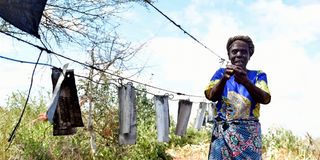
Rags dot the fence around Henritta Mkamburi's farm in Kajire village, Sagalla Ward, dancing in the wind. A second fence is lined with metal bells. The 74-year-old walks her farm with quiet satisfaction, glad to have brought in a full yield this year. It hasn't always been this way.
Henritta Mkamburi gestures as she explains how her fence made up of pieces of metals and strings infused with chilies are used as a repellant against elephant attacks on her farm.
Six years ago, elephants raided just before harvest, eating their fill, trampling the rest, and damaging part of her house. She depended on neighbours for food for the rest of that year. "I am not the only victim," she says. "It is very common to get elephants in our farms, especially as we approach harvest season."
Like many on the fringes of Tsavo National Park, Henritta faces a double threat: a shifting climate and a larger neighbour that can undo a season's work overnight.
She soaks the rags in chillies and used engine oil -(the pungent smell deters elephants) and she re-soaks them regularly as crops mature. The bells alert her if an elephant tests the fence after dark. Her third line of defence is chilli briquettes, made from elephant dung, chillies, and water, which release a choking smoke when burnt. Since combining these methods, she has all but stopped losses. Her only frustration now is scale; she has only fenced part of her large land.
A few kilometres away, Mwanajuma Mwanzoka is mid-harvest. Bundles of freshly cut sesame (simsim) dry beside green grams and heavy maize. She once lost crops to elephant raids, but her over 10 acres make full fencing impractical, so she works with the landscape. Sesame's pungent scent repels elephants naturally; she plants it as a buffer around her vulnerable maize. Her first attempt yielded 200kg, which sold readily and powered her house. "Harvesting the first huge batch was a big win that earned enough to improve my living," she says.
Mwanajuma Mwanzoka perches atop a ladder, keeping watch over her maize farm and trying to scare off elephants that encroach on her crops, on June 5, 2026.
Photo credit: Francis Nderitu I Nation Media Group
When her maize matures, she sleeps in two watchtowers within the plot, equipped with torches. She has refined her technique: instead of leaving a light on, which elephants learn to ignore, she flashes a strong beam erratically or swings a burning log. "Elephants can smell maize up to 12 kilometres away," she says. "They come for it as soon as it matures." The flickering light unnerves them enough to stay away.
She also maintains 12 beehives around her farm. Elephants fear bees as stings in their eyes, trunks, and inner ears are acutely painful, and they do not forget the source.
She now harvests honey as a secondary income; four hives recently earned her Sh12,000 for school fees. "Using hives has been beneficial as I didn't view honey as a profit maker before," she says. Her compound also features an elephant-proof food store, lined to mask the scent of stored grain. She currently holds six bags of green grams awaiting sale, a rarity in her past.
Not far away, Titus Mwawasi waits for his 15 hives to attract bees, a slow process hampered by chronic water shortages. The hives are strung together on a connected line; should an elephant attempt to cross, the line shakes the hives and triggers the bees. Titus has also changed his farming: sunflowers now grow alongside his maize as a buffer or even as a replacement. "We have since learnt to either plant sunflowers as a buffer crop to keep them away from our maize, or to replace maize completely," he says. "Elephant invasions do not necessitate a need to leave one's home."
Titus Mwawasi gestures while explaining how his beehives have helped repel elephant attacks on his farm.
Photo credit: Francis Nderitu I Nation Media Group
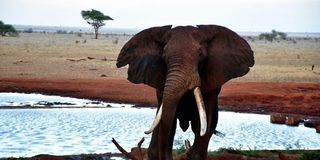
The conflict Henritta, Mwanajuma, Titus, and their neighbours navigate daily has a name: human-elephant conflict (HEC). It is not new to Kenya, but it is deepening. As human populations expand into wild spaces, ancient elephant corridors, used for generations to move between feeding grounds, water sources, and seasonal ranges, are blocked by farms, roads, and pipelines. Isolated from natural food by habitat fragmentation and worsening drought, elephants increasingly turn to farms.
An elephant eats 90–181kg of vegetation daily, drinks up to 210 litres of water, and browses for up to 16 hours. A single herd raid can devastate a farm overnight. Their extraordinary memory means they return season after season, following routes learned as calves. For a subsistence farmer, one visit erases a year's work.
The consequences ripple beyond economics. Desperate communities have resorted to retaliatory killings—shooting or spearing elephants—while stressed elephants have attacked herders and farmers. The collision is deadly for both species. Across Africa, illegal ivory trade continues to decimate populations; between 2010 and 2012 alone, an estimated 100,000 elephants were killed. The current continental population is roughly 500,000, declining at two to three per cent annually.
Yet, elephants are critical to the environment: they dig waterholes during drought, open forest paths, and disperse seeds. Lose them, and ecosystems unravel.
The farmers in Kajire are part of a broader training programme run by Save the Elephants (STE), which has worked across more than 10 African countries on coexistence strategies. Over 80 techniques are documented in an illustrated toolbox accessible even to illiterate users. STE's Coexistence Project Officer, Derrick Wanjala, says the hardest part is not teaching the methods; it is changing how farmers see elephants. "Since most farmers initially perceive elephants as intruders and enemies, shifting mindsets before the training is the hardest part," he says.
Save the Elephants Co-Existence Project officer Derrick Wanjala (right) and Co-Existence and Research Officer Irene Ndanu during the interview.
Photo credit: Francis Nderitu I Nation Media Group
Farmers attend workshops to review deterrent methods and select those suited to their landscapes. A Training of Trainers (ToT) programme equips participants to teach their own communities. The toolbox covers seven categories: understanding elephant behaviour, farm and boundary protection, early warning systems, elephant-compatible farming, alternative income, habitat protection, and shared-space safety. Farmers also go on game drives into elephant habitat. "With these, we have managed to change farmers' perception from wanting to kill elephants to wanting to coexist," Derrick says.
That knowledge spreads. George Salama from Bungule Village in Kasigau Ward recently attended a session and returned with new ideas. "Traditionally, we would use fences to keep elephants away," he says. "Today, I appreciate that adding metal strips makes noise to scare the elephants and alert us." His village records daily raids in high season, and he is eager to extend the training. "If we hold demos in Kasigau, more of my neighbours will see it in practice and embrace coexistence," he says.
The approach extends well beyond Tsavo. Dominic Mutali, conservation coordinator at Mugie Conservancy in Laikipia North, attended a ToT in 2023 while working in Tsavo. A former ranger who had watched an elephant overturn a Land Cruiser and witnessed countless farm raids, he knew confrontational responses were futile. When he moved to Mugie and found the same tensions, he borrowed his learnings and began organising community barazas to establish two-way dialogue.
He found local knowledge existed but was scattered. By combining community experience with structured training, he refined what farmers already did: torches, fences, noise systems, and made them far more effective. "We can't lock elephants in a single room. They don't know boundaries. We have to know how to coexist."
At Mugie, he advocates for small-scale kitchen gardens as a practical alternative to large open fields, which are harder to protect. Applying conservation agriculture skills, families now grow diverse food in secure spaces, harvesting surplus to sell. Beekeeping has become a key income stream, with a honey processing unit on-site and stable markets.
The conservancy has also taken the work into schools. Wildlife clubs teach students to identify elephant signs such as dung, footprints and understand that elephants attack only when threatened. They learn to check wind direction and move quietly. The result: safer commutes and improved school attendance.
Back in Kajire, transformation is visible. Conservation agriculture, which entails minimal soil disturbance, permanent cover and crop rotation, has broken farmers' rigid dependence on maize. Now they harvest varied crops across seasons, and a self-help group of 47 members processes and packages collectively. Sesame, green grams, chillies, and sunflower, all unpalatable to elephants, are gaining popularity.
At the communal honey processing plant, buckets of honey await jarring, each labelled with the farmer's name. STE's Coexistence and Research Assistant, Irene Ndanu, works directly with the Kajire community. She says partnerships with Taita Taveta's agriculture ministry, seed companies, and research institutions help identify drought-resistant crops suited to the area's poor soils and low rainfall.
Two permaculture gardens serve as test beds; trained farmers are welcome to try new crops. When a crop proves viable, seeds are shared community-wide. "We are enabling them by researching what crops work best for their farms, showing them water conservation methods and empowering them so that they won't depend on aid," Irene explains.
For resistant neighbours, the evidence in nearby farms often proves more persuasive than any training. As formerly vulnerable plots produce abundant, protected harvests, interest grows. STE is also working with Kenya Wildlife Service on a school feeding programme supplying lunches to nine schools and a vocational centre. This cushions families against drought and raids while educating children about animal behaviour. "Today, more children are aware of elephant behaviour and no longer view them as enemies," Irene says. "They know to react better to elephant sightings, information they transfer to their parents."
None of this is easy. Deterrents must evolve because elephants do. They learn to identify empty hives and ignore them. Non-palatable crops perform unevenly across landscapes. Water scarcity slows hive occupancy. There is no single solution. "We are constantly doing research to improve on existing coexistence methods," Derrick says.
What works is a combination of overlapping methods, continuously refined, adapted locally, and backed by a community that understands why the elephant matters. Henritta sums it up as she surveys her protected farm. The rags are damp, the bells set, the chilli briquettes within reach. She has enough food this year. She would like more, but she is glad she can depend on her farm again.