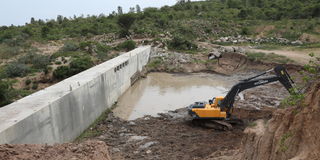
Every year, hundreds of families in flood-prone villages of Rachuonyo North flee their homes when heavy rains pound the region, seeking shelter in schools and churches.
The area remains one of the country's hardest hit during the long rains season between March and May. Climate change has intensified flooding by increasing rainfall in highland areas, which then pours into the Lake Victoria basin.
For residents in parts of Homa Bay, life in rescue camps has become a seasonal routine. For vulnerable groups, especially women and children, the disruption makes access to food a major challenge and stifles any meaningful income-generating activity.
"When floods come, they sweep crops into rivers and finally into the lake. Animals are also killed when they are swept away," said Tom Adhanya, a resident of Rambira location.
But flooding is only half the problem. When the rain stops in June, farmers harvest what little survived and immediately brace for another cycle of harsh weather; this time characterised by scorching sun and dust. Vegetation withers, pasture for livestock disappears, and animals sometimes die.
Farmers rely on water from Lake Victoria for their herds, but the journey is treacherous for those in remote villages. "Despite having vast farmland, we cannot cultivate all year round because of drought. Flooding is also a major issue affecting us," Adhanya explained.
For years, residents have appealed to the government for help. Elijah Owuor, a resident of Seka Kamser, said aid usually comes as relief food, but it is never enough.
"In the wake of climate change, we need real solutions. We cannot just sit and wait for disaster to strike before we are lined up and given food. There must be a sustainable solution to the adverse weather problems we face every year," he said.
In response to persistent water challenges in Rachuonyo North, the State Department for Irrigation has unveiled a plan for Wang' Chieng Ward. It is constructing a 150-million-litre dam in Rambira to boost water conservation and control floods.
The Sh164 million project, which began in January 2024, is set for completion in June this year. It aims to promote irrigated agriculture, improve food production, and raise household incomes through water harvesting and irrigation.
Irrigation PS Ephantus Kimotho and Karachuonyo MP Adipo Okuome visited the project on February 6 for an inspection.
Ministry officials said the dam will also enhance the livestock value chain by supporting fodder production and crop-livestock integration.
Mr Kimotho noted that the dam is being built in an area with seasonal rivers whose water currently flows into Lake Victoria without benefiting farmers. The reservoir will trap this water for later use.
"Rivers in the area are normally full for three months. The dry season lasts nine months. We want to harvest water during those three months to sustain residents for the remaining nine," the PS said.
The project includes a check dam, a smaller structure designed to reduce water flow velocity, decrease erosion, and trap sediment. Water from the reservoir will primarily be used for crop and animal production, with an estimated 20,000 livestock set to benefit directly. Farmers are also expected to irrigate up to 100,000 acres.
In a design meant to maximise efficiency, storage tanks have been placed on elevated ground. Water will be pumped using solar energy before flowing to farms by gravity. Farmers have been instructed to use drip irrigation to conserve every drop.
"Every drop of water should count. The water in the dam is not much, but with good efficiency models, we will reach more farmers and give them the commodity consistently," Mr Kimotho said.
Expected benefits include increased sustainability of irrigated crop production through water harvesting, storage and distribution, as well as enhanced food and nutrition security.
Beyond farming, the dam is set to reduce flooding in the lower parts of Wang' Chieng by storing floodwaters in the reservoir and releasing them in a controlled manner, instead of allowing them to spread suddenly and disastrously across the natural floodplain.
Mr Okuome said most rivers in the area are destructive as their water drains directly into the lake. He said the dam will help reduce that destruction.
"Storing water for future use has multiple benefits. It reduces the effects of floods and provides us with water for future use," the MP said.
The government is also constructing gabions and dykes in areas where flood water is most destructive. Mr Okuome said slowing water movement will help protect homes and ensure the structures last longer and work more effectively.
Beyond flood mitigation, the dam is expected to promote fishing. With 150 million litres of water, residents will find it easier to practise agriculture.
Homa Bay Agriculture Chief Officer Bernard Omwanda said they will work with the fisheries department to ensure aquaculture is done sustainably.
During their inspection, officials also visited the Kimira Oluch Smallholder Farmer Improvement Project, where they noted that only 25 per cent of the land designated for irrigation is currently under cultivation. On the Kimira side, approximately 900 acres out of a potential 3,900 are being utilised, with challenges including siltation and the need for farmer capacity building.
Ministry officials are set to address these challenges. Kimotho said his office will send a team to train farmers on the rice value chain and make better use of irrigable land.
"We have a big rice deficit. We consume one million metric tonnes of rice a year but can only produce 300,000 tonnes, with 50 per cent coming from the Mwea Irrigation Scheme. Regions like Kimira, Ahera, Nzoia and Kuja have the potential to increase rice production by another 200,000 metric tons," the PS said.
Mr Okuome urged farmers to take advantage of the project to create wealth. “Crop and animal production has the potential to make people millionaires,” he said.
"Young people particularly should use the water for farming. It is one way they can address unemployment.”